

Catalytic Properties of Selected Transition Metal Oxides—Computational Studies
375
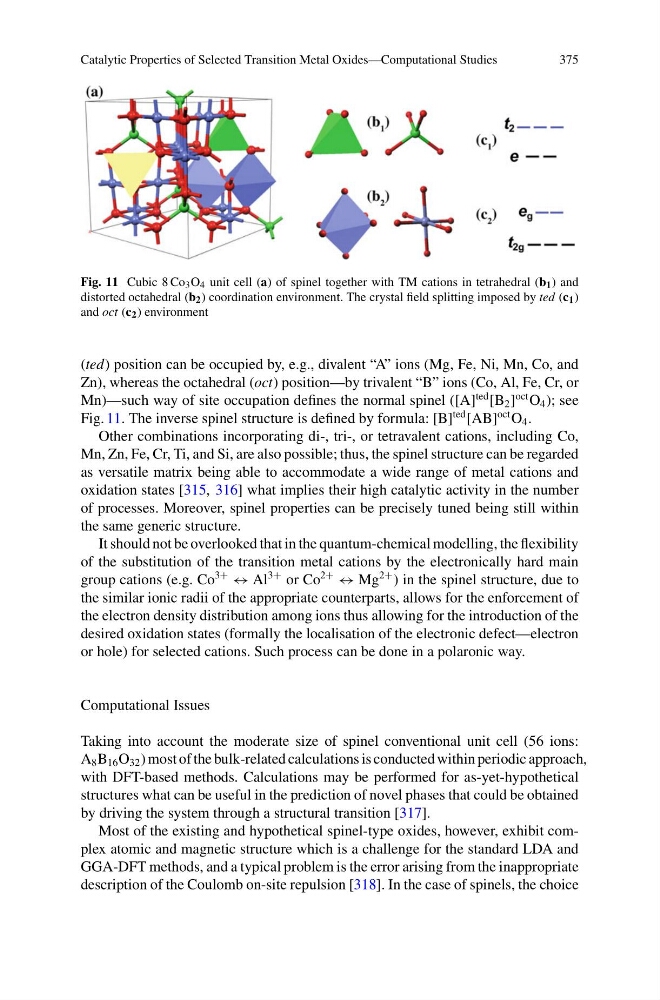
Fig. 11 Cubic 8 Co 3 O 4 unit cell (a) of spinel together with TM cations in tetrahedral (b 1 ) and
distorted octahedral (b 2 ) coordination environment. The crystal field splitting imposed by ted (c 1 )
and oct (c 2 ) environment
(ted) position can be occupied by, e.g., divalent “A” ions (Mg, Fe, Ni, Mn, Co, and
Zn), whereas the octahedral (oct) position—by trivalent “B” ions (Co, Al, Fe, Cr, or
Mn)—such way of site occupation defines the normal spinel ([A]
ted
[B 2 ]
oct O 4 ); see
Fig. 11. The inverse spinel structure is defined by formula: [B]
ted
[AB]
oct O 4 .
Other combinations incorporating di-, tri-, or tetravalent cations, including Co,
Mn, Zn, Fe, Cr, Ti, and Si, are also possible; thus, the spinel structure can be regarded
as versatile matrix being able to accommodate a wide range of metal cations and
oxidation states [315, 316] what implies their high catalytic activity in the number
of processes. Moreover, spinel properties can be precisely tuned being still within
the same generic structure.
It should not be overlooked that in the quantum-chemical modelling, the flexibility
of the substitution of the transition metal cations by the electronically hard main
group cations (e.g. Co
3+
↔ Al
3+ or Co
2+
↔ Mg
2+ ) in the spinel structure, due to
the similar ionic radii of the appropriate counterparts, allows for the enforcement of
the electron density distribution among ions thus allowing for the introduction of the
desired oxidation states (formally the localisation of the electronic defect—electron
or hole) for selected cations. Such process can be done in a polaronic way.
Computational Issues
Taking into account the moderate size of spinel conventional unit cell (56 ions:
A 8 B 16 O 32 ) most of the bulk-related calculations is conducted within periodic approach,
with DFT-based methods. Calculations may be performed for as-yet-hypothetical
structures what can be useful in the prediction of novel phases that could be obtained
by driving the system through a structural transition [317].
Most of the existing and hypothetical spinel-type oxides, however, exhibit complex atomic and magnetic structure which is a challenge for the standard LDA and
GGA-DFT methods, and a typical problem is the error arising from the inappropriate
description of the Coulomb on-site repulsion [318]. In the case of spinels, the choice
375
Fig. 11 Cubic 8 Co 3 O 4 unit cell (a) of spinel together with TM cations in tetrahedral (b 1 ) and
distorted octahedral (b 2 ) coordination environment. The crystal field splitting imposed by ted (c 1 )
and oct (c 2 ) environment
(ted) position can be occupied by, e.g., divalent “A” ions (Mg, Fe, Ni, Mn, Co, and
Zn), whereas the octahedral (oct) position—by trivalent “B” ions (Co, Al, Fe, Cr, or
Mn)—such way of site occupation defines the normal spinel ([A]
ted
[B 2 ]
oct O 4 ); see
Fig. 11. The inverse spinel structure is defined by formula: [B]
ted
[AB]
oct O 4 .
Other combinations incorporating di-, tri-, or tetravalent cations, including Co,
Mn, Zn, Fe, Cr, Ti, and Si, are also possible; thus, the spinel structure can be regarded
as versatile matrix being able to accommodate a wide range of metal cations and
oxidation states [315, 316] what implies their high catalytic activity in the number
of processes. Moreover, spinel properties can be precisely tuned being still within
the same generic structure.
It should not be overlooked that in the quantum-chemical modelling, the flexibility
of the substitution of the transition metal cations by the electronically hard main
group cations (e.g. Co
3+
↔ Al
3+ or Co
2+
↔ Mg
2+ ) in the spinel structure, due to
the similar ionic radii of the appropriate counterparts, allows for the enforcement of
the electron density distribution among ions thus allowing for the introduction of the
desired oxidation states (formally the localisation of the electronic defect—electron
or hole) for selected cations. Such process can be done in a polaronic way.
Computational Issues
Taking into account the moderate size of spinel conventional unit cell (56 ions:
A 8 B 16 O 32 ) most of the bulk-related calculations is conducted within periodic approach,
with DFT-based methods. Calculations may be performed for as-yet-hypothetical
structures what can be useful in the prediction of novel phases that could be obtained
by driving the system through a structural transition [317].
Most of the existing and hypothetical spinel-type oxides, however, exhibit complex atomic and magnetic structure which is a challenge for the standard LDA and
GGA-DFT methods, and a typical problem is the error arising from the inappropriate
description of the Coulomb on-site repulsion [318]. In the case of spinels, the choice