

Catalytic Properties of Selected Transition Metal Oxides—Computational Studies
373
the oxygen atom transfer, facilitated by the spin catalysis process. The activation of
NO molecules can follow through either the oxidative (nitrosonium) or the reductive
(nitroside) complex.
Methane Activation
The other catalytic issue, commonly represented in literature, is the methane activation on zeolitic systems. The review, augmented with own DFT+D calculations, on
methane activation on TH-exchanged zeolites was written by Kulkarni et al. [258]
They summarise the impact of TM cation, zeolite framework, and active site motif
on the calculated energy barrier of C–H bond activation.
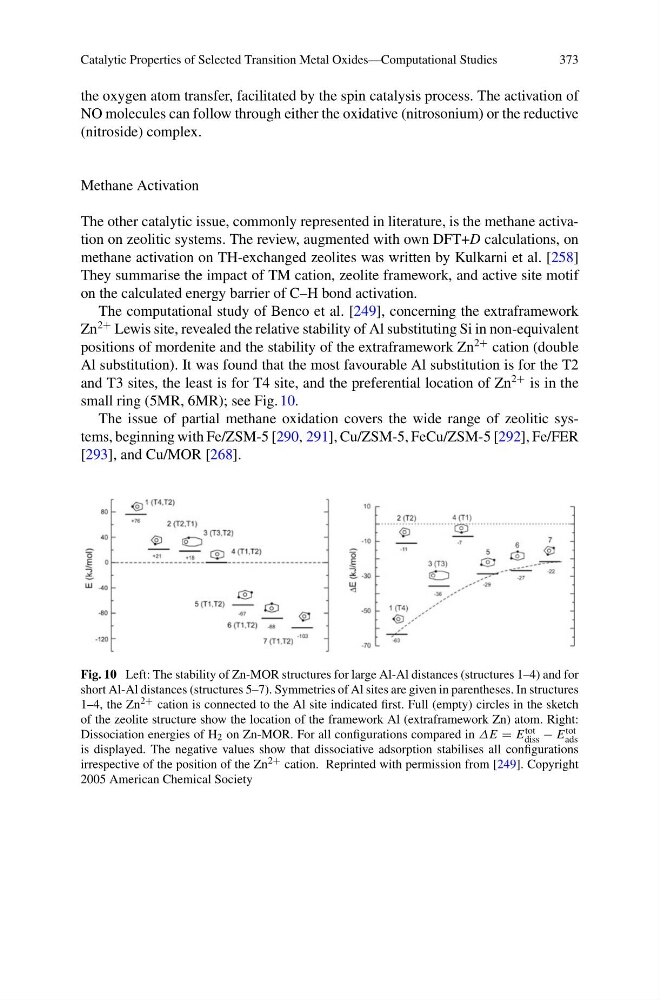
The computational study of Benco et al. [249], concerning the extraframework
Zn
2+ Lewis site, revealed the relative stability of Al substituting Si in non-equivalent
positions of mordenite and the stability of the extraframework Zn
2+ cation (double
Al substitution). It was found that the most favourable Al substitution is for the T2
and T3 sites, the least is for T4 site, and the preferential location of Zn
2+ is in the
small ring (5MR, 6MR); see Fig. 10.
The issue of partial methane oxidation covers the wide range of zeolitic systems, beginning with Fe/ZSM-5 [290, 291], Cu/ZSM-5, FeCu/ZSM-5 [292], Fe/FER
[293], and Cu/MOR [268].
Fig. 10 Left: The stability of Zn-MOR structures for large Al-Al distances (structures 1–4) and for
short Al-Al distances (structures 5–7). Symmetries of Al sites are given in parentheses. In structures
1–4, the Zn 2+ cation is connected to the Al site indicated first. Full (empty) circles in the sketch
of the zeolite structure show the location of the framework Al (extraframework Zn) atom. Right:
Dissociation energies of H 2 on Zn-MOR. For all configurations compared in ΔE = E tot
diss − E tot
ads
is displayed. The negative values show that dissociative adsorption stabilises all configurations
irrespective of the position of the Zn 2+ cation. Reprinted with permission from [249]. Copyright
2005 American Chemical Society
373
the oxygen atom transfer, facilitated by the spin catalysis process. The activation of
NO molecules can follow through either the oxidative (nitrosonium) or the reductive
(nitroside) complex.
Methane Activation
The other catalytic issue, commonly represented in literature, is the methane activation on zeolitic systems. The review, augmented with own DFT+D calculations, on
methane activation on TH-exchanged zeolites was written by Kulkarni et al. [258]
They summarise the impact of TM cation, zeolite framework, and active site motif
on the calculated energy barrier of C–H bond activation.
The computational study of Benco et al. [249], concerning the extraframework
Zn
2+ Lewis site, revealed the relative stability of Al substituting Si in non-equivalent
positions of mordenite and the stability of the extraframework Zn
2+ cation (double
Al substitution). It was found that the most favourable Al substitution is for the T2
and T3 sites, the least is for T4 site, and the preferential location of Zn
2+ is in the
small ring (5MR, 6MR); see Fig. 10.
The issue of partial methane oxidation covers the wide range of zeolitic systems, beginning with Fe/ZSM-5 [290, 291], Cu/ZSM-5, FeCu/ZSM-5 [292], Fe/FER
[293], and Cu/MOR [268].
Fig. 10 Left: The stability of Zn-MOR structures for large Al-Al distances (structures 1–4) and for
short Al-Al distances (structures 5–7). Symmetries of Al sites are given in parentheses. In structures
1–4, the Zn 2+ cation is connected to the Al site indicated first. Full (empty) circles in the sketch
of the zeolite structure show the location of the framework Al (extraframework Zn) atom. Right:
Dissociation energies of H 2 on Zn-MOR. For all configurations compared in ΔE = E tot
diss − E tot
ads
is displayed. The negative values show that dissociative adsorption stabilises all configurations
irrespective of the position of the Zn 2+ cation. Reprinted with permission from [249]. Copyright
2005 American Chemical Society