

364
W. Piskorz and F. Zasada
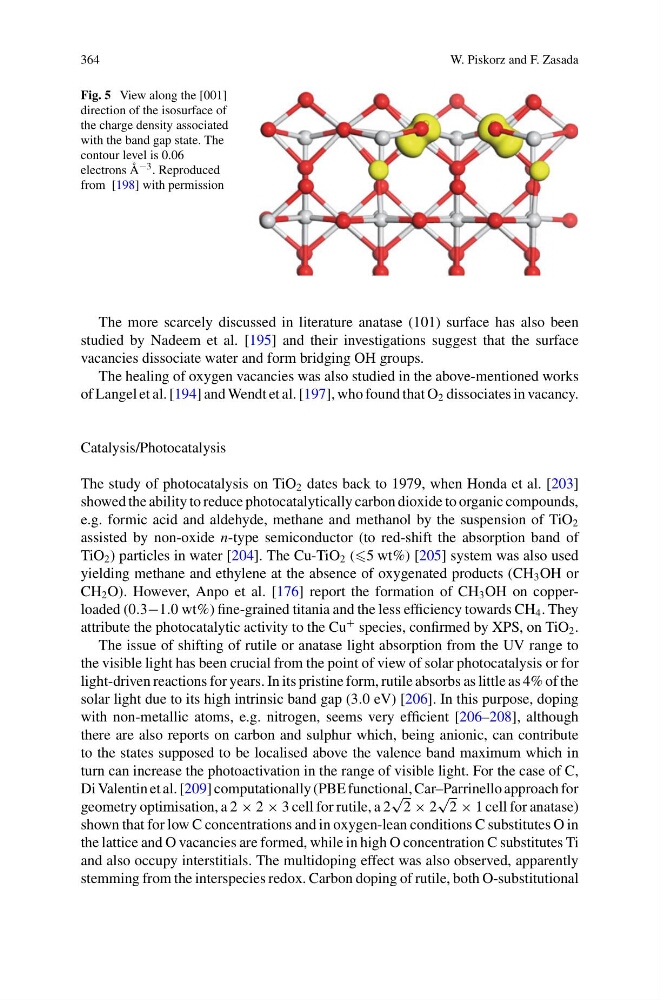
Fig. 5 View along the [001]
direction of the isosurface of
the charge density associated
with the band gap state. The
contour level is 0.06
electrons Å −3 . Reproduced
from [198] with permission
The more scarcely discussed in literature anatase (101) surface has also been
studied by Nadeem et al. [195] and their investigations suggest that the surface
vacancies dissociate water and form bridging OH groups.
The healing of oxygen vacancies was also studied in the above-mentioned works
of Langel et al. [194] and Wendt et al. [197], who found that O 2 dissociates in vacancy.
Catalysis/Photocatalysis
The study of photocatalysis on TiO 2 dates back to 1979, when Honda et al. [203]
showed the ability to reduce photocatalytically carbon dioxide to organic compounds,
e.g. formic acid and aldehyde, methane and methanol by the suspension of TiO 2
assisted by non-oxide n-type semiconductor (to red-shift the absorption band of
TiO 2 ) particles in water [204]. The Cu-TiO 2 (5 wt%) [205] system was also used
yielding methane and ethylene at the absence of oxygenated products (CH 3 OH or
CH 2 O). However, Anpo et al. [176] report the formation of CH 3 OH on copperloaded (0.3−1.0 wt%) fine-grained titania and the less efficiency towards CH 4 . They
attribute the photocatalytic activity to the Cu
+ species, confirmed by XPS, on TiO 2 .
The issue of shifting of rutile or anatase light absorption from the UV range to
the visible light has been crucial from the point of view of solar photocatalysis or for
light-driven reactions for years. In its pristine form, rutile absorbs as little as 4% of the
solar light due to its high intrinsic band gap (3.0 eV) [206]. In this purpose, doping
with non-metallic atoms, e.g. nitrogen, seems very efficient [206–208], although
there are also reports on carbon and sulphur which, being anionic, can contribute
to the states supposed to be localised above the valence band maximum which in
turn can increase the photoactivation in the range of visible light. For the case of C,
Di Valentin et al. [209] computationally (PBE functional, Car–Parrinello approach for
geometry optimisation, a 2 × 2 × 3 cell for rutile, a 2
√
2 × 2
√
2 × 1 cell for anatase)
shown that for low C concentrations and in oxygen-lean conditions C substitutes O in
the lattice and O vacancies are formed, while in high O concentration C substitutes Ti
and also occupy interstitials. The multidoping effect was also observed, apparently
stemming from the interspecies redox. Carbon doping of rutile, both O-substitutional
W. Piskorz and F. Zasada
Fig. 5 View along the [001]
direction of the isosurface of
the charge density associated
with the band gap state. The
contour level is 0.06
electrons Å −3 . Reproduced
from [198] with permission
The more scarcely discussed in literature anatase (101) surface has also been
studied by Nadeem et al. [195] and their investigations suggest that the surface
vacancies dissociate water and form bridging OH groups.
The healing of oxygen vacancies was also studied in the above-mentioned works
of Langel et al. [194] and Wendt et al. [197], who found that O 2 dissociates in vacancy.
Catalysis/Photocatalysis
The study of photocatalysis on TiO 2 dates back to 1979, when Honda et al. [203]
showed the ability to reduce photocatalytically carbon dioxide to organic compounds,
e.g. formic acid and aldehyde, methane and methanol by the suspension of TiO 2
assisted by non-oxide n-type semiconductor (to red-shift the absorption band of
TiO 2 ) particles in water [204]. The Cu-TiO 2 (5 wt%) [205] system was also used
yielding methane and ethylene at the absence of oxygenated products (CH 3 OH or
CH 2 O). However, Anpo et al. [176] report the formation of CH 3 OH on copperloaded (0.3−1.0 wt%) fine-grained titania and the less efficiency towards CH 4 . They
attribute the photocatalytic activity to the Cu
+ species, confirmed by XPS, on TiO 2 .
The issue of shifting of rutile or anatase light absorption from the UV range to
the visible light has been crucial from the point of view of solar photocatalysis or for
light-driven reactions for years. In its pristine form, rutile absorbs as little as 4% of the
solar light due to its high intrinsic band gap (3.0 eV) [206]. In this purpose, doping
with non-metallic atoms, e.g. nitrogen, seems very efficient [206–208], although
there are also reports on carbon and sulphur which, being anionic, can contribute
to the states supposed to be localised above the valence band maximum which in
turn can increase the photoactivation in the range of visible light. For the case of C,
Di Valentin et al. [209] computationally (PBE functional, Car–Parrinello approach for
geometry optimisation, a 2 × 2 × 3 cell for rutile, a 2
√
2 × 2
√
2 × 1 cell for anatase)
shown that for low C concentrations and in oxygen-lean conditions C substitutes O in
the lattice and O vacancies are formed, while in high O concentration C substitutes Ti
and also occupy interstitials. The multidoping effect was also observed, apparently
stemming from the interspecies redox. Carbon doping of rutile, both O-substitutional