

Catalytic Properties of Selected Transition Metal Oxides—Computational Studies
359
binding of oxygen and thus facilitates the formation of O vacancy and so enhances
the catalytic activity via the MvK mechanism, but when the donation of O is too
high, then the process becomes stoichiometric instead of catalytic as the healing of
O vacancies is too slow.
3.1.2 Titania TiO 2
The TiO 2 systems are among the most popular photocatalysts [168–170] of many
types of processes, e.g. methane forming from CO 2 and H 2 O [169], which is a highly
desirable perspective process in the days of environmental concern by lowering the
CO 2 emission and forming fuels with use of solar energy. Among the numerous
system, e.g. TiO 2 , CdS, ZrO 2 , ZnO, and MgO, TiO 2 seems the most convenient
concerning oxidation properties, charge transport properties, stability, non-toxicity,
and cost [171]. Another highly industrially demanded processes, belonging to socalled green chemistry, include the splitting of water (WS) into hydrogen and oxygen
with use of the solar energy (Grätzel’s dye-sensitised solar cells, DSSC [172–174]),
air/water purification devices, or self-cleaning windows and façades. The photocatalytic oxidation of pollutants is also of high environmental concern [168]. The
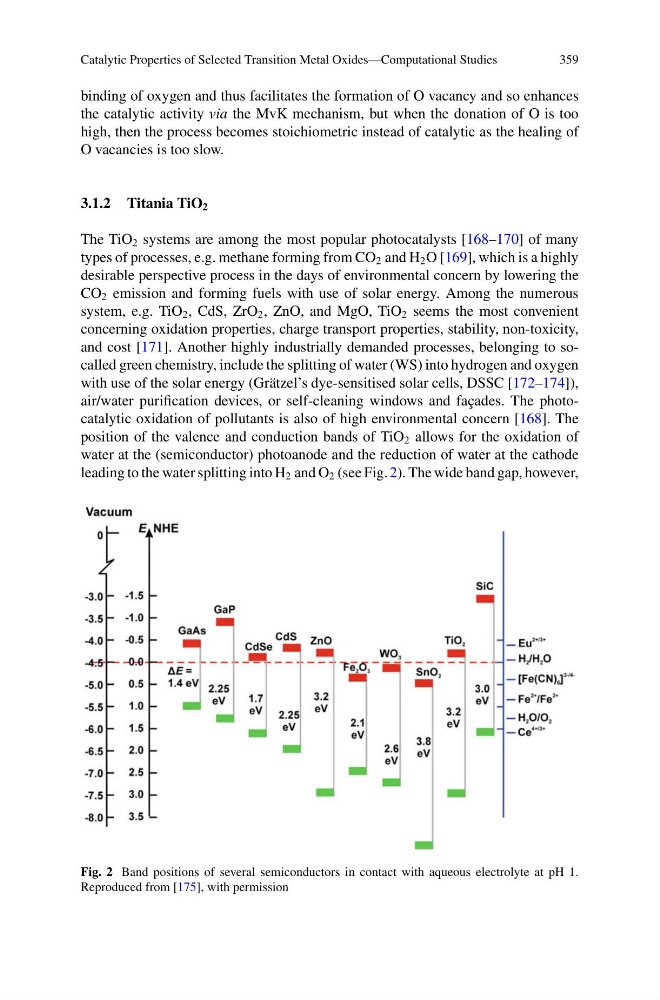
position of the valence and conduction bands of TiO 2 allows for the oxidation of
water at the (semiconductor) photoanode and the reduction of water at the cathode
leading to the water splitting into H 2 and O 2 (see Fig. 2). The wide band gap, however,
Fig. 2 Band positions of several semiconductors in contact with aqueous electrolyte at pH 1.
Reproduced from [175], with permission
359
binding of oxygen and thus facilitates the formation of O vacancy and so enhances
the catalytic activity via the MvK mechanism, but when the donation of O is too
high, then the process becomes stoichiometric instead of catalytic as the healing of
O vacancies is too slow.
3.1.2 Titania TiO 2
The TiO 2 systems are among the most popular photocatalysts [168–170] of many
types of processes, e.g. methane forming from CO 2 and H 2 O [169], which is a highly
desirable perspective process in the days of environmental concern by lowering the
CO 2 emission and forming fuels with use of solar energy. Among the numerous
system, e.g. TiO 2 , CdS, ZrO 2 , ZnO, and MgO, TiO 2 seems the most convenient
concerning oxidation properties, charge transport properties, stability, non-toxicity,
and cost [171]. Another highly industrially demanded processes, belonging to socalled green chemistry, include the splitting of water (WS) into hydrogen and oxygen
with use of the solar energy (Grätzel’s dye-sensitised solar cells, DSSC [172–174]),
air/water purification devices, or self-cleaning windows and façades. The photocatalytic oxidation of pollutants is also of high environmental concern [168]. The
position of the valence and conduction bands of TiO 2 allows for the oxidation of
water at the (semiconductor) photoanode and the reduction of water at the cathode
leading to the water splitting into H 2 and O 2 (see Fig. 2). The wide band gap, however,
Fig. 2 Band positions of several semiconductors in contact with aqueous electrolyte at pH 1.
Reproduced from [175], with permission