

Catalytic Properties of Selected Transition Metal Oxides—Computational Studies
353
sensitivity [107, 108], exploited by the shape-controlled synthesis [109], easy oxygen
transport and storage [88, 110], acid–base properties [111]. The oxygen transport
phenomena include the facile creation, healing, and diffusion of oxygen vacancies,
and is pronounced especially at the ceria surfaces. The wide applicability of ceria
originates from its ability to the fast and repeatedly undergoing the catalytic redox
cycle (i.e. high oxygen storage capability) for the low energy of forming, diffusion,
and healing of the oxygen vacancies. Ceria is also a perspective catalyst for the
two-step water splitting process yielding hydrogen [112].
Ceria is also a common reactive support for other metal oxides like vanadia in the
oxidative dehydrogenation reactions of alkanes to produce alkenes [113]. In some
systems, however, ceria plays a role of inactive support [114].
Structure
Ceria in normal conditions crystallises in the fluorite structure (Fm ¯
3m). In the cubic
arrangement of the equivalent O
2− anions, the Ce
4+ cations occupy tetrahedral positions around the O
2− sites. The mixed valence ground state of the Ce
4+ once was
believed to be deduced from the XPS spectra [115, 116] (partial charge transfer from
the valence O
2− 2 p orbital to the virtual 4 f
0 state of cerium cation), it is, however,
not the only interpretation, see, e.g., Wuilloud et al. [117], who say in their abstract
that “A mixed valence can be definitely excluded in CeO 2 ”, supporting their reasoning by the many-body calculations. Based on the reflectance measurements, there is
a possibility of small occupation of 4 f
1 configuration [118]. The experimental band
gap width is 3.00 eV [117].
Even though the interactions between O
2− and Ce
4+ have some covalent component, for the sake of simplicity ceria is often regarded and a fully ionic compound,
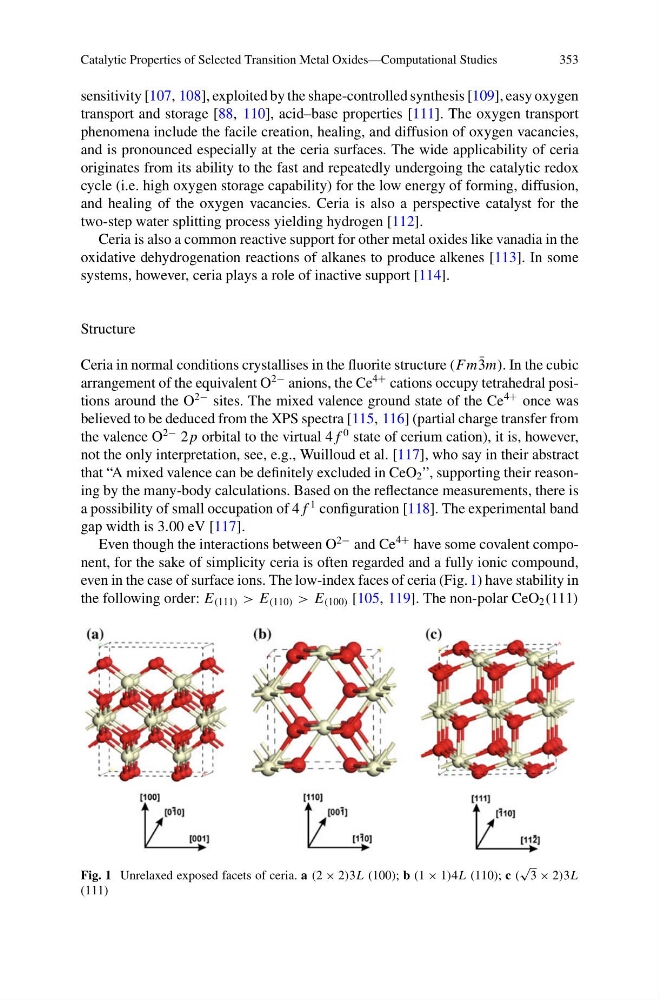
even in the case of surface ions. The low-index faces of ceria (Fig. 1) have stability in
the following order: E (111) > E (110) > E (100) [105, 119]. The non-polar CeO 2 (111)
Fig. 1 Unrelaxed exposed facets of ceria. a (2 × 2)3L (100); b (1 × 1)4L (110); c (
√
3 × 2)3L
(111)
353
sensitivity [107, 108], exploited by the shape-controlled synthesis [109], easy oxygen
transport and storage [88, 110], acid–base properties [111]. The oxygen transport
phenomena include the facile creation, healing, and diffusion of oxygen vacancies,
and is pronounced especially at the ceria surfaces. The wide applicability of ceria
originates from its ability to the fast and repeatedly undergoing the catalytic redox
cycle (i.e. high oxygen storage capability) for the low energy of forming, diffusion,
and healing of the oxygen vacancies. Ceria is also a perspective catalyst for the
two-step water splitting process yielding hydrogen [112].
Ceria is also a common reactive support for other metal oxides like vanadia in the
oxidative dehydrogenation reactions of alkanes to produce alkenes [113]. In some
systems, however, ceria plays a role of inactive support [114].
Structure
Ceria in normal conditions crystallises in the fluorite structure (Fm ¯
3m). In the cubic
arrangement of the equivalent O
2− anions, the Ce
4+ cations occupy tetrahedral positions around the O
2− sites. The mixed valence ground state of the Ce
4+ once was
believed to be deduced from the XPS spectra [115, 116] (partial charge transfer from
the valence O
2− 2 p orbital to the virtual 4 f
0 state of cerium cation), it is, however,
not the only interpretation, see, e.g., Wuilloud et al. [117], who say in their abstract
that “A mixed valence can be definitely excluded in CeO 2 ”, supporting their reasoning by the many-body calculations. Based on the reflectance measurements, there is
a possibility of small occupation of 4 f
1 configuration [118]. The experimental band
gap width is 3.00 eV [117].
Even though the interactions between O
2− and Ce
4+ have some covalent component, for the sake of simplicity ceria is often regarded and a fully ionic compound,
even in the case of surface ions. The low-index faces of ceria (Fig. 1) have stability in
the following order: E (111) > E (110) > E (100) [105, 119]. The non-polar CeO 2 (111)
Fig. 1 Unrelaxed exposed facets of ceria. a (2 × 2)3L (100); b (1 × 1)4L (110); c (
√
3 × 2)3L
(111)