

20
K. P. Kepp
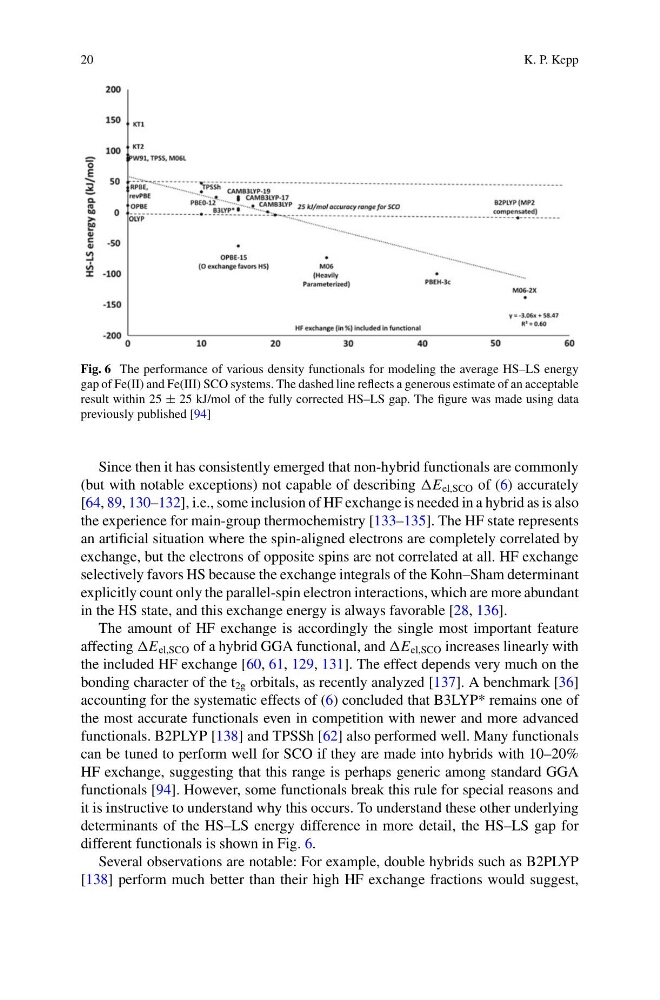
Fig. 6 The performance of various density functionals for modeling the average HS–LS energy
gap of Fe(II) and Fe(III) SCO systems. The dashed line reflects a generous estimate of an acceptable
result within 25 ± 25 kJ/mol of the fully corrected HS–LS gap. The figure was made using data
previously published [94]
Since then it has consistently emerged that non-hybrid functionals are commonly
(but with notable exceptions) not capable of describing E el,SCO of (6) accurately
[64, 89, 130–132], i.e., some inclusion of HF exchange is needed in a hybrid as is also
the experience for main-group thermochemistry [133–135]. The HF state represents
an artificial situation where the spin-aligned electrons are completely correlated by
exchange, but the electrons of opposite spins are not correlated at all. HF exchange
selectively favors HS because the exchange integrals of the Kohn–Sham determinant
explicitly count only the parallel-spin electron interactions, which are more abundant
in the HS state, and this exchange energy is always favorable [28, 136].
The amount of HF exchange is accordingly the single most important feature
affecting E el,SCO of a hybrid GGA functional, and E el,SCO increases linearly with
the included HF exchange [60, 61, 129, 131]. The effect depends very much on the
bonding character of the t 2g orbitals, as recently analyzed [137]. A benchmark [36]
accounting for the systematic effects of (6) concluded that B3LYP* remains one of
the most accurate functionals even in competition with newer and more advanced
functionals. B2PLYP [138] and TPSSh [62] also performed well. Many functionals
can be tuned to perform well for SCO if they are made into hybrids with 10–20%
HF exchange, suggesting that this range is perhaps generic among standard GGA
functionals [94]. However, some functionals break this rule for special reasons and
it is instructive to understand why this occurs. To understand these other underlying
determinants of the HS–LS energy difference in more detail, the HS–LS gap for
different functionals is shown in Fig. 6.
Several observations are notable: For example, double hybrids such as B2PLYP
[138] perform much better than their high HF exchange fractions would suggest,
K. P. Kepp
Fig. 6 The performance of various density functionals for modeling the average HS–LS energy
gap of Fe(II) and Fe(III) SCO systems. The dashed line reflects a generous estimate of an acceptable
result within 25 ± 25 kJ/mol of the fully corrected HS–LS gap. The figure was made using data
previously published [94]
Since then it has consistently emerged that non-hybrid functionals are commonly
(but with notable exceptions) not capable of describing E el,SCO of (6) accurately
[64, 89, 130–132], i.e., some inclusion of HF exchange is needed in a hybrid as is also
the experience for main-group thermochemistry [133–135]. The HF state represents
an artificial situation where the spin-aligned electrons are completely correlated by
exchange, but the electrons of opposite spins are not correlated at all. HF exchange
selectively favors HS because the exchange integrals of the Kohn–Sham determinant
explicitly count only the parallel-spin electron interactions, which are more abundant
in the HS state, and this exchange energy is always favorable [28, 136].
The amount of HF exchange is accordingly the single most important feature
affecting E el,SCO of a hybrid GGA functional, and E el,SCO increases linearly with
the included HF exchange [60, 61, 129, 131]. The effect depends very much on the
bonding character of the t 2g orbitals, as recently analyzed [137]. A benchmark [36]
accounting for the systematic effects of (6) concluded that B3LYP* remains one of
the most accurate functionals even in competition with newer and more advanced
functionals. B2PLYP [138] and TPSSh [62] also performed well. Many functionals
can be tuned to perform well for SCO if they are made into hybrids with 10–20%
HF exchange, suggesting that this range is perhaps generic among standard GGA
functionals [94]. However, some functionals break this rule for special reasons and
it is instructive to understand why this occurs. To understand these other underlying
determinants of the HS–LS energy difference in more detail, the HS–LS gap for
different functionals is shown in Fig. 6.
Several observations are notable: For example, double hybrids such as B2PLYP
[138] perform much better than their high HF exchange fractions would suggest,