

Computational Modelling of Structure and Catalytic Properties …
337
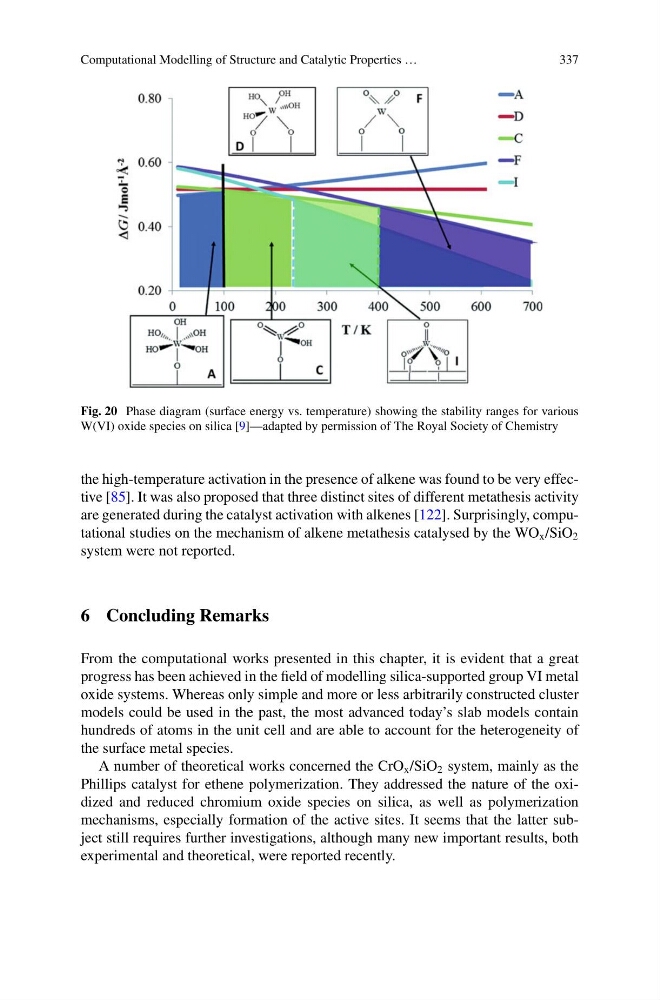
Fig. 20 Phase diagram (surface energy vs. temperature) showing the stability ranges for various
W(VI) oxide species on silica [9]—adapted by permission of The Royal Society of Chemistry
the high-temperature activation in the presence of alkene was found to be very effective [85]. It was also proposed that three distinct sites of different metathesis activity
are generated during the catalyst activation with alkenes [122]. Surprisingly, computational studies on the mechanism of alkene metathesis catalysed by the WO x /SiO 2
system were not reported.
6 Concluding Remarks
From the computational works presented in this chapter, it is evident that a great
progress has been achieved in the field of modelling silica-supported group VI metal
oxide systems. Whereas only simple and more or less arbitrarily constructed cluster
models could be used in the past, the most advanced today’s slab models contain
hundreds of atoms in the unit cell and are able to account for the heterogeneity of
the surface metal species.
A number of theoretical works concerned the CrO x /SiO 2 system, mainly as the
Phillips catalyst for ethene polymerization. They addressed the nature of the oxidized and reduced chromium oxide species on silica, as well as polymerization
mechanisms, especially formation of the active sites. It seems that the latter subject still requires further investigations, although many new important results, both
experimental and theoretical, were reported recently.
337
Fig. 20 Phase diagram (surface energy vs. temperature) showing the stability ranges for various
W(VI) oxide species on silica [9]—adapted by permission of The Royal Society of Chemistry
the high-temperature activation in the presence of alkene was found to be very effective [85]. It was also proposed that three distinct sites of different metathesis activity
are generated during the catalyst activation with alkenes [122]. Surprisingly, computational studies on the mechanism of alkene metathesis catalysed by the WO x /SiO 2
system were not reported.
6 Concluding Remarks
From the computational works presented in this chapter, it is evident that a great
progress has been achieved in the field of modelling silica-supported group VI metal
oxide systems. Whereas only simple and more or less arbitrarily constructed cluster
models could be used in the past, the most advanced today’s slab models contain
hundreds of atoms in the unit cell and are able to account for the heterogeneity of
the surface metal species.
A number of theoretical works concerned the CrO x /SiO 2 system, mainly as the
Phillips catalyst for ethene polymerization. They addressed the nature of the oxidized and reduced chromium oxide species on silica, as well as polymerization
mechanisms, especially formation of the active sites. It seems that the latter subject still requires further investigations, although many new important results, both
experimental and theoretical, were reported recently.