

Computational Modelling of Structure and Catalytic Properties …
335
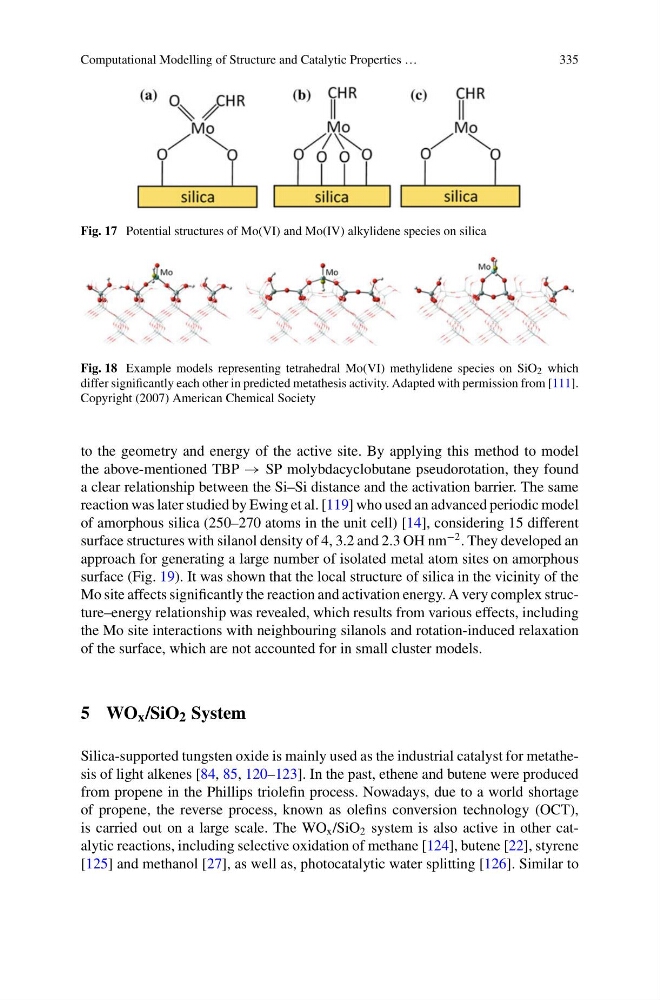
Fig. 17 Potential structures of Mo(VI) and Mo(IV) alkylidene species on silica
Fig. 18 Example models representing tetrahedral Mo(VI) methylidene species on SiO 2 which
differ significantly each other in predicted metathesis activity. Adapted with permission from [111].
Copyright (2007) American Chemical Society
to the geometry and energy of the active site. By applying this method to model
the above-mentioned TBP → SP molybdacyclobutane pseudorotation, they found
a clear relationship between the Si–Si distance and the activation barrier. The same
reaction was later studied by Ewing et al. [119] who used an advanced periodic model
of amorphous silica (250–270 atoms in the unit cell) [14], considering 15 different
surface structures with silanol density of 4, 3.2 and 2.3 OH nm
−2 . They developed an
approach for generating a large number of isolated metal atom sites on amorphous
surface (Fig. 19). It was shown that the local structure of silica in the vicinity of the
Mo site affects significantly the reaction and activation energy. A very complex structure–energy relationship was revealed, which results from various effects, including
the Mo site interactions with neighbouring silanols and rotation-induced relaxation
of the surface, which are not accounted for in small cluster models.
5 WO x /SiO 2 System
Silica-supported tungsten oxide is mainly used as the industrial catalyst for metathesis of light alkenes [84, 85, 120–123]. In the past, ethene and butene were produced
from propene in the Phillips triolefin process. Nowadays, due to a world shortage
of propene, the reverse process, known as olefins conversion technology (OCT),
is carried out on a large scale. The WO x /SiO 2 system is also active in other catalytic reactions, including selective oxidation of methane [124], butene [22], styrene
[125] and methanol [27], as well as, photocatalytic water splitting [126]. Similar to
335
Fig. 17 Potential structures of Mo(VI) and Mo(IV) alkylidene species on silica
Fig. 18 Example models representing tetrahedral Mo(VI) methylidene species on SiO 2 which
differ significantly each other in predicted metathesis activity. Adapted with permission from [111].
Copyright (2007) American Chemical Society
to the geometry and energy of the active site. By applying this method to model
the above-mentioned TBP → SP molybdacyclobutane pseudorotation, they found
a clear relationship between the Si–Si distance and the activation barrier. The same
reaction was later studied by Ewing et al. [119] who used an advanced periodic model
of amorphous silica (250–270 atoms in the unit cell) [14], considering 15 different
surface structures with silanol density of 4, 3.2 and 2.3 OH nm
−2 . They developed an
approach for generating a large number of isolated metal atom sites on amorphous
surface (Fig. 19). It was shown that the local structure of silica in the vicinity of the
Mo site affects significantly the reaction and activation energy. A very complex structure–energy relationship was revealed, which results from various effects, including
the Mo site interactions with neighbouring silanols and rotation-induced relaxation
of the surface, which are not accounted for in small cluster models.
5 WO x /SiO 2 System
Silica-supported tungsten oxide is mainly used as the industrial catalyst for metathesis of light alkenes [84, 85, 120–123]. In the past, ethene and butene were produced
from propene in the Phillips triolefin process. Nowadays, due to a world shortage
of propene, the reverse process, known as olefins conversion technology (OCT),
is carried out on a large scale. The WO x /SiO 2 system is also active in other catalytic reactions, including selective oxidation of methane [124], butene [22], styrene
[125] and methanol [27], as well as, photocatalytic water splitting [126]. Similar to