

Mechanism and Kinetics in Homogeneous Catalysis …
309
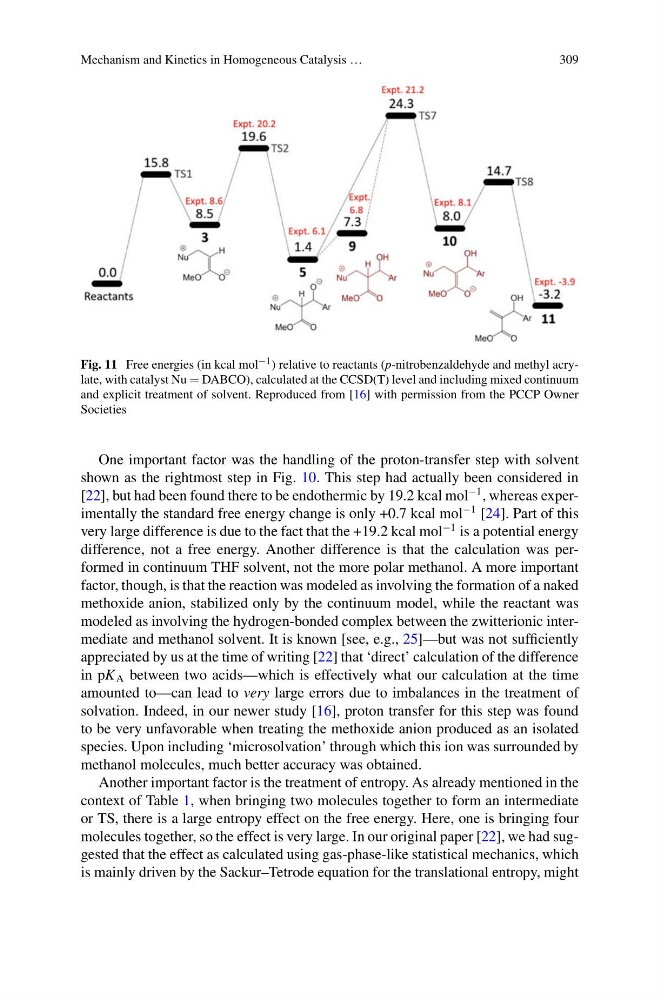
Fig. 11 Free energies (in kcal mol −1 ) relative to reactants (p-nitrobenzaldehyde and methyl acrylate, with catalyst Nu DABCO), calculated at the CCSD(T) level and including mixed continuum
and explicit treatment of solvent. Reproduced from [16] with permission from the PCCP Owner
Societies
One important factor was the handling of the proton-transfer step with solvent
shown as the rightmost step in Fig. 10. This step had actually been considered in
[22], but had been found there to be endothermic by 19.2 kcal mol
−1 , whereas experimentally the standard free energy change is only +0.7 kcal mol
−1 [24]. Part of this
very large difference is due to the fact that the +19.2 kcal mol
−1 is a potential energy
difference, not a free energy. Another difference is that the calculation was performed in continuum THF solvent, not the more polar methanol. A more important
factor, though, is that the reaction was modeled as involving the formation of a naked
methoxide anion, stabilized only by the continuum model, while the reactant was
modeled as involving the hydrogen-bonded complex between the zwitterionic intermediate and methanol solvent. It is known [see, e.g., 25]—but was not sufficiently
appreciated by us at the time of writing [22] that ‘direct’ calculation of the difference
in pK A between two acids—which is effectively what our calculation at the time
amounted to—can lead to very large errors due to imbalances in the treatment of
solvation. Indeed, in our newer study [16], proton transfer for this step was found
to be very unfavorable when treating the methoxide anion produced as an isolated
species. Upon including ‘microsolvation’ through which this ion was surrounded by
methanol molecules, much better accuracy was obtained.
Another important factor is the treatment of entropy. As already mentioned in the
context of Table 1, when bringing two molecules together to form an intermediate
or TS, there is a large entropy effect on the free energy. Here, one is bringing four
molecules together, so the effect is very large. In our original paper [22], we had suggested that the effect as calculated using gas-phase-like statistical mechanics, which
is mainly driven by the Sackur–Tetrode equation for the translational entropy, might
309
Fig. 11 Free energies (in kcal mol −1 ) relative to reactants (p-nitrobenzaldehyde and methyl acrylate, with catalyst Nu DABCO), calculated at the CCSD(T) level and including mixed continuum
and explicit treatment of solvent. Reproduced from [16] with permission from the PCCP Owner
Societies
One important factor was the handling of the proton-transfer step with solvent
shown as the rightmost step in Fig. 10. This step had actually been considered in
[22], but had been found there to be endothermic by 19.2 kcal mol
−1 , whereas experimentally the standard free energy change is only +0.7 kcal mol
−1 [24]. Part of this
very large difference is due to the fact that the +19.2 kcal mol
−1 is a potential energy
difference, not a free energy. Another difference is that the calculation was performed in continuum THF solvent, not the more polar methanol. A more important
factor, though, is that the reaction was modeled as involving the formation of a naked
methoxide anion, stabilized only by the continuum model, while the reactant was
modeled as involving the hydrogen-bonded complex between the zwitterionic intermediate and methanol solvent. It is known [see, e.g., 25]—but was not sufficiently
appreciated by us at the time of writing [22] that ‘direct’ calculation of the difference
in pK A between two acids—which is effectively what our calculation at the time
amounted to—can lead to very large errors due to imbalances in the treatment of
solvation. Indeed, in our newer study [16], proton transfer for this step was found
to be very unfavorable when treating the methoxide anion produced as an isolated
species. Upon including ‘microsolvation’ through which this ion was surrounded by
methanol molecules, much better accuracy was obtained.
Another important factor is the treatment of entropy. As already mentioned in the
context of Table 1, when bringing two molecules together to form an intermediate
or TS, there is a large entropy effect on the free energy. Here, one is bringing four
molecules together, so the effect is very large. In our original paper [22], we had suggested that the effect as calculated using gas-phase-like statistical mechanics, which
is mainly driven by the Sackur–Tetrode equation for the translational entropy, might