

Mechanism and Kinetics in Homogeneous Catalysis …
307
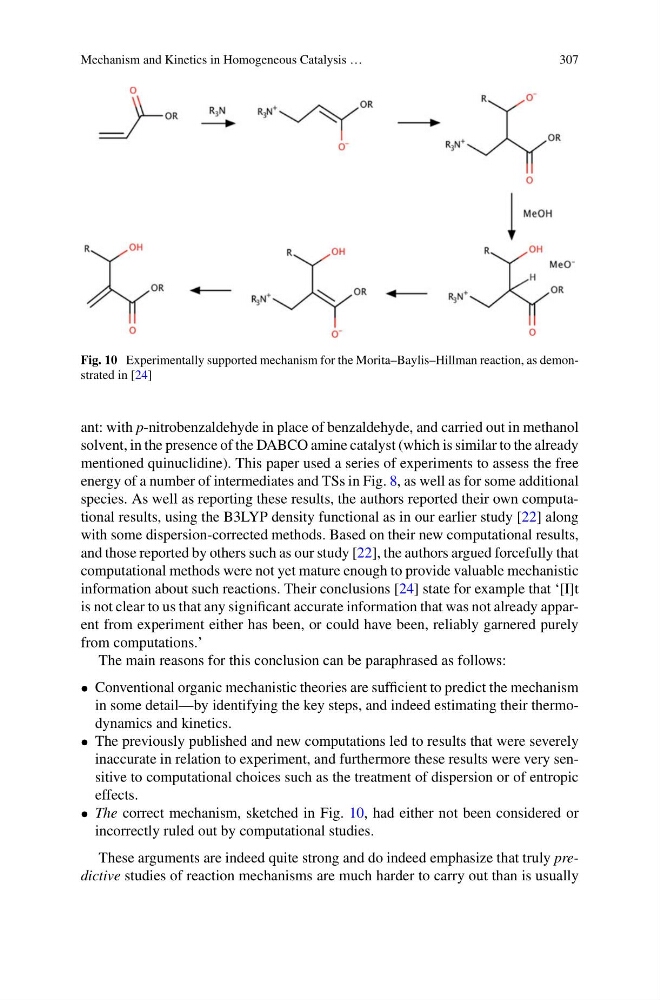
Fig. 10 Experimentally supported mechanism for the Morita–Baylis–Hillman reaction, as demonstrated in [24]
ant: with p-nitrobenzaldehyde in place of benzaldehyde, and carried out in methanol
solvent, in the presence of the DABCO amine catalyst (which is similar to the already
mentioned quinuclidine). This paper used a series of experiments to assess the free
energy of a number of intermediates and TSs in Fig. 8, as well as for some additional
species. As well as reporting these results, the authors reported their own computational results, using the B3LYP density functional as in our earlier study [22] along
with some dispersion-corrected methods. Based on their new computational results,
and those reported by others such as our study [22], the authors argued forcefully that
computational methods were not yet mature enough to provide valuable mechanistic
information about such reactions. Their conclusions [24] state for example that ‘[I]t
is not clear to us that any significant accurate information that was not already apparent from experiment either has been, or could have been, reliably garnered purely
from computations.’
The main reasons for this conclusion can be paraphrased as follows:
• Conventional organic mechanistic theories are sufficient to predict the mechanism
in some detail—by identifying the key steps, and indeed estimating their thermodynamics and kinetics.
• The previously published and new computations led to results that were severely
inaccurate in relation to experiment, and furthermore these results were very sensitive to computational choices such as the treatment of dispersion or of entropic
effects.
• The correct mechanism, sketched in Fig. 10, had either not been considered or
incorrectly ruled out by computational studies.
These arguments are indeed quite strong and do indeed emphasize that truly predictive studies of reaction mechanisms are much harder to carry out than is usually
307
Fig. 10 Experimentally supported mechanism for the Morita–Baylis–Hillman reaction, as demonstrated in [24]
ant: with p-nitrobenzaldehyde in place of benzaldehyde, and carried out in methanol
solvent, in the presence of the DABCO amine catalyst (which is similar to the already
mentioned quinuclidine). This paper used a series of experiments to assess the free
energy of a number of intermediates and TSs in Fig. 8, as well as for some additional
species. As well as reporting these results, the authors reported their own computational results, using the B3LYP density functional as in our earlier study [22] along
with some dispersion-corrected methods. Based on their new computational results,
and those reported by others such as our study [22], the authors argued forcefully that
computational methods were not yet mature enough to provide valuable mechanistic
information about such reactions. Their conclusions [24] state for example that ‘[I]t
is not clear to us that any significant accurate information that was not already apparent from experiment either has been, or could have been, reliably garnered purely
from computations.’
The main reasons for this conclusion can be paraphrased as follows:
• Conventional organic mechanistic theories are sufficient to predict the mechanism
in some detail—by identifying the key steps, and indeed estimating their thermodynamics and kinetics.
• The previously published and new computations led to results that were severely
inaccurate in relation to experiment, and furthermore these results were very sensitive to computational choices such as the treatment of dispersion or of entropic
effects.
• The correct mechanism, sketched in Fig. 10, had either not been considered or
incorrectly ruled out by computational studies.
These arguments are indeed quite strong and do indeed emphasize that truly predictive studies of reaction mechanisms are much harder to carry out than is usually