

Photodeactivation Channels of Transition Metal Complexes …
265
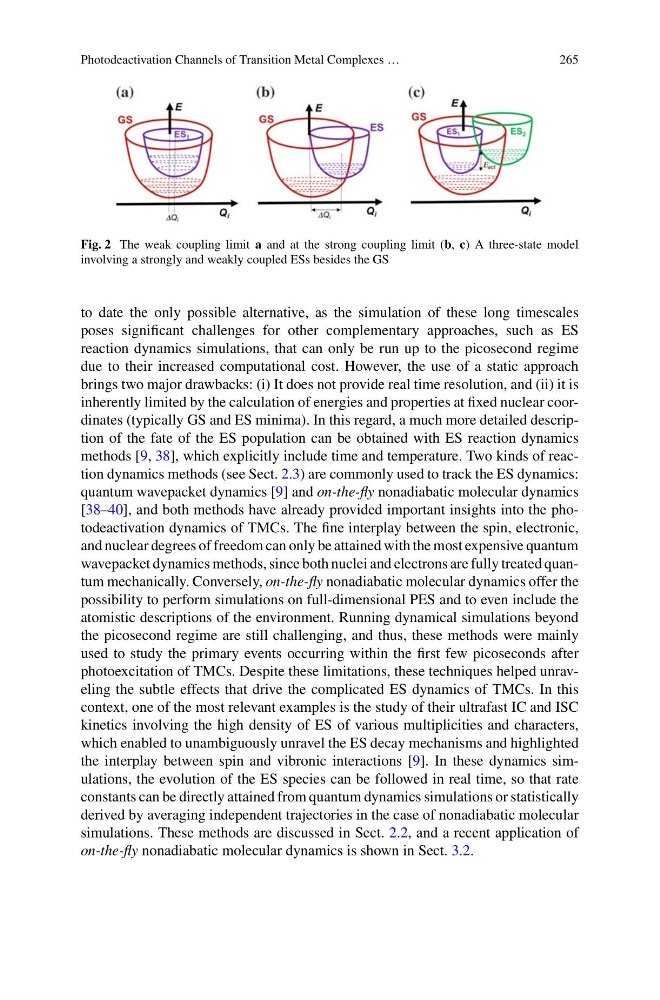
Fig. 2 The weak coupling limit a and at the strong coupling limit (b, c) A three-state model
involving a strongly and weakly coupled ESs besides the GS
to date the only possible alternative, as the simulation of these long timescales
poses significant challenges for other complementary approaches, such as ES
reaction dynamics simulations, that can only be run up to the picosecond regime
due to their increased computational cost. However, the use of a static approach
brings two major drawbacks: (i) It does not provide real time resolution, and (ii) it is
inherently limited by the calculation of energies and properties at fixed nuclear coordinates (typically GS and ES minima). In this regard, a much more detailed description of the fate of the ES population can be obtained with ES reaction dynamics
methods [9, 38], which explicitly include time and temperature. Two kinds of reaction dynamics methods (see Sect. 2.3) are commonly used to track the ES dynamics:
quantum wavepacket dynamics [9] and on-the-fly nonadiabatic molecular dynamics
[38–40], and both methods have already provided important insights into the photodeactivation dynamics of TMCs. The fine interplay between the spin, electronic,
and nuclear degrees of freedom can only be attained with the most expensive quantum
wavepacket dynamics methods, since both nuclei and electrons are fully treated quantum mechanically. Conversely, on-the-fly nonadiabatic molecular dynamics offer the
possibility to perform simulations on full-dimensional PES and to even include the
atomistic descriptions of the environment. Running dynamical simulations beyond
the picosecond regime are still challenging, and thus, these methods were mainly
used to study the primary events occurring within the first few picoseconds after
photoexcitation of TMCs. Despite these limitations, these techniques helped unraveling the subtle effects that drive the complicated ES dynamics of TMCs. In this
context, one of the most relevant examples is the study of their ultrafast IC and ISC
kinetics involving the high density of ES of various multiplicities and characters,
which enabled to unambiguously unravel the ES decay mechanisms and highlighted
the interplay between spin and vibronic interactions [9]. In these dynamics simulations, the evolution of the ES species can be followed in real time, so that rate
constants can be directly attained from quantum dynamics simulations or statistically
derived by averaging independent trajectories in the case of nonadiabatic molecular
simulations. These methods are discussed in Sect. 2.2, and a recent application of
on-the-fly nonadiabatic molecular dynamics is shown in Sect. 3.2.
265
Fig. 2 The weak coupling limit a and at the strong coupling limit (b, c) A three-state model
involving a strongly and weakly coupled ESs besides the GS
to date the only possible alternative, as the simulation of these long timescales
poses significant challenges for other complementary approaches, such as ES
reaction dynamics simulations, that can only be run up to the picosecond regime
due to their increased computational cost. However, the use of a static approach
brings two major drawbacks: (i) It does not provide real time resolution, and (ii) it is
inherently limited by the calculation of energies and properties at fixed nuclear coordinates (typically GS and ES minima). In this regard, a much more detailed description of the fate of the ES population can be obtained with ES reaction dynamics
methods [9, 38], which explicitly include time and temperature. Two kinds of reaction dynamics methods (see Sect. 2.3) are commonly used to track the ES dynamics:
quantum wavepacket dynamics [9] and on-the-fly nonadiabatic molecular dynamics
[38–40], and both methods have already provided important insights into the photodeactivation dynamics of TMCs. The fine interplay between the spin, electronic,
and nuclear degrees of freedom can only be attained with the most expensive quantum
wavepacket dynamics methods, since both nuclei and electrons are fully treated quantum mechanically. Conversely, on-the-fly nonadiabatic molecular dynamics offer the
possibility to perform simulations on full-dimensional PES and to even include the
atomistic descriptions of the environment. Running dynamical simulations beyond
the picosecond regime are still challenging, and thus, these methods were mainly
used to study the primary events occurring within the first few picoseconds after
photoexcitation of TMCs. Despite these limitations, these techniques helped unraveling the subtle effects that drive the complicated ES dynamics of TMCs. In this
context, one of the most relevant examples is the study of their ultrafast IC and ISC
kinetics involving the high density of ES of various multiplicities and characters,
which enabled to unambiguously unravel the ES decay mechanisms and highlighted
the interplay between spin and vibronic interactions [9]. In these dynamics simulations, the evolution of the ES species can be followed in real time, so that rate
constants can be directly attained from quantum dynamics simulations or statistically
derived by averaging independent trajectories in the case of nonadiabatic molecular
simulations. These methods are discussed in Sect. 2.2, and a recent application of
on-the-fly nonadiabatic molecular dynamics is shown in Sect. 3.2.