

262
D. Escudero
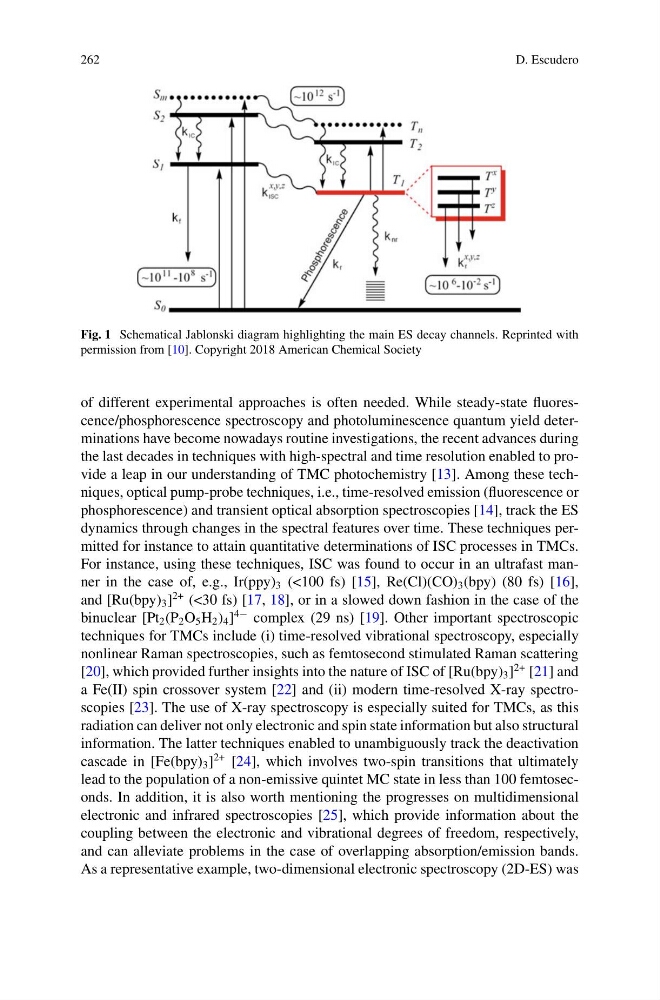
Fig. 1 Schematical Jablonski diagram highlighting the main ES decay channels. Reprinted with
permission from [10]. Copyright 2018 American Chemical Society
of different experimental approaches is often needed. While steady-state fluorescence/phosphorescence spectroscopy and photoluminescence quantum yield determinations have become nowadays routine investigations, the recent advances during
the last decades in techniques with high-spectral and time resolution enabled to provide a leap in our understanding of TMC photochemistry [13]. Among these techniques, optical pump-probe techniques, i.e., time-resolved emission (fluorescence or
phosphorescence) and transient optical absorption spectroscopies [14], track the ES
dynamics through changes in the spectral features over time. These techniques permitted for instance to attain quantitative determinations of ISC processes in TMCs.
For instance, using these techniques, ISC was found to occur in an ultrafast manner in the case of, e.g., Ir(ppy) 3 (<100 fs) [15], Re(Cl)(CO) 3 (bpy) (80 fs) [16],
and [Ru(bpy) 3 ]
2+ (<30 fs) [17, 18], or in a slowed down fashion in the case of the
binuclear [Pt 2 (P 2 O 5 H 2 ) 4 ]
4− complex (29 ns) [19]. Other important spectroscopic
techniques for TMCs include (i) time-resolved vibrational spectroscopy, especially
nonlinear Raman spectroscopies, such as femtosecond stimulated Raman scattering
[20], which provided further insights into the nature of ISC of [Ru(bpy) 3 ]
2+ [21] and
a Fe(II) spin crossover system [22] and (ii) modern time-resolved X-ray spectroscopies [23]. The use of X-ray spectroscopy is especially suited for TMCs, as this
radiation can deliver not only electronic and spin state information but also structural
information. The latter techniques enabled to unambiguously track the deactivation
cascade in [Fe(bpy) 3 ]
2+ [24], which involves two-spin transitions that ultimately
lead to the population of a non-emissive quintet MC state in less than 100 femtoseconds. In addition, it is also worth mentioning the progresses on multidimensional
electronic and infrared spectroscopies [25], which provide information about the
coupling between the electronic and vibrational degrees of freedom, respectively,
and can alleviate problems in the case of overlapping absorption/emission bands.
As a representative example, two-dimensional electronic spectroscopy (2D-ES) was
D. Escudero
Fig. 1 Schematical Jablonski diagram highlighting the main ES decay channels. Reprinted with
permission from [10]. Copyright 2018 American Chemical Society
of different experimental approaches is often needed. While steady-state fluorescence/phosphorescence spectroscopy and photoluminescence quantum yield determinations have become nowadays routine investigations, the recent advances during
the last decades in techniques with high-spectral and time resolution enabled to provide a leap in our understanding of TMC photochemistry [13]. Among these techniques, optical pump-probe techniques, i.e., time-resolved emission (fluorescence or
phosphorescence) and transient optical absorption spectroscopies [14], track the ES
dynamics through changes in the spectral features over time. These techniques permitted for instance to attain quantitative determinations of ISC processes in TMCs.
For instance, using these techniques, ISC was found to occur in an ultrafast manner in the case of, e.g., Ir(ppy) 3 (<100 fs) [15], Re(Cl)(CO) 3 (bpy) (80 fs) [16],
and [Ru(bpy) 3 ]
2+ (<30 fs) [17, 18], or in a slowed down fashion in the case of the
binuclear [Pt 2 (P 2 O 5 H 2 ) 4 ]
4− complex (29 ns) [19]. Other important spectroscopic
techniques for TMCs include (i) time-resolved vibrational spectroscopy, especially
nonlinear Raman spectroscopies, such as femtosecond stimulated Raman scattering
[20], which provided further insights into the nature of ISC of [Ru(bpy) 3 ]
2+ [21] and
a Fe(II) spin crossover system [22] and (ii) modern time-resolved X-ray spectroscopies [23]. The use of X-ray spectroscopy is especially suited for TMCs, as this
radiation can deliver not only electronic and spin state information but also structural
information. The latter techniques enabled to unambiguously track the deactivation
cascade in [Fe(bpy) 3 ]
2+ [24], which involves two-spin transitions that ultimately
lead to the population of a non-emissive quintet MC state in less than 100 femtoseconds. In addition, it is also worth mentioning the progresses on multidimensional
electronic and infrared spectroscopies [25], which provide information about the
coupling between the electronic and vibrational degrees of freedom, respectively,
and can alleviate problems in the case of overlapping absorption/emission bands.
As a representative example, two-dimensional electronic spectroscopy (2D-ES) was