

The Electronic Determinants of Spin Crossover Described …
11
gradual. Accordingly, the transition behavior is typically very different in solid and
solution [2, 3], and largely influenced by electrostatic interactions of molecules [87].
Covalent linkers and hydrogen bonds can be introduced to enhance the cooperativity
[2, 3, 25, 88].
Hysteresis, defined as magnetization curves that differ upon heating and cooling
for the same molecular composition, is shown schematically in Fig. 1c. Hysteresis
is a priori expected during SCO because of the change in molar volume associated
with the more expanded HS state. In case of hysteresis, one has to distinguish two
transition temperatures, T ½ (↑) for heating and T ½ (↓) for cooling. Because of the
“friction” due to the distinct cooperative interactions in each state of distinct molar
volumes, it generally holds that T ½ (↓) < T ½ (↑) (Fig. 1c). The difference in these
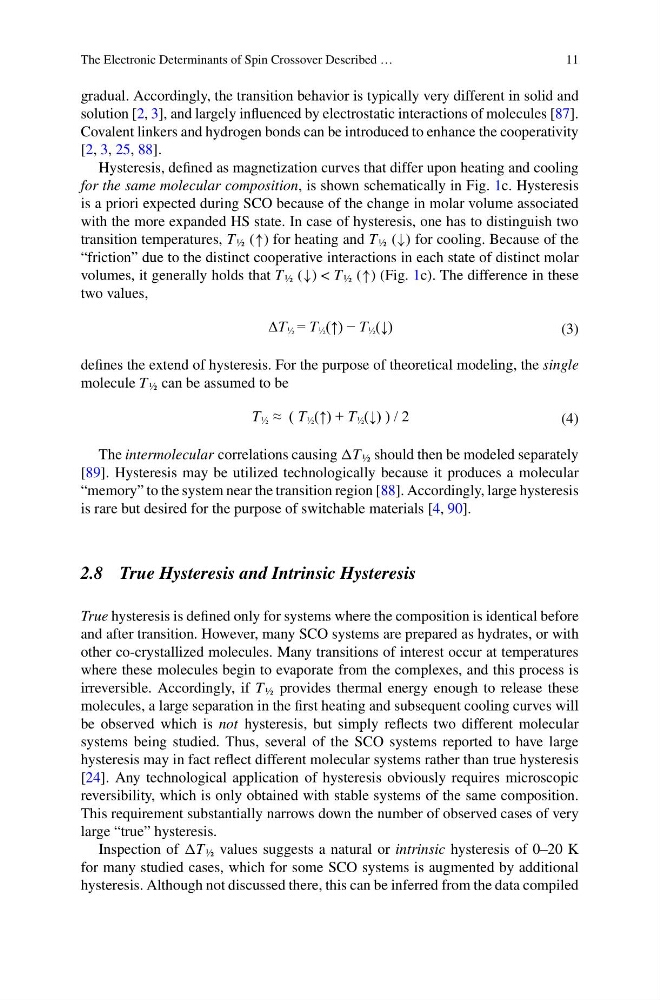
two values,
(3)
defines the extend of hysteresis. For the purpose of theoretical modeling, the single
molecule T ½ can be assumed to be
(4)
The intermolecular correlations causing T ½ should then be modeled separately
[89]. Hysteresis may be utilized technologically because it produces a molecular
“memory” to the system near the transition region [88]. Accordingly, large hysteresis
is rare but desired for the purpose of switchable materials [4, 90].
2.8 True Hysteresis and Intrinsic Hysteresis
True hysteresis is defined only for systems where the composition is identical before
and after transition. However, many SCO systems are prepared as hydrates, or with
other co-crystallized molecules. Many transitions of interest occur at temperatures
where these molecules begin to evaporate from the complexes, and this process is
irreversible. Accordingly, if T ½ provides thermal energy enough to release these
molecules, a large separation in the first heating and subsequent cooling curves will
be observed which is not hysteresis, but simply reflects two different molecular
systems being studied. Thus, several of the SCO systems reported to have large
hysteresis may in fact reflect different molecular systems rather than true hysteresis
[24]. Any technological application of hysteresis obviously requires microscopic
reversibility, which is only obtained with stable systems of the same composition.
This requirement substantially narrows down the number of observed cases of very
large “true” hysteresis.
Inspection of ½ values suggests a natural or intrinsic hysteresis of 0–20 K
for many studied cases, which for some SCO systems is augmented by additional
hysteresis. Although not discussed there, this can be inferred from the data compiled
11
gradual. Accordingly, the transition behavior is typically very different in solid and
solution [2, 3], and largely influenced by electrostatic interactions of molecules [87].
Covalent linkers and hydrogen bonds can be introduced to enhance the cooperativity
[2, 3, 25, 88].
Hysteresis, defined as magnetization curves that differ upon heating and cooling
for the same molecular composition, is shown schematically in Fig. 1c. Hysteresis
is a priori expected during SCO because of the change in molar volume associated
with the more expanded HS state. In case of hysteresis, one has to distinguish two
transition temperatures, T ½ (↑) for heating and T ½ (↓) for cooling. Because of the
“friction” due to the distinct cooperative interactions in each state of distinct molar
volumes, it generally holds that T ½ (↓) < T ½ (↑) (Fig. 1c). The difference in these
two values,
(3)
defines the extend of hysteresis. For the purpose of theoretical modeling, the single
molecule T ½ can be assumed to be
(4)
The intermolecular correlations causing T ½ should then be modeled separately
[89]. Hysteresis may be utilized technologically because it produces a molecular
“memory” to the system near the transition region [88]. Accordingly, large hysteresis
is rare but desired for the purpose of switchable materials [4, 90].
2.8 True Hysteresis and Intrinsic Hysteresis
True hysteresis is defined only for systems where the composition is identical before
and after transition. However, many SCO systems are prepared as hydrates, or with
other co-crystallized molecules. Many transitions of interest occur at temperatures
where these molecules begin to evaporate from the complexes, and this process is
irreversible. Accordingly, if T ½ provides thermal energy enough to release these
molecules, a large separation in the first heating and subsequent cooling curves will
be observed which is not hysteresis, but simply reflects two different molecular
systems being studied. Thus, several of the SCO systems reported to have large
hysteresis may in fact reflect different molecular systems rather than true hysteresis
[24]. Any technological application of hysteresis obviously requires microscopic
reversibility, which is only obtained with stable systems of the same composition.
This requirement substantially narrows down the number of observed cases of very
large “true” hysteresis.
Inspection of ½ values suggests a natural or intrinsic hysteresis of 0–20 K
for many studied cases, which for some SCO systems is augmented by additional
hysteresis. Although not discussed there, this can be inferred from the data compiled