

Assessing Electronically Excited States of Cobalamins …
253
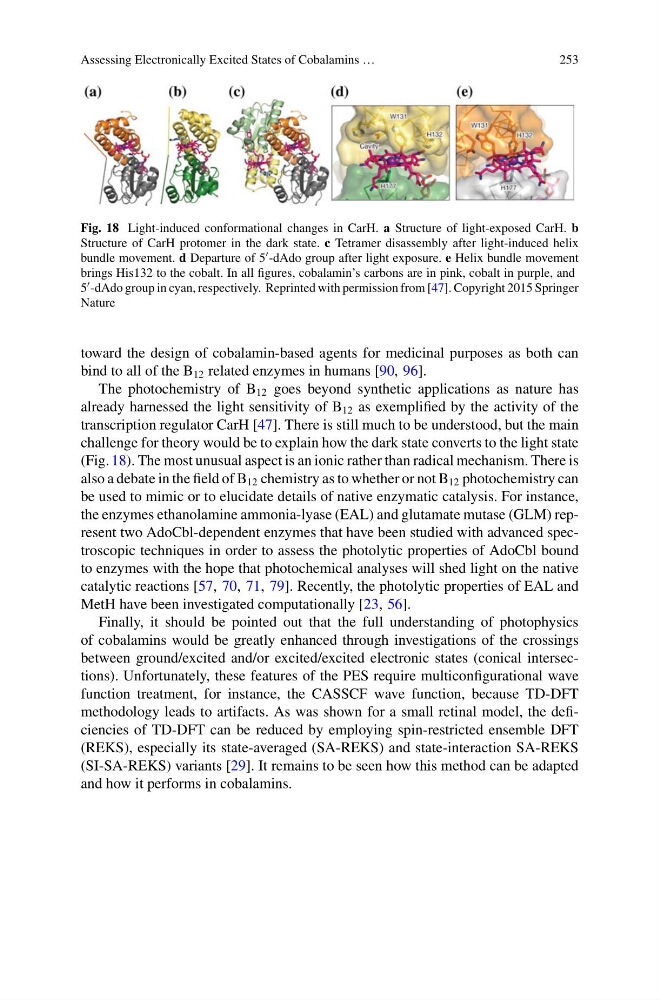
Fig. 18 Light-induced conformational changes in CarH. a Structure of light-exposed CarH. b
Structure of CarH protomer in the dark state. c Tetramer disassembly after light-induced helix
bundle movement. d Departure of 5 -dAdo group after light exposure. e Helix bundle movement
brings His132 to the cobalt. In all figures, cobalamin’s carbons are in pink, cobalt in purple, and
5 -dAdo group in cyan, respectively. Reprinted with permission from [47]. Copyright 2015 Springer
Nature
toward the design of cobalamin-based agents for medicinal purposes as both can
bind to all of the B 12 related enzymes in humans [90, 96].
The photochemistry of B 12 goes beyond synthetic applications as nature has
already harnessed the light sensitivity of B 12 as exemplified by the activity of the
transcription regulator CarH [47]. There is still much to be understood, but the main
challenge for theory would be to explain how the dark state converts to the light state
(Fig. 18). The most unusual aspect is an ionic rather than radical mechanism. There is
also a debate in the field of B 12 chemistry as to whether or not B 12 photochemistry can
be used to mimic or to elucidate details of native enzymatic catalysis. For instance,
the enzymes ethanolamine ammonia-lyase (EAL) and glutamate mutase (GLM) represent two AdoCbl-dependent enzymes that have been studied with advanced spectroscopic techniques in order to assess the photolytic properties of AdoCbl bound
to enzymes with the hope that photochemical analyses will shed light on the native
catalytic reactions [57, 70, 71, 79]. Recently, the photolytic properties of EAL and
MetH have been investigated computationally [23, 56].
Finally, it should be pointed out that the full understanding of photophysics
of cobalamins would be greatly enhanced through investigations of the crossings
between ground/excited and/or excited/excited electronic states (conical intersections). Unfortunately, these features of the PES require multiconfigurational wave
function treatment, for instance, the CASSCF wave function, because TD-DFT
methodology leads to artifacts. As was shown for a small retinal model, the deficiencies of TD-DFT can be reduced by employing spin-restricted ensemble DFT
(REKS), especially its state-averaged (SA-REKS) and state-interaction SA-REKS
(SI-SA-REKS) variants [29]. It remains to be seen how this method can be adapted
and how it performs in cobalamins.
253
Fig. 18 Light-induced conformational changes in CarH. a Structure of light-exposed CarH. b
Structure of CarH protomer in the dark state. c Tetramer disassembly after light-induced helix
bundle movement. d Departure of 5 -dAdo group after light exposure. e Helix bundle movement
brings His132 to the cobalt. In all figures, cobalamin’s carbons are in pink, cobalt in purple, and
5 -dAdo group in cyan, respectively. Reprinted with permission from [47]. Copyright 2015 Springer
Nature
toward the design of cobalamin-based agents for medicinal purposes as both can
bind to all of the B 12 related enzymes in humans [90, 96].
The photochemistry of B 12 goes beyond synthetic applications as nature has
already harnessed the light sensitivity of B 12 as exemplified by the activity of the
transcription regulator CarH [47]. There is still much to be understood, but the main
challenge for theory would be to explain how the dark state converts to the light state
(Fig. 18). The most unusual aspect is an ionic rather than radical mechanism. There is
also a debate in the field of B 12 chemistry as to whether or not B 12 photochemistry can
be used to mimic or to elucidate details of native enzymatic catalysis. For instance,
the enzymes ethanolamine ammonia-lyase (EAL) and glutamate mutase (GLM) represent two AdoCbl-dependent enzymes that have been studied with advanced spectroscopic techniques in order to assess the photolytic properties of AdoCbl bound
to enzymes with the hope that photochemical analyses will shed light on the native
catalytic reactions [57, 70, 71, 79]. Recently, the photolytic properties of EAL and
MetH have been investigated computationally [23, 56].
Finally, it should be pointed out that the full understanding of photophysics
of cobalamins would be greatly enhanced through investigations of the crossings
between ground/excited and/or excited/excited electronic states (conical intersections). Unfortunately, these features of the PES require multiconfigurational wave
function treatment, for instance, the CASSCF wave function, because TD-DFT
methodology leads to artifacts. As was shown for a small retinal model, the deficiencies of TD-DFT can be reduced by employing spin-restricted ensemble DFT
(REKS), especially its state-averaged (SA-REKS) and state-interaction SA-REKS
(SI-SA-REKS) variants [29]. It remains to be seen how this method can be adapted
and how it performs in cobalamins.