

Assessing Electronically Excited States of Cobalamins …
239
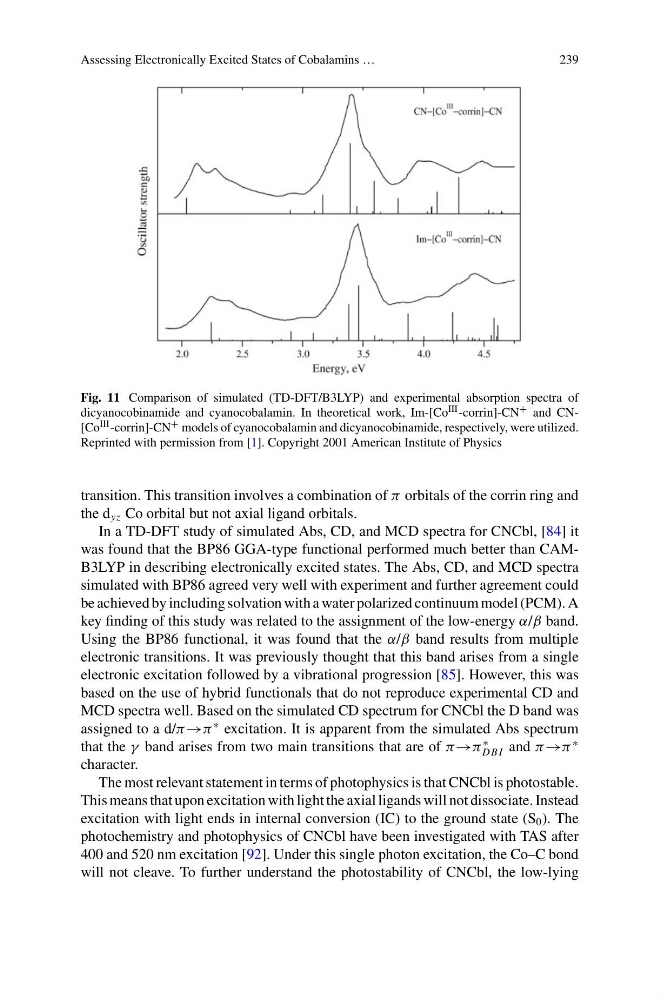
Fig. 11 Comparison of simulated (TD-DFT/B3LYP) and experimental absorption spectra of
dicyanocobinamide and cyanocobalamin. In theoretical work, Im-[Co III -corrin]-CN + and CN[Co III -corrin]-CN + models of cyanocobalamin and dicyanocobinamide, respectively, were utilized.
Reprinted with permission from [1]. Copyright 2001 American Institute of Physics
transition. This transition involves a combination of π orbitals of the corrin ring and
the d yz Co orbital but not axial ligand orbitals.
In a TD-DFT study of simulated Abs, CD, and MCD spectra for CNCbl, [84] it
was found that the BP86 GGA-type functional performed much better than CAMB3LYP in describing electronically excited states. The Abs, CD, and MCD spectra
simulated with BP86 agreed very well with experiment and further agreement could
be achieved by including solvation with a water polarized continuum model (PCM). A
key finding of this study was related to the assignment of the low-energy α/β band.
Using the BP86 functional, it was found that the α/β band results from multiple
electronic transitions. It was previously thought that this band arises from a single
electronic excitation followed by a vibrational progression [85]. However, this was
based on the use of hybrid functionals that do not reproduce experimental CD and
MCD spectra well. Based on the simulated CD spectrum for CNCbl the D band was
assigned to a d/π →π
∗ excitation. It is apparent from the simulated Abs spectrum
that the γ band arises from two main transitions that are of π →π
∗
D B I and π →π
∗
character.
The most relevant statement in terms of photophysics is that CNCbl is photostable.
This means that upon excitation with light the axial ligands will not dissociate. Instead
excitation with light ends in internal conversion (IC) to the ground state (S 0 ). The
photochemistry and photophysics of CNCbl have been investigated with TAS after
400 and 520 nm excitation [92]. Under this single photon excitation, the Co–C bond
will not cleave. To further understand the photostability of CNCbl, the low-lying
239
Fig. 11 Comparison of simulated (TD-DFT/B3LYP) and experimental absorption spectra of
dicyanocobinamide and cyanocobalamin. In theoretical work, Im-[Co III -corrin]-CN + and CN[Co III -corrin]-CN + models of cyanocobalamin and dicyanocobinamide, respectively, were utilized.
Reprinted with permission from [1]. Copyright 2001 American Institute of Physics
transition. This transition involves a combination of π orbitals of the corrin ring and
the d yz Co orbital but not axial ligand orbitals.
In a TD-DFT study of simulated Abs, CD, and MCD spectra for CNCbl, [84] it
was found that the BP86 GGA-type functional performed much better than CAMB3LYP in describing electronically excited states. The Abs, CD, and MCD spectra
simulated with BP86 agreed very well with experiment and further agreement could
be achieved by including solvation with a water polarized continuum model (PCM). A
key finding of this study was related to the assignment of the low-energy α/β band.
Using the BP86 functional, it was found that the α/β band results from multiple
electronic transitions. It was previously thought that this band arises from a single
electronic excitation followed by a vibrational progression [85]. However, this was
based on the use of hybrid functionals that do not reproduce experimental CD and
MCD spectra well. Based on the simulated CD spectrum for CNCbl the D band was
assigned to a d/π →π
∗ excitation. It is apparent from the simulated Abs spectrum
that the γ band arises from two main transitions that are of π →π
∗
D B I and π →π
∗
character.
The most relevant statement in terms of photophysics is that CNCbl is photostable.
This means that upon excitation with light the axial ligands will not dissociate. Instead
excitation with light ends in internal conversion (IC) to the ground state (S 0 ). The
photochemistry and photophysics of CNCbl have been investigated with TAS after
400 and 520 nm excitation [92]. Under this single photon excitation, the Co–C bond
will not cleave. To further understand the photostability of CNCbl, the low-lying