

The Electronic Determinants of Spin Crossover Described …
9
2.6 Geometry Preferences and Changes During SCO
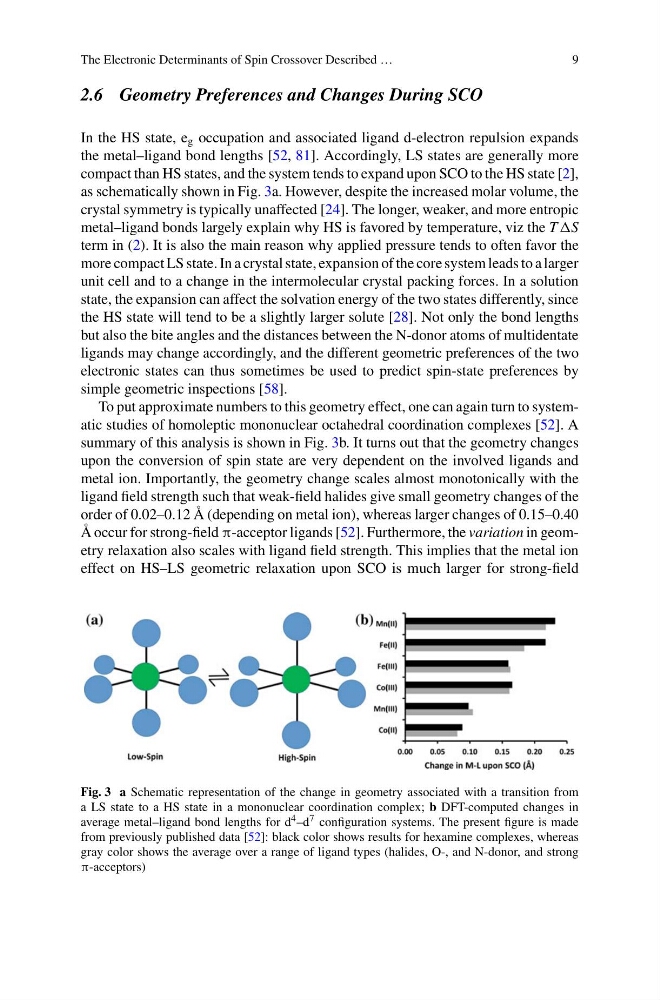
In the HS state, e g occupation and associated ligand d-electron repulsion expands
the metal–ligand bond lengths [52, 81]. Accordingly, LS states are generally more
compact than HS states, and the system tends to expand upon SCO to the HS state [2],
as schematically shown in Fig. 3a. However, despite the increased molar volume, the
crystal symmetry is typically unaffected [24]. The longer, weaker, and more entropic
metal–ligand bonds largely explain why HS is favored by temperature, viz the T S
term in (2). It is also the main reason why applied pressure tends to often favor the
more compact LS state. In a crystal state, expansion of the core system leads to a larger
unit cell and to a change in the intermolecular crystal packing forces. In a solution
state, the expansion can affect the solvation energy of the two states differently, since
the HS state will tend to be a slightly larger solute [28]. Not only the bond lengths
but also the bite angles and the distances between the N-donor atoms of multidentate
ligands may change accordingly, and the different geometric preferences of the two
electronic states can thus sometimes be used to predict spin-state preferences by
simple geometric inspections [58].
To put approximate numbers to this geometry effect, one can again turn to systematic studies of homoleptic mononuclear octahedral coordination complexes [52]. A
summary of this analysis is shown in Fig. 3b. It turns out that the geometry changes
upon the conversion of spin state are very dependent on the involved ligands and
metal ion. Importantly, the geometry change scales almost monotonically with the
ligand field strength such that weak-field halides give small geometry changes of the
order of 0.02–0.12 Å (depending on metal ion), whereas larger changes of 0.15–0.40
Å occur for strong-field π-acceptor ligands [52]. Furthermore, the variation in geometry relaxation also scales with ligand field strength. This implies that the metal ion
effect on HS–LS geometric relaxation upon SCO is much larger for strong-field
Fig. 3 a Schematic representation of the change in geometry associated with a transition from
a LS state to a HS state in a mononuclear coordination complex; b DFT-computed changes in
average metal–ligand bond lengths for d 4 –d 7 configuration systems. The present figure is made
from previously published data [52]: black color shows results for hexamine complexes, whereas
gray color shows the average over a range of ligand types (halides, O-, and N-donor, and strong
π-acceptors)
9
2.6 Geometry Preferences and Changes During SCO
In the HS state, e g occupation and associated ligand d-electron repulsion expands
the metal–ligand bond lengths [52, 81]. Accordingly, LS states are generally more
compact than HS states, and the system tends to expand upon SCO to the HS state [2],
as schematically shown in Fig. 3a. However, despite the increased molar volume, the
crystal symmetry is typically unaffected [24]. The longer, weaker, and more entropic
metal–ligand bonds largely explain why HS is favored by temperature, viz the T S
term in (2). It is also the main reason why applied pressure tends to often favor the
more compact LS state. In a crystal state, expansion of the core system leads to a larger
unit cell and to a change in the intermolecular crystal packing forces. In a solution
state, the expansion can affect the solvation energy of the two states differently, since
the HS state will tend to be a slightly larger solute [28]. Not only the bond lengths
but also the bite angles and the distances between the N-donor atoms of multidentate
ligands may change accordingly, and the different geometric preferences of the two
electronic states can thus sometimes be used to predict spin-state preferences by
simple geometric inspections [58].
To put approximate numbers to this geometry effect, one can again turn to systematic studies of homoleptic mononuclear octahedral coordination complexes [52]. A
summary of this analysis is shown in Fig. 3b. It turns out that the geometry changes
upon the conversion of spin state are very dependent on the involved ligands and
metal ion. Importantly, the geometry change scales almost monotonically with the
ligand field strength such that weak-field halides give small geometry changes of the
order of 0.02–0.12 Å (depending on metal ion), whereas larger changes of 0.15–0.40
Å occur for strong-field π-acceptor ligands [52]. Furthermore, the variation in geometry relaxation also scales with ligand field strength. This implies that the metal ion
effect on HS–LS geometric relaxation upon SCO is much larger for strong-field
Fig. 3 a Schematic representation of the change in geometry associated with a transition from
a LS state to a HS state in a mononuclear coordination complex; b DFT-computed changes in
average metal–ligand bond lengths for d 4 –d 7 configuration systems. The present figure is made
from previously published data [52]: black color shows results for hexamine complexes, whereas
gray color shows the average over a range of ligand types (halides, O-, and N-donor, and strong
π-acceptors)