

The Electronic Determinants of Spin Crossover Described …
7
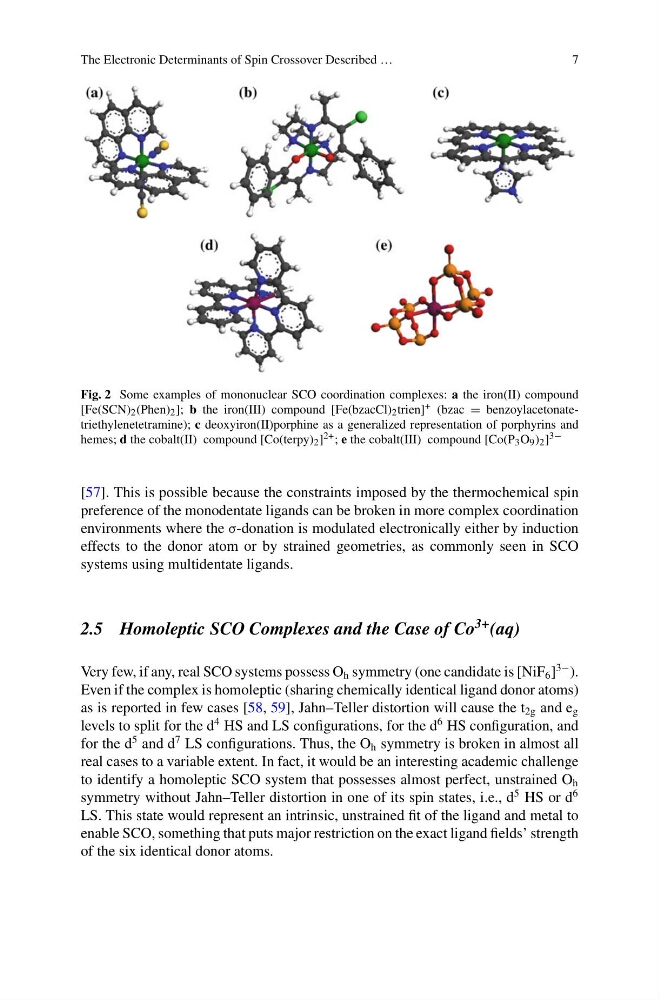
Fig. 2 Some examples of mononuclear SCO coordination complexes: a the iron(II) compound
[Fe(SCN) 2 (Phen) 2 ]; b the iron(III) compound [Fe(bzacCl) 2 trien] + (bzac benzoylacetonatetriethylenetetramine); c deoxyiron(II)porphine as a generalized representation of porphyrins and
hemes; d the cobalt(II) compound [Co(terpy) 2 ] 2+ ; e the cobalt(III) compound [Co(P 3 O 9 ) 2 ] 3−
[57]. This is possible because the constraints imposed by the thermochemical spin
preference of the monodentate ligands can be broken in more complex coordination
environments where the σ-donation is modulated electronically either by induction
effects to the donor atom or by strained geometries, as commonly seen in SCO
systems using multidentate ligands.
2.5 Homoleptic SCO Complexes and the Case of Co 3+ (aq)
Very few, if any, real SCO systems possess O h symmetry (one candidate is [NiF 6 ]
3− ).
Even if the complex is homoleptic (sharing chemically identical ligand donor atoms)
as is reported in few cases [58, 59], Jahn–Teller distortion will cause the t 2g and e g
levels to split for the d
4 HS and LS configurations, for the d
6 HS configuration, and
for the d
5 and d
7 LS configurations. Thus, the O h symmetry is broken in almost all
real cases to a variable extent. In fact, it would be an interesting academic challenge
to identify a homoleptic SCO system that possesses almost perfect, unstrained O h
symmetry without Jahn–Teller distortion in one of its spin states, i.e., d
5 HS or d
6
LS. This state would represent an intrinsic, unstrained fit of the ligand and metal to
enable SCO, something that puts major restriction on the exact ligand fields’ strength
of the six identical donor atoms.
7
Fig. 2 Some examples of mononuclear SCO coordination complexes: a the iron(II) compound
[Fe(SCN) 2 (Phen) 2 ]; b the iron(III) compound [Fe(bzacCl) 2 trien] + (bzac benzoylacetonatetriethylenetetramine); c deoxyiron(II)porphine as a generalized representation of porphyrins and
hemes; d the cobalt(II) compound [Co(terpy) 2 ] 2+ ; e the cobalt(III) compound [Co(P 3 O 9 ) 2 ] 3−
[57]. This is possible because the constraints imposed by the thermochemical spin
preference of the monodentate ligands can be broken in more complex coordination
environments where the σ-donation is modulated electronically either by induction
effects to the donor atom or by strained geometries, as commonly seen in SCO
systems using multidentate ligands.
2.5 Homoleptic SCO Complexes and the Case of Co 3+ (aq)
Very few, if any, real SCO systems possess O h symmetry (one candidate is [NiF 6 ]
3− ).
Even if the complex is homoleptic (sharing chemically identical ligand donor atoms)
as is reported in few cases [58, 59], Jahn–Teller distortion will cause the t 2g and e g
levels to split for the d
4 HS and LS configurations, for the d
6 HS configuration, and
for the d
5 and d
7 LS configurations. Thus, the O h symmetry is broken in almost all
real cases to a variable extent. In fact, it would be an interesting academic challenge
to identify a homoleptic SCO system that possesses almost perfect, unstrained O h
symmetry without Jahn–Teller distortion in one of its spin states, i.e., d
5 HS or d
6
LS. This state would represent an intrinsic, unstrained fit of the ligand and metal to
enable SCO, something that puts major restriction on the exact ligand fields’ strength
of the six identical donor atoms.