

208
M. Lundberg and M. G. Delcey
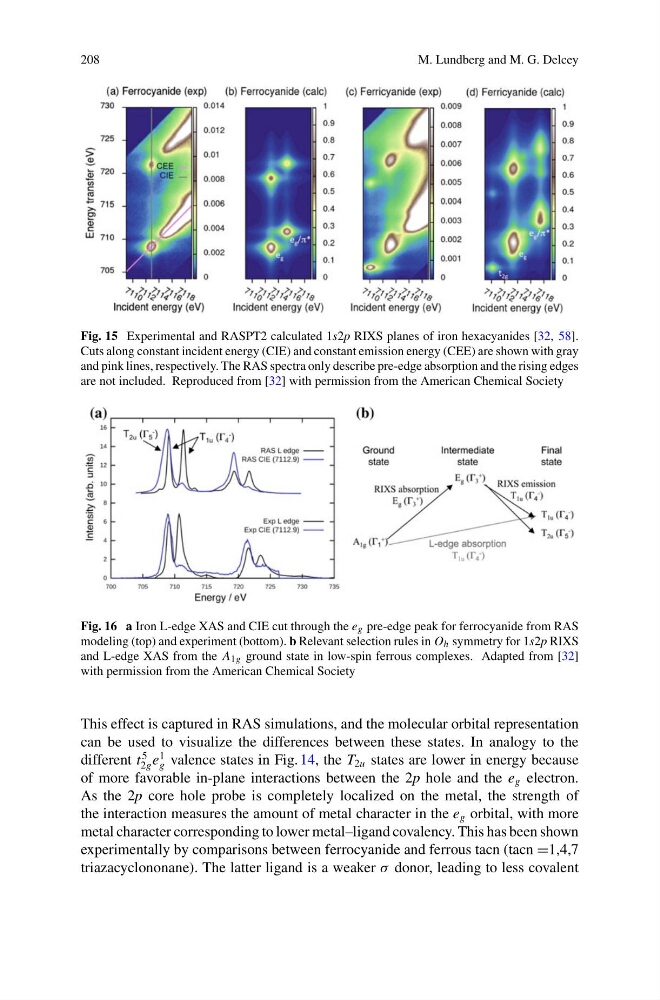
Fig. 15 Experimental and RASPT2 calculated 1s2p RIXS planes of iron hexacyanides [32, 58].
Cuts along constant incident energy (CIE) and constant emission energy (CEE) are shown with gray
and pink lines, respectively. The RAS spectra only describe pre-edge absorption and the rising edges
are not included. Reproduced from [32] with permission from the American Chemical Society
Fig. 16 a Iron L-edge XAS and CIE cut through the e g pre-edge peak for ferrocyanide from RAS
modeling (top) and experiment (bottom). b Relevant selection rules in O h symmetry for 1s2p RIXS
and L-edge XAS from the A 1g ground state in low-spin ferrous complexes. Adapted from [32]
with permission from the American Chemical Society
This effect is captured in RAS simulations, and the molecular orbital representation
can be used to visualize the differences between these states. In analogy to the
different t
5
2g e
1
g valence states in Fig. 14, the T 2u states are lower in energy because
of more favorable in-plane interactions between the 2p hole and the e g electron.
As the 2p core hole probe is completely localized on the metal, the strength of
the interaction measures the amount of metal character in the e g orbital, with more
metal character corresponding to lower metal–ligand covalency. This has been shown
experimentally by comparisons between ferrocyanide and ferrous tacn (tacn =1,4,7
triazacyclononane). The latter ligand is a weaker σ donor, leading to less covalent
M. Lundberg and M. G. Delcey
Fig. 15 Experimental and RASPT2 calculated 1s2p RIXS planes of iron hexacyanides [32, 58].
Cuts along constant incident energy (CIE) and constant emission energy (CEE) are shown with gray
and pink lines, respectively. The RAS spectra only describe pre-edge absorption and the rising edges
are not included. Reproduced from [32] with permission from the American Chemical Society
Fig. 16 a Iron L-edge XAS and CIE cut through the e g pre-edge peak for ferrocyanide from RAS
modeling (top) and experiment (bottom). b Relevant selection rules in O h symmetry for 1s2p RIXS
and L-edge XAS from the A 1g ground state in low-spin ferrous complexes. Adapted from [32]
with permission from the American Chemical Society
This effect is captured in RAS simulations, and the molecular orbital representation
can be used to visualize the differences between these states. In analogy to the
different t
5
2g e
1
g valence states in Fig. 14, the T 2u states are lower in energy because
of more favorable in-plane interactions between the 2p hole and the e g electron.
As the 2p core hole probe is completely localized on the metal, the strength of
the interaction measures the amount of metal character in the e g orbital, with more
metal character corresponding to lower metal–ligand covalency. This has been shown
experimentally by comparisons between ferrocyanide and ferrous tacn (tacn =1,4,7
triazacyclononane). The latter ligand is a weaker σ donor, leading to less covalent