

4
K. P. Kepp
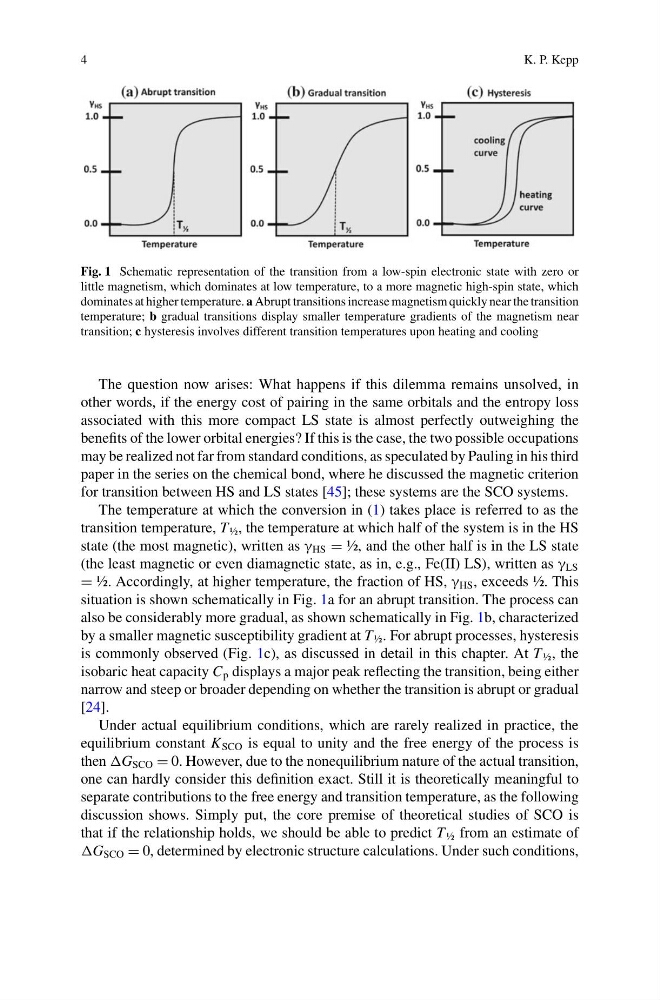
Fig. 1 Schematic representation of the transition from a low-spin electronic state with zero or
little magnetism, which dominates at low temperature, to a more magnetic high-spin state, which
dominates at higher temperature. a Abrupt transitions increase magnetism quickly near the transition
temperature; b gradual transitions display smaller temperature gradients of the magnetism near
transition; c hysteresis involves different transition temperatures upon heating and cooling
The question now arises: What happens if this dilemma remains unsolved, in
other words, if the energy cost of pairing in the same orbitals and the entropy loss
associated with this more compact LS state is almost perfectly outweighing the
benefits of the lower orbital energies? If this is the case, the two possible occupations
may be realized not far from standard conditions, as speculated by Pauling in his third
paper in the series on the chemical bond, where he discussed the magnetic criterion
for transition between HS and LS states [45]; these systems are the SCO systems.
The temperature at which the conversion in (1) takes place is referred to as the
transition temperature, T ½ , the temperature at which half of the system is in the HS
state (the most magnetic), written as γ HS ½, and the other half is in the LS state
(the least magnetic or even diamagnetic state, as in, e.g., Fe(II) LS), written as γ LS
½. Accordingly, at higher temperature, the fraction of HS, γ HS , exceeds ½. This
situation is shown schematically in Fig. 1a for an abrupt transition. The process can
also be considerably more gradual, as shown schematically in Fig. 1b, characterized
by a smaller magnetic susceptibility gradient at T ½ . For abrupt processes, hysteresis
is commonly observed (Fig. 1c), as discussed in detail in this chapter. At T ½ , the
isobaric heat capacity C p displays a major peak reflecting the transition, being either
narrow and steep or broader depending on whether the transition is abrupt or gradual
[24].
Under actual equilibrium conditions, which are rarely realized in practice, the
equilibrium constant K SCO is equal to unity and the free energy of the process is
then G SCO 0. However, due to the nonequilibrium nature of the actual transition,
one can hardly consider this definition exact. Still it is theoretically meaningful to
separate contributions to the free energy and transition temperature, as the following
discussion shows. Simply put, the core premise of theoretical studies of SCO is
that if the relationship holds, we should be able to predict T ½ from an estimate of
G SCO 0, determined by electronic structure calculations. Under such conditions,
K. P. Kepp
Fig. 1 Schematic representation of the transition from a low-spin electronic state with zero or
little magnetism, which dominates at low temperature, to a more magnetic high-spin state, which
dominates at higher temperature. a Abrupt transitions increase magnetism quickly near the transition
temperature; b gradual transitions display smaller temperature gradients of the magnetism near
transition; c hysteresis involves different transition temperatures upon heating and cooling
The question now arises: What happens if this dilemma remains unsolved, in
other words, if the energy cost of pairing in the same orbitals and the entropy loss
associated with this more compact LS state is almost perfectly outweighing the
benefits of the lower orbital energies? If this is the case, the two possible occupations
may be realized not far from standard conditions, as speculated by Pauling in his third
paper in the series on the chemical bond, where he discussed the magnetic criterion
for transition between HS and LS states [45]; these systems are the SCO systems.
The temperature at which the conversion in (1) takes place is referred to as the
transition temperature, T ½ , the temperature at which half of the system is in the HS
state (the most magnetic), written as γ HS ½, and the other half is in the LS state
(the least magnetic or even diamagnetic state, as in, e.g., Fe(II) LS), written as γ LS
½. Accordingly, at higher temperature, the fraction of HS, γ HS , exceeds ½. This
situation is shown schematically in Fig. 1a for an abrupt transition. The process can
also be considerably more gradual, as shown schematically in Fig. 1b, characterized
by a smaller magnetic susceptibility gradient at T ½ . For abrupt processes, hysteresis
is commonly observed (Fig. 1c), as discussed in detail in this chapter. At T ½ , the
isobaric heat capacity C p displays a major peak reflecting the transition, being either
narrow and steep or broader depending on whether the transition is abrupt or gradual
[24].
Under actual equilibrium conditions, which are rarely realized in practice, the
equilibrium constant K SCO is equal to unity and the free energy of the process is
then G SCO 0. However, due to the nonequilibrium nature of the actual transition,
one can hardly consider this definition exact. Still it is theoretically meaningful to
separate contributions to the free energy and transition temperature, as the following
discussion shows. Simply put, the core premise of theoretical studies of SCO is
that if the relationship holds, we should be able to predict T ½ from an estimate of
G SCO 0, determined by electronic structure calculations. Under such conditions,