

178
M. Gruden et al.
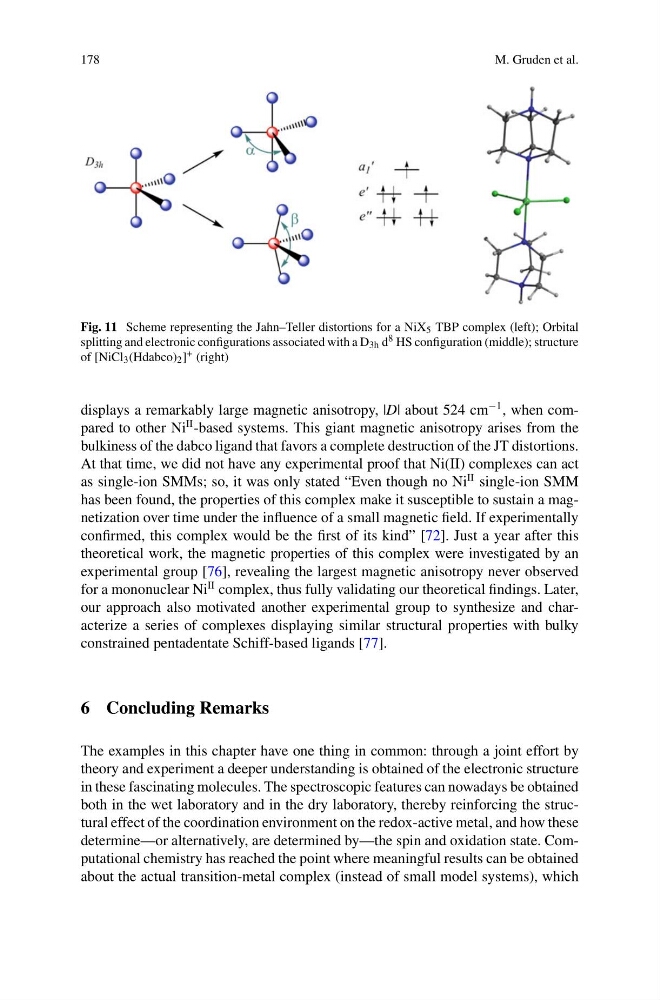
Fig. 11 Scheme representing the Jahn–Teller distortions for a NiX 5 TBP complex (left); Orbital
splitting and electronic configurations associated with a D 3h d 8 HS configuration (middle); structure
of [NiCl 3 (Hdabco) 2 ] + (right)
displays a remarkably large magnetic anisotropy, |D| about 524 cm
−1 , when compared to other Ni
II -based systems. This giant magnetic anisotropy arises from the
bulkiness of the dabco ligand that favors a complete destruction of the JT distortions.
At that time, we did not have any experimental proof that Ni(II) complexes can act
as single-ion SMMs; so, it was only stated “Even though no Ni
II single-ion SMM
has been found, the properties of this complex make it susceptible to sustain a magnetization over time under the influence of a small magnetic field. If experimentally
confirmed, this complex would be the first of its kind” [72]. Just a year after this
theoretical work, the magnetic properties of this complex were investigated by an
experimental group [76], revealing the largest magnetic anisotropy never observed
for a mononuclear Ni
II complex, thus fully validating our theoretical findings. Later,
our approach also motivated another experimental group to synthesize and characterize a series of complexes displaying similar structural properties with bulky
constrained pentadentate Schiff-based ligands [77].
6 Concluding Remarks
The examples in this chapter have one thing in common: through a joint effort by
theory and experiment a deeper understanding is obtained of the electronic structure
in these fascinating molecules. The spectroscopic features can nowadays be obtained
both in the wet laboratory and in the dry laboratory, thereby reinforcing the structural effect of the coordination environment on the redox-active metal, and how these
determine—or alternatively, are determined by—the spin and oxidation state. Computational chemistry has reached the point where meaningful results can be obtained
about the actual transition-metal complex (instead of small model systems), which
M. Gruden et al.
Fig. 11 Scheme representing the Jahn–Teller distortions for a NiX 5 TBP complex (left); Orbital
splitting and electronic configurations associated with a D 3h d 8 HS configuration (middle); structure
of [NiCl 3 (Hdabco) 2 ] + (right)
displays a remarkably large magnetic anisotropy, |D| about 524 cm
−1 , when compared to other Ni
II -based systems. This giant magnetic anisotropy arises from the
bulkiness of the dabco ligand that favors a complete destruction of the JT distortions.
At that time, we did not have any experimental proof that Ni(II) complexes can act
as single-ion SMMs; so, it was only stated “Even though no Ni
II single-ion SMM
has been found, the properties of this complex make it susceptible to sustain a magnetization over time under the influence of a small magnetic field. If experimentally
confirmed, this complex would be the first of its kind” [72]. Just a year after this
theoretical work, the magnetic properties of this complex were investigated by an
experimental group [76], revealing the largest magnetic anisotropy never observed
for a mononuclear Ni
II complex, thus fully validating our theoretical findings. Later,
our approach also motivated another experimental group to synthesize and characterize a series of complexes displaying similar structural properties with bulky
constrained pentadentate Schiff-based ligands [77].
6 Concluding Remarks
The examples in this chapter have one thing in common: through a joint effort by
theory and experiment a deeper understanding is obtained of the electronic structure
in these fascinating molecules. The spectroscopic features can nowadays be obtained
both in the wet laboratory and in the dry laboratory, thereby reinforcing the structural effect of the coordination environment on the redox-active metal, and how these
determine—or alternatively, are determined by—the spin and oxidation state. Computational chemistry has reached the point where meaningful results can be obtained
about the actual transition-metal complex (instead of small model systems), which