

2
K. P. Kepp
processes via the management of
3 O 2 by hemes [12–14]. They are also important to
many emerging technologies [1, 3], as they manifest as two distinct quantum states
that can be interconverted by external stimuli. This makes them suitable for, e.g.,
molecular electronics [3, 15–17], sensors [18–20], and nano-mechanical behavior
such as molecular motors [3, 7, 21–27].
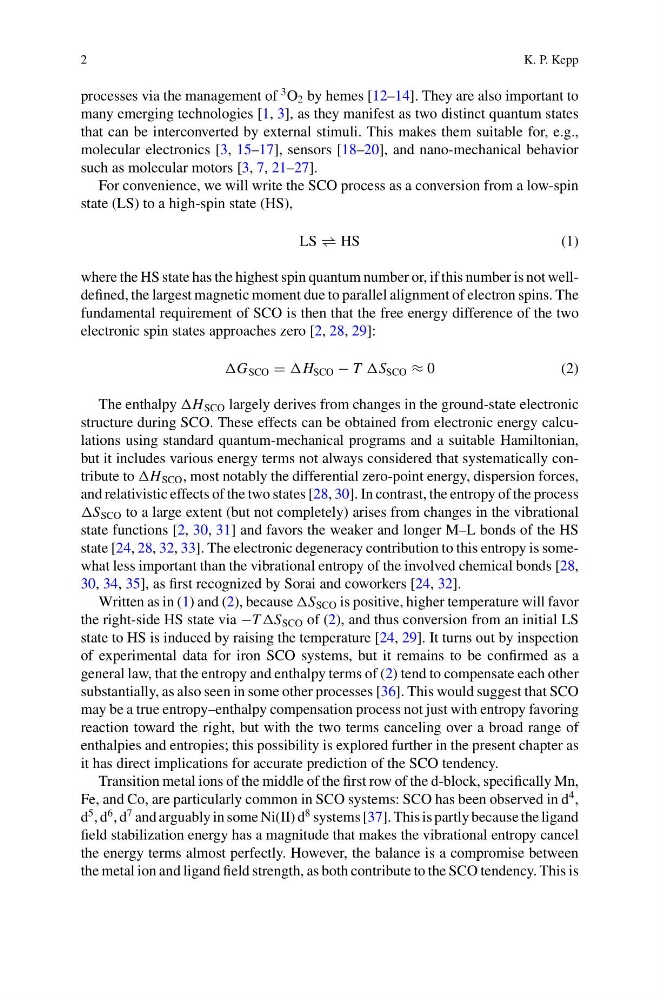
For convenience, we will write the SCO process as a conversion from a low-spin
state (LS) to a high-spin state (HS),
LS HS
(1)
where the HS state has the highest spin quantum number or, if this number is not welldefined, the largest magnetic moment due to parallel alignment of electron spins. The
fundamental requirement of SCO is then that the free energy difference of the two
electronic spin states approaches zero [2, 28, 29]:
G SCO H SCO − T S SCO ≈ 0
( 2 )
The enthalpy H SCO largely derives from changes in the ground-state electronic
structure during SCO. These effects can be obtained from electronic energy calculations using standard quantum-mechanical programs and a suitable Hamiltonian,
but it includes various energy terms not always considered that systematically contribute to H SCO , most notably the differential zero-point energy, dispersion forces,
and relativistic effects of the two states [28, 30]. In contrast, the entropy of the process
S SCO to a large extent (but not completely) arises from changes in the vibrational
state functions [2, 30, 31] and favors the weaker and longer M–L bonds of the HS
state [24, 28, 32, 33]. The electronic degeneracy contribution to this entropy is somewhat less important than the vibrational entropy of the involved chemical bonds [28,
30, 34, 35], as first recognized by Sorai and coworkers [24, 32].
Written as in (1) and (2), because S SCO is positive, higher temperature will favor
the right-side HS state via −T S SCO of (2), and thus conversion from an initial LS
state to HS is induced by raising the temperature [24, 29]. It turns out by inspection
of experimental data for iron SCO systems, but it remains to be confirmed as a
general law, that the entropy and enthalpy terms of (2) tend to compensate each other
substantially, as also seen in some other processes [36]. This would suggest that SCO
may be a true entropy–enthalpy compensation process not just with entropy favoring
reaction toward the right, but with the two terms canceling over a broad range of
enthalpies and entropies; this possibility is explored further in the present chapter as
it has direct implications for accurate prediction of the SCO tendency.
Transition metal ions of the middle of the first row of the d-block, specifically Mn,
Fe, and Co, are particularly common in SCO systems: SCO has been observed in d
4 ,
d
5 , d
6 , d
7 and arguably in some Ni(II) d
8 systems [37]. This is partly because the ligand
field stabilization energy has a magnitude that makes the vibrational entropy cancel
the energy terms almost perfectly. However, the balance is a compromise between
the metal ion and ligand field strength, as both contribute to the SCO tendency. This is
K. P. Kepp
processes via the management of
3 O 2 by hemes [12–14]. They are also important to
many emerging technologies [1, 3], as they manifest as two distinct quantum states
that can be interconverted by external stimuli. This makes them suitable for, e.g.,
molecular electronics [3, 15–17], sensors [18–20], and nano-mechanical behavior
such as molecular motors [3, 7, 21–27].
For convenience, we will write the SCO process as a conversion from a low-spin
state (LS) to a high-spin state (HS),
LS HS
(1)
where the HS state has the highest spin quantum number or, if this number is not welldefined, the largest magnetic moment due to parallel alignment of electron spins. The
fundamental requirement of SCO is then that the free energy difference of the two
electronic spin states approaches zero [2, 28, 29]:
G SCO H SCO − T S SCO ≈ 0
( 2 )
The enthalpy H SCO largely derives from changes in the ground-state electronic
structure during SCO. These effects can be obtained from electronic energy calculations using standard quantum-mechanical programs and a suitable Hamiltonian,
but it includes various energy terms not always considered that systematically contribute to H SCO , most notably the differential zero-point energy, dispersion forces,
and relativistic effects of the two states [28, 30]. In contrast, the entropy of the process
S SCO to a large extent (but not completely) arises from changes in the vibrational
state functions [2, 30, 31] and favors the weaker and longer M–L bonds of the HS
state [24, 28, 32, 33]. The electronic degeneracy contribution to this entropy is somewhat less important than the vibrational entropy of the involved chemical bonds [28,
30, 34, 35], as first recognized by Sorai and coworkers [24, 32].
Written as in (1) and (2), because S SCO is positive, higher temperature will favor
the right-side HS state via −T S SCO of (2), and thus conversion from an initial LS
state to HS is induced by raising the temperature [24, 29]. It turns out by inspection
of experimental data for iron SCO systems, but it remains to be confirmed as a
general law, that the entropy and enthalpy terms of (2) tend to compensate each other
substantially, as also seen in some other processes [36]. This would suggest that SCO
may be a true entropy–enthalpy compensation process not just with entropy favoring
reaction toward the right, but with the two terms canceling over a broad range of
enthalpies and entropies; this possibility is explored further in the present chapter as
it has direct implications for accurate prediction of the SCO tendency.
Transition metal ions of the middle of the first row of the d-block, specifically Mn,
Fe, and Co, are particularly common in SCO systems: SCO has been observed in d
4 ,
d
5 , d
6 , d
7 and arguably in some Ni(II) d
8 systems [37]. This is partly because the ligand
field stabilization energy has a magnitude that makes the vibrational entropy cancel
the energy terms almost perfectly. However, the balance is a compromise between
the metal ion and ligand field strength, as both contribute to the SCO tendency. This is