

Computational Versus Experimental Spectroscopy …
163
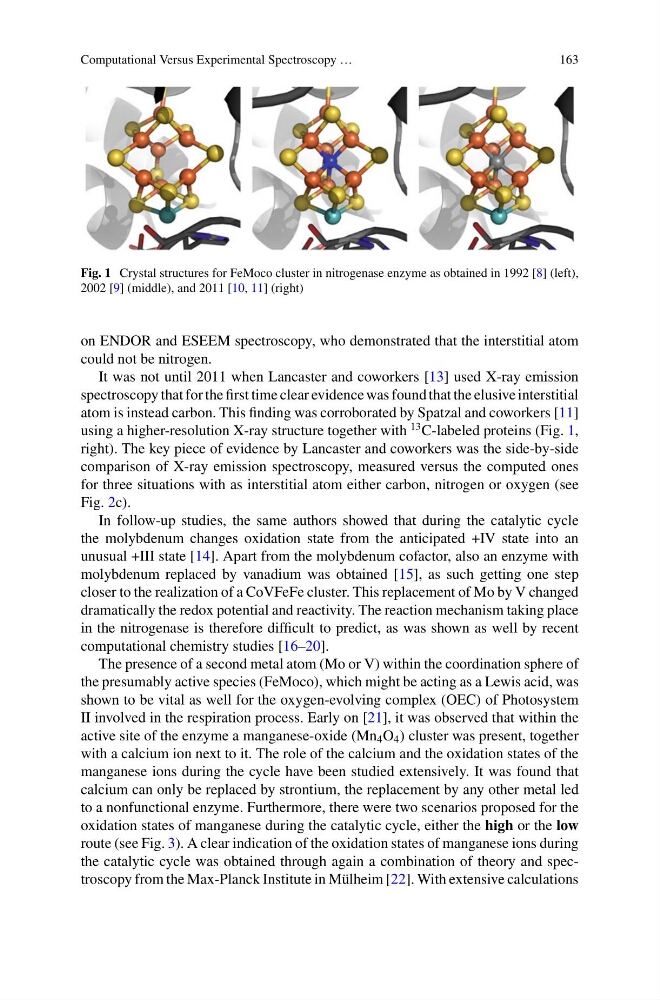
Fig. 1 Crystal structures for FeMoco cluster in nitrogenase enzyme as obtained in 1992 [8] (left),
2002 [9] (middle), and 2011 [10, 11] (right)
on ENDOR and ESEEM spectroscopy, who demonstrated that the interstitial atom
could not be nitrogen.
It was not until 2011 when Lancaster and coworkers [13] used X-ray emission
spectroscopy that for the first time clear evidence was found that the elusive interstitial
atom is instead carbon. This finding was corroborated by Spatzal and coworkers [11]
using a higher-resolution X-ray structure together with
13 C-labeled proteins (Fig. 1,
right). The key piece of evidence by Lancaster and coworkers was the side-by-side
comparison of X-ray emission spectroscopy, measured versus the computed ones
for three situations with as interstitial atom either carbon, nitrogen or oxygen (see
Fig. 2c).
In follow-up studies, the same authors showed that during the catalytic cycle
the molybdenum changes oxidation state from the anticipated +IV state into an
unusual +III state [14]. Apart from the molybdenum cofactor, also an enzyme with
molybdenum replaced by vanadium was obtained [15], as such getting one step
closer to the realization of a CoVFeFe cluster. This replacement of Mo by V changed
dramatically the redox potential and reactivity. The reaction mechanism taking place
in the nitrogenase is therefore difficult to predict, as was shown as well by recent
computational chemistry studies [16–20].
The presence of a second metal atom (Mo or V) within the coordination sphere of
the presumably active species (FeMoco), which might be acting as a Lewis acid, was
shown to be vital as well for the oxygen-evolving complex (OEC) of Photosystem
II involved in the respiration process. Early on [21], it was observed that within the
active site of the enzyme a manganese-oxide (Mn 4 O 4 ) cluster was present, together
with a calcium ion next to it. The role of the calcium and the oxidation states of the
manganese ions during the cycle have been studied extensively. It was found that
calcium can only be replaced by strontium, the replacement by any other metal led
to a nonfunctional enzyme. Furthermore, there were two scenarios proposed for the
oxidation states of manganese during the catalytic cycle, either the high or the low
route (see Fig. 3). A clear indication of the oxidation states of manganese ions during
the catalytic cycle was obtained through again a combination of theory and spectroscopy from the Max-Planck Institute in Mülheim [22]. With extensive calculations
163
Fig. 1 Crystal structures for FeMoco cluster in nitrogenase enzyme as obtained in 1992 [8] (left),
2002 [9] (middle), and 2011 [10, 11] (right)
on ENDOR and ESEEM spectroscopy, who demonstrated that the interstitial atom
could not be nitrogen.
It was not until 2011 when Lancaster and coworkers [13] used X-ray emission
spectroscopy that for the first time clear evidence was found that the elusive interstitial
atom is instead carbon. This finding was corroborated by Spatzal and coworkers [11]
using a higher-resolution X-ray structure together with
13 C-labeled proteins (Fig. 1,
right). The key piece of evidence by Lancaster and coworkers was the side-by-side
comparison of X-ray emission spectroscopy, measured versus the computed ones
for three situations with as interstitial atom either carbon, nitrogen or oxygen (see
Fig. 2c).
In follow-up studies, the same authors showed that during the catalytic cycle
the molybdenum changes oxidation state from the anticipated +IV state into an
unusual +III state [14]. Apart from the molybdenum cofactor, also an enzyme with
molybdenum replaced by vanadium was obtained [15], as such getting one step
closer to the realization of a CoVFeFe cluster. This replacement of Mo by V changed
dramatically the redox potential and reactivity. The reaction mechanism taking place
in the nitrogenase is therefore difficult to predict, as was shown as well by recent
computational chemistry studies [16–20].
The presence of a second metal atom (Mo or V) within the coordination sphere of
the presumably active species (FeMoco), which might be acting as a Lewis acid, was
shown to be vital as well for the oxygen-evolving complex (OEC) of Photosystem
II involved in the respiration process. Early on [21], it was observed that within the
active site of the enzyme a manganese-oxide (Mn 4 O 4 ) cluster was present, together
with a calcium ion next to it. The role of the calcium and the oxidation states of the
manganese ions during the cycle have been studied extensively. It was found that
calcium can only be replaced by strontium, the replacement by any other metal led
to a nonfunctional enzyme. Furthermore, there were two scenarios proposed for the
oxidation states of manganese during the catalytic cycle, either the high or the low
route (see Fig. 3). A clear indication of the oxidation states of manganese ions during
the catalytic cycle was obtained through again a combination of theory and spectroscopy from the Max-Planck Institute in Mülheim [22]. With extensive calculations