

148
A. Łachma´ nska et al.
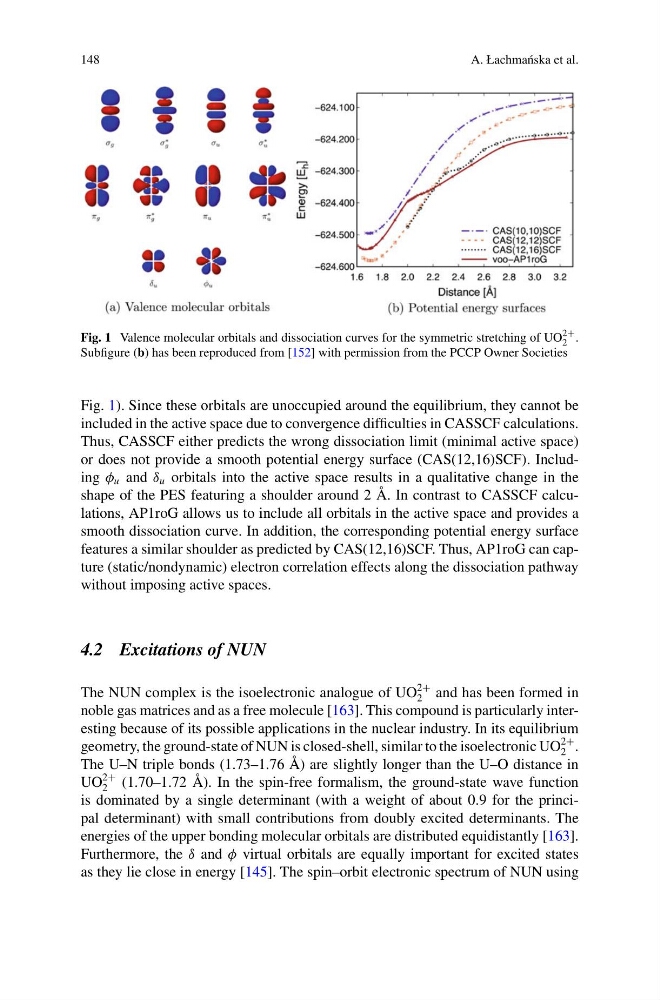
Fig. 1 Valence molecular orbitals and dissociation curves for the symmetric stretching of UO
2+
2 .
Subfigure (b) has been reproduced from [152] with permission from the PCCP Owner Societies
Fig. 1). Since these orbitals are unoccupied around the equilibrium, they cannot be
included in the active space due to convergence difficulties in CASSCF calculations.
Thus, CASSCF either predicts the wrong dissociation limit (minimal active space)
or does not provide a smooth potential energy surface (CAS(12,16)SCF). Including φ u and δ u orbitals into the active space results in a qualitative change in the
shape of the PES featuring a shoulder around 2 Å. In contrast to CASSCF calculations, AP1roG allows us to include all orbitals in the active space and provides a
smooth dissociation curve. In addition, the corresponding potential energy surface
features a similar shoulder as predicted by CAS(12,16)SCF. Thus, AP1roG can capture (static/nondynamic) electron correlation effects along the dissociation pathway
without imposing active spaces.
4.2 Excitations of NUN
The NUN complex is the isoelectronic analogue of UO
2+
2 and has been formed in
noble gas matrices and as a free molecule [163]. This compound is particularly interesting because of its possible applications in the nuclear industry. In its equilibrium
geometry, the ground-state of NUN is closed-shell, similar to the isoelectronic UO
2+
2 .
The U–N triple bonds (1.73–1.76 Å) are slightly longer than the U–O distance in
UO
2+
2 (1.70–1.72 Å). In the spin-free formalism, the ground-state wave function
is dominated by a single determinant (with a weight of about 0.9 for the principal determinant) with small contributions from doubly excited determinants. The
energies of the upper bonding molecular orbitals are distributed equidistantly [163].
Furthermore, the δ and φ virtual orbitals are equally important for excited states
as they lie close in energy [145]. The spin–orbit electronic spectrum of NUN using
A. Łachma´ nska et al.
Fig. 1 Valence molecular orbitals and dissociation curves for the symmetric stretching of UO
2+
2 .
Subfigure (b) has been reproduced from [152] with permission from the PCCP Owner Societies
Fig. 1). Since these orbitals are unoccupied around the equilibrium, they cannot be
included in the active space due to convergence difficulties in CASSCF calculations.
Thus, CASSCF either predicts the wrong dissociation limit (minimal active space)
or does not provide a smooth potential energy surface (CAS(12,16)SCF). Including φ u and δ u orbitals into the active space results in a qualitative change in the
shape of the PES featuring a shoulder around 2 Å. In contrast to CASSCF calculations, AP1roG allows us to include all orbitals in the active space and provides a
smooth dissociation curve. In addition, the corresponding potential energy surface
features a similar shoulder as predicted by CAS(12,16)SCF. Thus, AP1roG can capture (static/nondynamic) electron correlation effects along the dissociation pathway
without imposing active spaces.
4.2 Excitations of NUN
The NUN complex is the isoelectronic analogue of UO
2+
2 and has been formed in
noble gas matrices and as a free molecule [163]. This compound is particularly interesting because of its possible applications in the nuclear industry. In its equilibrium
geometry, the ground-state of NUN is closed-shell, similar to the isoelectronic UO
2+
2 .
The U–N triple bonds (1.73–1.76 Å) are slightly longer than the U–O distance in
UO
2+
2 (1.70–1.72 Å). In the spin-free formalism, the ground-state wave function
is dominated by a single determinant (with a weight of about 0.9 for the principal determinant) with small contributions from doubly excited determinants. The
energies of the upper bonding molecular orbitals are distributed equidistantly [163].
Furthermore, the δ and φ virtual orbitals are equally important for excited states
as they lie close in energy [145]. The spin–orbit electronic spectrum of NUN using