

146
A. Łachma´ nska et al.
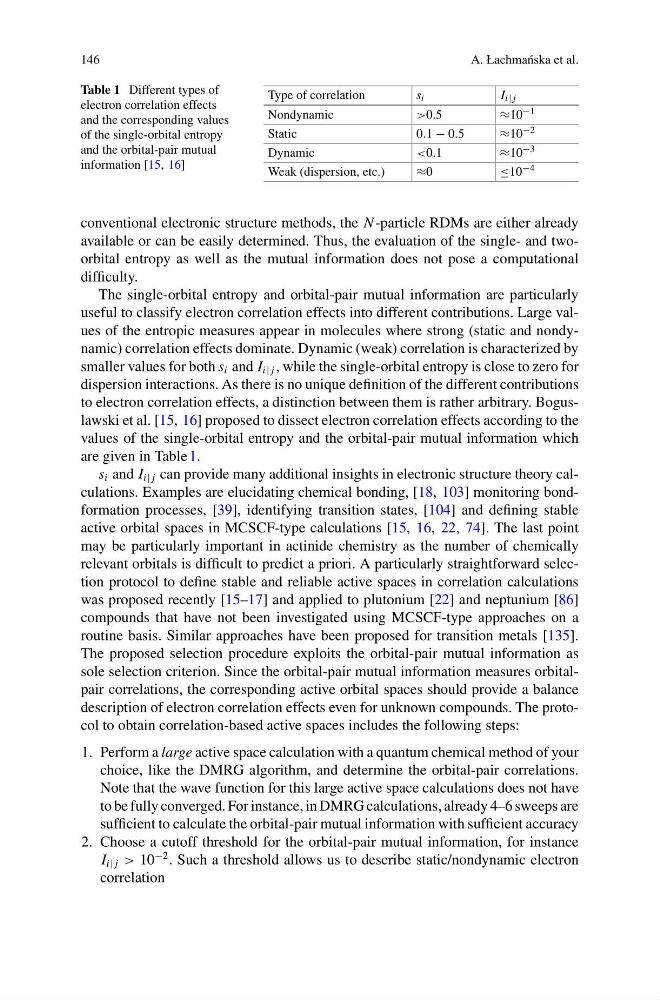
Table 1 Different types of
electron correlation effects
and the corresponding values
of the single-orbital entropy
and the orbital-pair mutual
information [15, 16]
Type of correlation
s i
I i| j
Nondynamic
>0.5
≈10 −1
Static
0.1 − 0.5
≈10 −2
Dynamic
<0.1
≈10 −3
Weak (dispersion, etc.)
≈0
≤10 −4
conventional electronic structure methods, the N -particle RDMs are either already
available or can be easily determined. Thus, the evaluation of the single- and twoorbital entropy as well as the mutual information does not pose a computational
difficulty.
The single-orbital entropy and orbital-pair mutual information are particularly
useful to classify electron correlation effects into different contributions. Large values of the entropic measures appear in molecules where strong (static and nondynamic) correlation effects dominate. Dynamic (weak) correlation is characterized by
smaller values for both s i and I i| j , while the single-orbital entropy is close to zero for
dispersion interactions. As there is no unique definition of the different contributions
to electron correlation effects, a distinction between them is rather arbitrary. Boguslawski et al. [15, 16] proposed to dissect electron correlation effects according to the
values of the single-orbital entropy and the orbital-pair mutual information which
are given in Table 1.
s i and I i| j can provide many additional insights in electronic structure theory calculations. Examples are elucidating chemical bonding, [18, 103] monitoring bondformation processes, [39], identifying transition states, [104] and defining stable
active orbital spaces in MCSCF-type calculations [15, 16, 22, 74]. The last point
may be particularly important in actinide chemistry as the number of chemically
relevant orbitals is difficult to predict a priori. A particularly straightforward selection protocol to define stable and reliable active spaces in correlation calculations
was proposed recently [15–17] and applied to plutonium [22] and neptunium [86]
compounds that have not been investigated using MCSCF-type approaches on a
routine basis. Similar approaches have been proposed for transition metals [135].
The proposed selection procedure exploits the orbital-pair mutual information as
sole selection criterion. Since the orbital-pair mutual information measures orbitalpair correlations, the corresponding active orbital spaces should provide a balance
description of electron correlation effects even for unknown compounds. The protocol to obtain correlation-based active spaces includes the following steps:
1. Perform a large active space calculation with a quantum chemical method of your
choice, like the DMRG algorithm, and determine the orbital-pair correlations.
Note that the wave function for this large active space calculations does not have
to be fully converged. For instance, in DMRG calculations, already 4–6 sweeps are
sufficient to calculate the orbital-pair mutual information with sufficient accuracy
2. Choose a cutoff threshold for the orbital-pair mutual information, for instance
I i| j > 10
−2 . Such a threshold allows us to describe static/nondynamic electron
correlation
A. Łachma´ nska et al.
Table 1 Different types of
electron correlation effects
and the corresponding values
of the single-orbital entropy
and the orbital-pair mutual
information [15, 16]
Type of correlation
s i
I i| j
Nondynamic
>0.5
≈10 −1
Static
0.1 − 0.5
≈10 −2
Dynamic
<0.1
≈10 −3
Weak (dispersion, etc.)
≈0
≤10 −4
conventional electronic structure methods, the N -particle RDMs are either already
available or can be easily determined. Thus, the evaluation of the single- and twoorbital entropy as well as the mutual information does not pose a computational
difficulty.
The single-orbital entropy and orbital-pair mutual information are particularly
useful to classify electron correlation effects into different contributions. Large values of the entropic measures appear in molecules where strong (static and nondynamic) correlation effects dominate. Dynamic (weak) correlation is characterized by
smaller values for both s i and I i| j , while the single-orbital entropy is close to zero for
dispersion interactions. As there is no unique definition of the different contributions
to electron correlation effects, a distinction between them is rather arbitrary. Boguslawski et al. [15, 16] proposed to dissect electron correlation effects according to the
values of the single-orbital entropy and the orbital-pair mutual information which
are given in Table 1.
s i and I i| j can provide many additional insights in electronic structure theory calculations. Examples are elucidating chemical bonding, [18, 103] monitoring bondformation processes, [39], identifying transition states, [104] and defining stable
active orbital spaces in MCSCF-type calculations [15, 16, 22, 74]. The last point
may be particularly important in actinide chemistry as the number of chemically
relevant orbitals is difficult to predict a priori. A particularly straightforward selection protocol to define stable and reliable active spaces in correlation calculations
was proposed recently [15–17] and applied to plutonium [22] and neptunium [86]
compounds that have not been investigated using MCSCF-type approaches on a
routine basis. Similar approaches have been proposed for transition metals [135].
The proposed selection procedure exploits the orbital-pair mutual information as
sole selection criterion. Since the orbital-pair mutual information measures orbitalpair correlations, the corresponding active orbital spaces should provide a balance
description of electron correlation effects even for unknown compounds. The protocol to obtain correlation-based active spaces includes the following steps:
1. Perform a large active space calculation with a quantum chemical method of your
choice, like the DMRG algorithm, and determine the orbital-pair correlations.
Note that the wave function for this large active space calculations does not have
to be fully converged. For instance, in DMRG calculations, already 4–6 sweeps are
sufficient to calculate the orbital-pair mutual information with sufficient accuracy
2. Choose a cutoff threshold for the orbital-pair mutual information, for instance
I i| j > 10
−2 . Such a threshold allows us to describe static/nondynamic electron
correlation