

110
V. Krewald and D. A. Pantazis
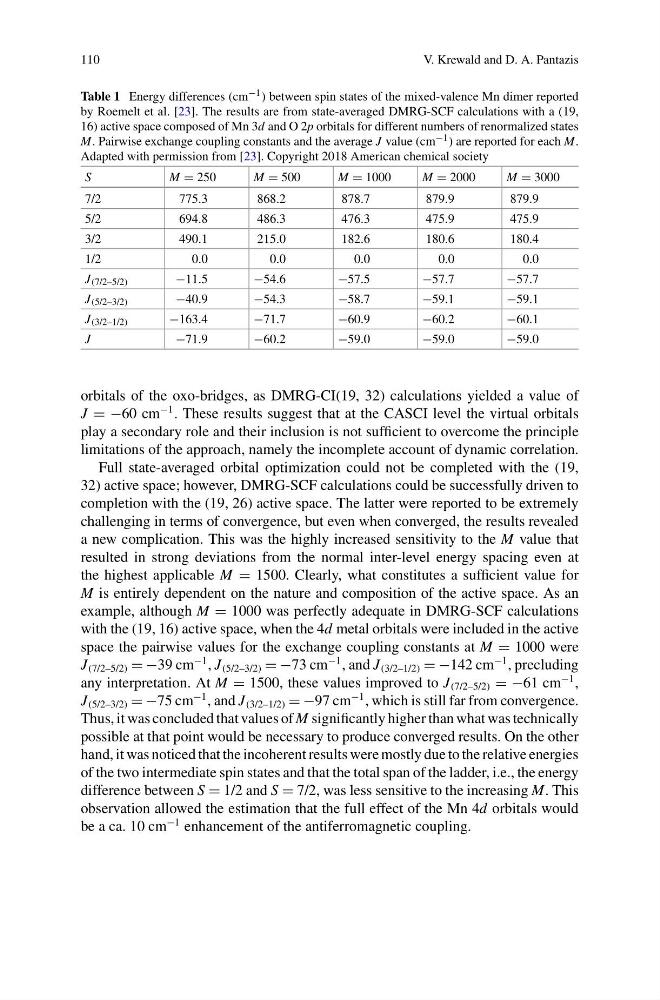
Table 1 Energy differences (cm −1 ) between spin states of the mixed-valence Mn dimer reported
by Roemelt et al. [23]. The results are from state-averaged DMRG-SCF calculations with a (19,
16) active space composed of Mn 3d and O 2p orbitals for different numbers of renormalized states
M. Pairwise exchange coupling constants and the average J value (cm −1 ) are reported for each M.
Adapted with permission from [23]. Copyright 2018 American chemical society
S
M 250
M 500
M 1000
M 2000
M 3000
7/2
775.3
868.2
878.7
879.9
879.9
5/2
694.8
486.3
476.3
475.9
475.9
3/2
490.1
215.0
182.6
180.6
180.4
1/2
0.0
0.0
0.0
0.0
0.0
J (7/2–5/2)
−11.5
−54.6
−57.5
−57.7
−57.7
J (5/2–3/2)
−40.9
−54.3
−58.7
−59.1
−59.1
J (3/2–1/2)
−163.4
−71.7
−60.9
−60.2
−60.1
J
−71.9
−60.2
−59.0
−59.0
−59.0
orbitals of the oxo-bridges, as DMRG-CI(19, 32) calculations yielded a value of
J −60 cm
−1 . These results suggest that at the CASCI level the virtual orbitals
play a secondary role and their inclusion is not sufficient to overcome the principle
limitations of the approach, namely the incomplete account of dynamic correlation.
Full state-averaged orbital optimization could not be completed with the (19,
32) active space; however, DMRG-SCF calculations could be successfully driven to
completion with the (19, 26) active space. The latter were reported to be extremely
challenging in terms of convergence, but even when converged, the results revealed
a new complication. This was the highly increased sensitivity to the M value that
resulted in strong deviations from the normal inter-level energy spacing even at
the highest applicable M 1500. Clearly, what constitutes a sufficient value for
M is entirely dependent on the nature and composition of the active space. As an
example, although M 1000 was perfectly adequate in DMRG-SCF calculations
with the (19, 16) active space, when the 4d metal orbitals were included in the active
space the pairwise values for the exchange coupling constants at M 1000 were
J (7/2–5/2) −39 cm
−1 , J (5/2–3/2) −73 cm
−1 , and J (3/2–1/2) −142 cm
−1 , precluding
any interpretation. At M 1500, these values improved to J (7/2–5/2) −61 cm
−1 ,
J (5/2–3/2) −75 cm
−1 , and J (3/2–1/2) −97 cm
−1 , which is still far from convergence.
Thus, it was concluded that values of M significantly higher than what was technically
possible at that point would be necessary to produce converged results. On the other
hand, it was noticed that the incoherent results were mostly due to the relative energies
of the two intermediate spin states and that the total span of the ladder, i.e., the energy
difference between S 1/2 and S 7/2, was less sensitive to the increasing M. This
observation allowed the estimation that the full effect of the Mn 4d orbitals would
be a ca. 10 cm
−1 enhancement of the antiferromagnetic coupling.
V. Krewald and D. A. Pantazis
Table 1 Energy differences (cm −1 ) between spin states of the mixed-valence Mn dimer reported
by Roemelt et al. [23]. The results are from state-averaged DMRG-SCF calculations with a (19,
16) active space composed of Mn 3d and O 2p orbitals for different numbers of renormalized states
M. Pairwise exchange coupling constants and the average J value (cm −1 ) are reported for each M.
Adapted with permission from [23]. Copyright 2018 American chemical society
S
M 250
M 500
M 1000
M 2000
M 3000
7/2
775.3
868.2
878.7
879.9
879.9
5/2
694.8
486.3
476.3
475.9
475.9
3/2
490.1
215.0
182.6
180.6
180.4
1/2
0.0
0.0
0.0
0.0
0.0
J (7/2–5/2)
−11.5
−54.6
−57.5
−57.7
−57.7
J (5/2–3/2)
−40.9
−54.3
−58.7
−59.1
−59.1
J (3/2–1/2)
−163.4
−71.7
−60.9
−60.2
−60.1
J
−71.9
−60.2
−59.0
−59.0
−59.0
orbitals of the oxo-bridges, as DMRG-CI(19, 32) calculations yielded a value of
J −60 cm
−1 . These results suggest that at the CASCI level the virtual orbitals
play a secondary role and their inclusion is not sufficient to overcome the principle
limitations of the approach, namely the incomplete account of dynamic correlation.
Full state-averaged orbital optimization could not be completed with the (19,
32) active space; however, DMRG-SCF calculations could be successfully driven to
completion with the (19, 26) active space. The latter were reported to be extremely
challenging in terms of convergence, but even when converged, the results revealed
a new complication. This was the highly increased sensitivity to the M value that
resulted in strong deviations from the normal inter-level energy spacing even at
the highest applicable M 1500. Clearly, what constitutes a sufficient value for
M is entirely dependent on the nature and composition of the active space. As an
example, although M 1000 was perfectly adequate in DMRG-SCF calculations
with the (19, 16) active space, when the 4d metal orbitals were included in the active
space the pairwise values for the exchange coupling constants at M 1000 were
J (7/2–5/2) −39 cm
−1 , J (5/2–3/2) −73 cm
−1 , and J (3/2–1/2) −142 cm
−1 , precluding
any interpretation. At M 1500, these values improved to J (7/2–5/2) −61 cm
−1 ,
J (5/2–3/2) −75 cm
−1 , and J (3/2–1/2) −97 cm
−1 , which is still far from convergence.
Thus, it was concluded that values of M significantly higher than what was technically
possible at that point would be necessary to produce converged results. On the other
hand, it was noticed that the incoherent results were mostly due to the relative energies
of the two intermediate spin states and that the total span of the ladder, i.e., the energy
difference between S 1/2 and S 7/2, was less sensitive to the increasing M. This
observation allowed the estimation that the full effect of the Mn 4d orbitals would
be a ca. 10 cm
−1 enhancement of the antiferromagnetic coupling.