

Applications of the Density Matrix Renormalization Group …
105
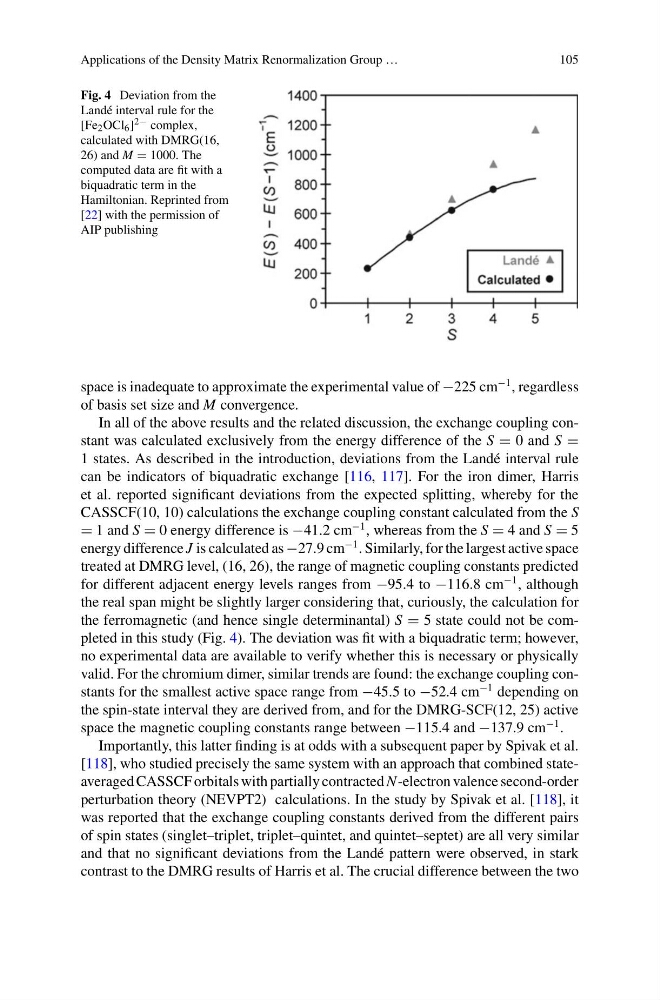
Fig. 4 Deviation from the
Landé interval rule for the
[Fe 2 OCl 6 ] 2− complex,
calculated with DMRG(16,
26) and M 1000. The
computed data are fit with a
biquadratic term in the
Hamiltonian. Reprinted from
[22] with the permission of
AIP publishing
space is inadequate to approximate the experimental value of −225 cm
−1 , regardless
of basis set size and M convergence.
In all of the above results and the related discussion, the exchange coupling constant was calculated exclusively from the energy difference of the S 0 and S
1 states. As described in the introduction, deviations from the Landé interval rule
can be indicators of biquadratic exchange [116, 117]. For the iron dimer, Harris
et al. reported significant deviations from the expected splitting, whereby for the
CASSCF(10, 10) calculations the exchange coupling constant calculated from the S
1 and S 0 energy difference is −41.2 cm
−1 , whereas from the S 4 and S 5
energy difference J is calculated as −27.9 cm
−1 . Similarly, for the largest active space
treated at DMRG level, (16, 26), the range of magnetic coupling constants predicted
for different adjacent energy levels ranges from −95.4 to −116.8 cm
−1 , although
the real span might be slightly larger considering that, curiously, the calculation for
the ferromagnetic (and hence single determinantal) S 5 state could not be completed in this study (Fig. 4). The deviation was fit with a biquadratic term; however,
no experimental data are available to verify whether this is necessary or physically
valid. For the chromium dimer, similar trends are found: the exchange coupling constants for the smallest active space range from −45.5 to −52.4 cm
−1 depending on
the spin-state interval they are derived from, and for the DMRG-SCF(12, 25) active
space the magnetic coupling constants range between −115.4 and −137.9 cm
−1 .
Importantly, this latter finding is at odds with a subsequent paper by Spivak et al.
[118], who studied precisely the same system with an approach that combined stateaveraged CASSCF orbitals with partially contracted N-electron valence second-order
perturbation theory (NEVPT2) calculations. In the study by Spivak et al. [118], it
was reported that the exchange coupling constants derived from the different pairs
of spin states (singlet–triplet, triplet–quintet, and quintet–septet) are all very similar
and that no significant deviations from the Landé pattern were observed, in stark
contrast to the DMRG results of Harris et al. The crucial difference between the two
105
Fig. 4 Deviation from the
Landé interval rule for the
[Fe 2 OCl 6 ] 2− complex,
calculated with DMRG(16,
26) and M 1000. The
computed data are fit with a
biquadratic term in the
Hamiltonian. Reprinted from
[22] with the permission of
AIP publishing
space is inadequate to approximate the experimental value of −225 cm
−1 , regardless
of basis set size and M convergence.
In all of the above results and the related discussion, the exchange coupling constant was calculated exclusively from the energy difference of the S 0 and S
1 states. As described in the introduction, deviations from the Landé interval rule
can be indicators of biquadratic exchange [116, 117]. For the iron dimer, Harris
et al. reported significant deviations from the expected splitting, whereby for the
CASSCF(10, 10) calculations the exchange coupling constant calculated from the S
1 and S 0 energy difference is −41.2 cm
−1 , whereas from the S 4 and S 5
energy difference J is calculated as −27.9 cm
−1 . Similarly, for the largest active space
treated at DMRG level, (16, 26), the range of magnetic coupling constants predicted
for different adjacent energy levels ranges from −95.4 to −116.8 cm
−1 , although
the real span might be slightly larger considering that, curiously, the calculation for
the ferromagnetic (and hence single determinantal) S 5 state could not be completed in this study (Fig. 4). The deviation was fit with a biquadratic term; however,
no experimental data are available to verify whether this is necessary or physically
valid. For the chromium dimer, similar trends are found: the exchange coupling constants for the smallest active space range from −45.5 to −52.4 cm
−1 depending on
the spin-state interval they are derived from, and for the DMRG-SCF(12, 25) active
space the magnetic coupling constants range between −115.4 and −137.9 cm
−1 .
Importantly, this latter finding is at odds with a subsequent paper by Spivak et al.
[118], who studied precisely the same system with an approach that combined stateaveraged CASSCF orbitals with partially contracted N-electron valence second-order
perturbation theory (NEVPT2) calculations. In the study by Spivak et al. [118], it
was reported that the exchange coupling constants derived from the different pairs
of spin states (singlet–triplet, triplet–quintet, and quintet–septet) are all very similar
and that no significant deviations from the Landé pattern were observed, in stark
contrast to the DMRG results of Harris et al. The crucial difference between the two