

Applications of the Density Matrix Renormalization Group …
103
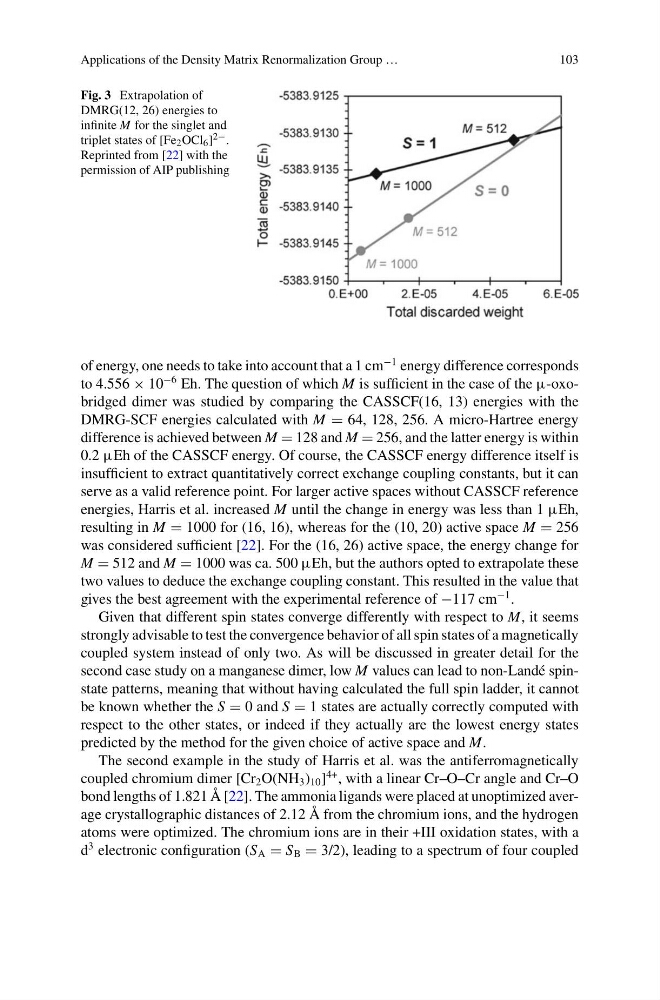
Fig. 3 Extrapolation of
DMRG(12, 26) energies to
infinite M for the singlet and
triplet states of [Fe 2 OCl 6 ] 2− .
Reprinted from [22] with the
permission of AIP publishing
of energy, one needs to take into account that a 1 cm
−1 energy difference corresponds
to 4.556 × 10
−6 Eh. The question of which M is sufficient in the case of the μ-oxobridged dimer was studied by comparing the CASSCF(16, 13) energies with the
DMRG-SCF energies calculated with M 64, 128, 256. A micro-Hartree energy
difference is achieved between M 128 and M 256, and the latter energy is within
0.2 μEh of the CASSCF energy. Of course, the CASSCF energy difference itself is
insufficient to extract quantitatively correct exchange coupling constants, but it can
serve as a valid reference point. For larger active spaces without CASSCF reference
energies, Harris et al. increased M until the change in energy was less than 1 μEh,
resulting in M 1000 for (16, 16), whereas for the (10, 20) active space M 256
was considered sufficient [22]. For the (16, 26) active space, the energy change for
M 512 and M 1000 was ca. 500 μEh, but the authors opted to extrapolate these
two values to deduce the exchange coupling constant. This resulted in the value that
gives the best agreement with the experimental reference of −117 cm
−1 .
Given that different spin states converge differently with respect to M, it seems
strongly advisable to test the convergence behavior of all spin states of a magnetically
coupled system instead of only two. As will be discussed in greater detail for the
second case study on a manganese dimer, low M values can lead to non-Landé spinstate patterns, meaning that without having calculated the full spin ladder, it cannot
be known whether the S 0 and S 1 states are actually correctly computed with
respect to the other states, or indeed if they actually are the lowest energy states
predicted by the method for the given choice of active space and M.
The second example in the study of Harris et al. was the antiferromagnetically
coupled chromium dimer [Cr 2 O(NH 3 ) 10 ]
4+ , with a linear Cr–O–Cr angle and Cr–O
bond lengths of 1.821 Å [22]. The ammonia ligands were placed at unoptimized average crystallographic distances of 2.12 Å from the chromium ions, and the hydrogen
atoms were optimized. The chromium ions are in their +III oxidation states, with a
d
3 electronic configuration (S A S B 3/2), leading to a spectrum of four coupled
103
Fig. 3 Extrapolation of
DMRG(12, 26) energies to
infinite M for the singlet and
triplet states of [Fe 2 OCl 6 ] 2− .
Reprinted from [22] with the
permission of AIP publishing
of energy, one needs to take into account that a 1 cm
−1 energy difference corresponds
to 4.556 × 10
−6 Eh. The question of which M is sufficient in the case of the μ-oxobridged dimer was studied by comparing the CASSCF(16, 13) energies with the
DMRG-SCF energies calculated with M 64, 128, 256. A micro-Hartree energy
difference is achieved between M 128 and M 256, and the latter energy is within
0.2 μEh of the CASSCF energy. Of course, the CASSCF energy difference itself is
insufficient to extract quantitatively correct exchange coupling constants, but it can
serve as a valid reference point. For larger active spaces without CASSCF reference
energies, Harris et al. increased M until the change in energy was less than 1 μEh,
resulting in M 1000 for (16, 16), whereas for the (10, 20) active space M 256
was considered sufficient [22]. For the (16, 26) active space, the energy change for
M 512 and M 1000 was ca. 500 μEh, but the authors opted to extrapolate these
two values to deduce the exchange coupling constant. This resulted in the value that
gives the best agreement with the experimental reference of −117 cm
−1 .
Given that different spin states converge differently with respect to M, it seems
strongly advisable to test the convergence behavior of all spin states of a magnetically
coupled system instead of only two. As will be discussed in greater detail for the
second case study on a manganese dimer, low M values can lead to non-Landé spinstate patterns, meaning that without having calculated the full spin ladder, it cannot
be known whether the S 0 and S 1 states are actually correctly computed with
respect to the other states, or indeed if they actually are the lowest energy states
predicted by the method for the given choice of active space and M.
The second example in the study of Harris et al. was the antiferromagnetically
coupled chromium dimer [Cr 2 O(NH 3 ) 10 ]
4+ , with a linear Cr–O–Cr angle and Cr–O
bond lengths of 1.821 Å [22]. The ammonia ligands were placed at unoptimized average crystallographic distances of 2.12 Å from the chromium ions, and the hydrogen
atoms were optimized. The chromium ions are in their +III oxidation states, with a
d
3 electronic configuration (S A S B 3/2), leading to a spectrum of four coupled