

Applications of the Density Matrix Renormalization Group …
93
calculations, DMRG-CI, as well as in calculations involving orbital optimization,
DMRG-SCF, to a range of chemical questions (for example [14–17]). DMRG-SCF
has been reported for dinuclear and even tetranuclear complexes with open-shell
transition metals [18–21], although these studies have focused on specific electronic
states of the systems of interest without addressing explicitly the problem of exchange
coupling. It is important to stress this point because the methodological and technical
requirements for the application of DMRG-based approaches are neither obvious nor
necessarily transferrable from other wavefunction-based approaches. At the time of
this writing, very few studies have used DMRG to predict the relative energies of
spin states that arise from magnetic coupling in transition metal clusters. Our aim
is to review two of these very first case studies [22, 23] in order to understand the
technical and methodological challenges encountered in applications of DMRG to
problems of magnetic coupling, as well as to highlight the emerging opportunities
that DMRG brings for the computational treatment of these systems. The point of
view adopted here is of application-oriented quantum chemistry; the reader interested
in the theoretical foundations of the methods and in current theoretical developments
is directed to existing excellent reviews [24–27].
2 Theoretical Treatment of Exchange Coupling
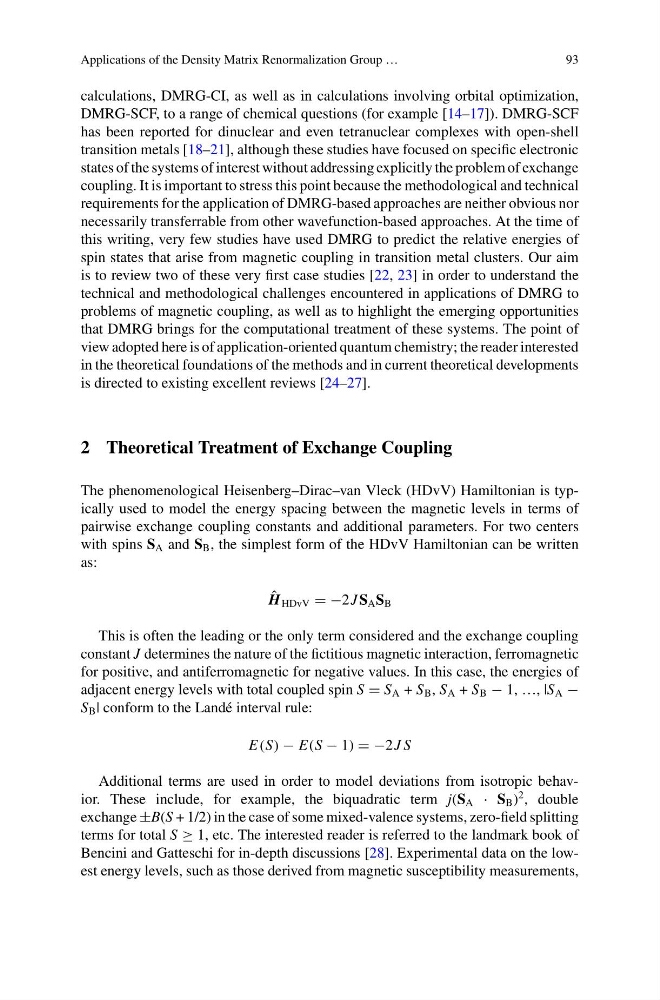
The phenomenological Heisenberg–Dirac–van Vleck (HDvV) Hamiltonian is typically used to model the energy spacing between the magnetic levels in terms of
pairwise exchange coupling constants and additional parameters. For two centers
with spins S A and S B , the simplest form of the HDvV Hamiltonian can be written
as:
ˆ
H HDvV −2J S A S B
This is often the leading or the only term considered and the exchange coupling
constant J determines the nature of the fictitious magnetic interaction, ferromagnetic
for positive, and antiferromagnetic for negative values. In this case, the energies of
adjacent energy levels with total coupled spin S S A + S B , S A + S B − 1, …, |S A −
S B | conform to the Landé interval rule:
E(S) − E(S − 1) −2J S
Additional terms are used in order to model deviations from isotropic behavior. These include, for example, the biquadratic term j(S A · S B )
2 , double
exchange ±B(S + 1/2) in the case of some mixed-valence systems, zero-field splitting
terms for total S ≥ 1, etc. The interested reader is referred to the landmark book of
Bencini and Gatteschi for in-depth discussions [28]. Experimental data on the lowest energy levels, such as those derived from magnetic susceptibility measurements,
93
calculations, DMRG-CI, as well as in calculations involving orbital optimization,
DMRG-SCF, to a range of chemical questions (for example [14–17]). DMRG-SCF
has been reported for dinuclear and even tetranuclear complexes with open-shell
transition metals [18–21], although these studies have focused on specific electronic
states of the systems of interest without addressing explicitly the problem of exchange
coupling. It is important to stress this point because the methodological and technical
requirements for the application of DMRG-based approaches are neither obvious nor
necessarily transferrable from other wavefunction-based approaches. At the time of
this writing, very few studies have used DMRG to predict the relative energies of
spin states that arise from magnetic coupling in transition metal clusters. Our aim
is to review two of these very first case studies [22, 23] in order to understand the
technical and methodological challenges encountered in applications of DMRG to
problems of magnetic coupling, as well as to highlight the emerging opportunities
that DMRG brings for the computational treatment of these systems. The point of
view adopted here is of application-oriented quantum chemistry; the reader interested
in the theoretical foundations of the methods and in current theoretical developments
is directed to existing excellent reviews [24–27].
2 Theoretical Treatment of Exchange Coupling
The phenomenological Heisenberg–Dirac–van Vleck (HDvV) Hamiltonian is typically used to model the energy spacing between the magnetic levels in terms of
pairwise exchange coupling constants and additional parameters. For two centers
with spins S A and S B , the simplest form of the HDvV Hamiltonian can be written
as:
ˆ
H HDvV −2J S A S B
This is often the leading or the only term considered and the exchange coupling
constant J determines the nature of the fictitious magnetic interaction, ferromagnetic
for positive, and antiferromagnetic for negative values. In this case, the energies of
adjacent energy levels with total coupled spin S S A + S B , S A + S B − 1, …, |S A −
S B | conform to the Landé interval rule:
E(S) − E(S − 1) −2J S
Additional terms are used in order to model deviations from isotropic behavior. These include, for example, the biquadratic term j(S A · S B )
2 , double
exchange ±B(S + 1/2) in the case of some mixed-valence systems, zero-field splitting
terms for total S ≥ 1, etc. The interested reader is referred to the landmark book of
Bencini and Gatteschi for in-depth discussions [28]. Experimental data on the lowest energy levels, such as those derived from magnetic susceptibility measurements,