

6.10 The Uncertainty of the Certified Value and the Expanded …
79
certified value. It was already noted that the position of the reference in the metrological hierarchy depends on the associated uncertainty. It is not always reasonable
to purchase the material of the highest possible metrological quality, meaning with
the lowest possible uncertainty of the certified value, due to economic aspects. The
production of the RM and the certification process of the respective properties can
be very expensive; thus, the price of the material depends strongly on the uncertainty with which the reference value is given. In practice, beyond the previously set
requirements, the most reasonable and the economically justified choice is to look
for the one whose standard uncertainty will not exceed the target combined uncertainty of the result. A good guideline is that the standard uncertainty assigned to the
reference value does not exceed one third of the standard combined uncertainty for
the result obtained with applied measurement procedure.
Example
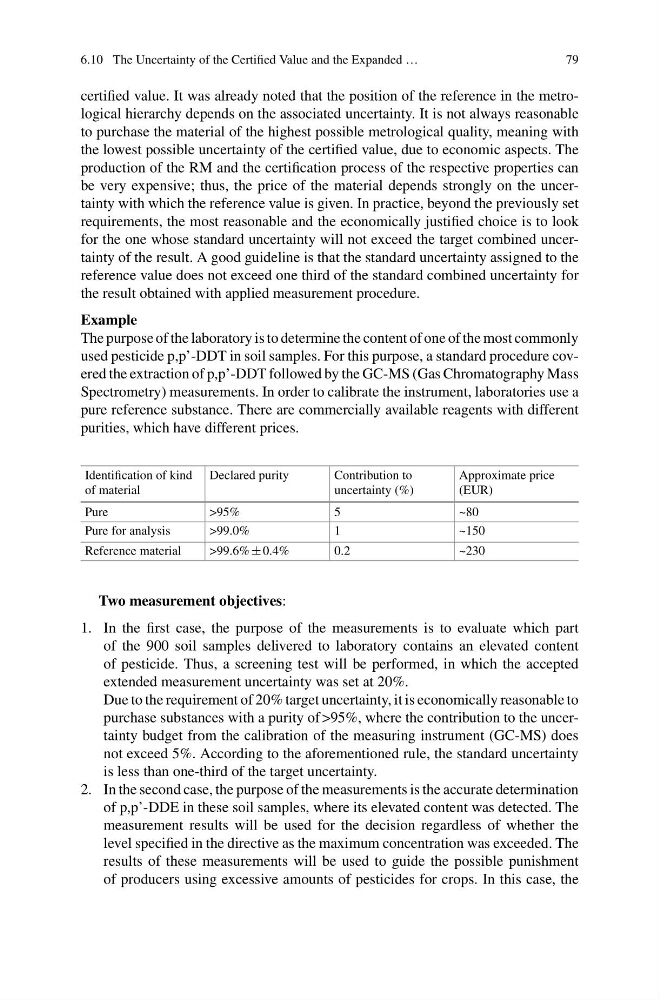
The purpose of the laboratory is to determine the content of one of the most commonly
used pesticide p,p’-DDT in soil samples. For this purpose, a standard procedure covered the extraction of p,p’-DDT followed by the GC-MS (Gas Chromatography Mass
Spectrometry) measurements. In order to calibrate the instrument, laboratories use a
pure reference substance. There are commercially available reagents with different
purities, which have different prices.
Identification of kind
of material
Declared purity
Contribution to
uncertainty (%)
Approximate price
(EUR)
Pure
>95%
5
~80
Pure for analysis
>99.0%
1
~150
Reference material
>99.6% ± 0.4%
0.2
~230
Two measurement objectives:
1. In the first case, the purpose of the measurements is to evaluate which part
of the 900 soil samples delivered to laboratory contains an elevated content
of pesticide. Thus, a screening test will be performed, in which the accepted
extended measurement uncertainty was set at 20%.
Due to the requirement of 20% target uncertainty, it is economically reasonable to
purchase substances with a purity of >95%, where the contribution to the uncertainty budget from the calibration of the measuring instrument (GC-MS) does
not exceed 5%. According to the aforementioned rule, the standard uncertainty
is less than one-third of the target uncertainty.
2. In the second case, the purpose of the measurements is the accurate determination
of p,p’-DDE in these soil samples, where its elevated content was detected. The
measurement results will be used for the decision regardless of whether the
level specified in the directive as the maximum concentration was exceeded. The
results of these measurements will be used to guide the possible punishment
of producers using excessive amounts of pesticides for crops. In this case, the
79
certified value. It was already noted that the position of the reference in the metrological hierarchy depends on the associated uncertainty. It is not always reasonable
to purchase the material of the highest possible metrological quality, meaning with
the lowest possible uncertainty of the certified value, due to economic aspects. The
production of the RM and the certification process of the respective properties can
be very expensive; thus, the price of the material depends strongly on the uncertainty with which the reference value is given. In practice, beyond the previously set
requirements, the most reasonable and the economically justified choice is to look
for the one whose standard uncertainty will not exceed the target combined uncertainty of the result. A good guideline is that the standard uncertainty assigned to the
reference value does not exceed one third of the standard combined uncertainty for
the result obtained with applied measurement procedure.
Example
The purpose of the laboratory is to determine the content of one of the most commonly
used pesticide p,p’-DDT in soil samples. For this purpose, a standard procedure covered the extraction of p,p’-DDT followed by the GC-MS (Gas Chromatography Mass
Spectrometry) measurements. In order to calibrate the instrument, laboratories use a
pure reference substance. There are commercially available reagents with different
purities, which have different prices.
Identification of kind
of material
Declared purity
Contribution to
uncertainty (%)
Approximate price
(EUR)
Pure
>95%
5
~80
Pure for analysis
>99.0%
1
~150
Reference material
>99.6% ± 0.4%
0.2
~230
Two measurement objectives:
1. In the first case, the purpose of the measurements is to evaluate which part
of the 900 soil samples delivered to laboratory contains an elevated content
of pesticide. Thus, a screening test will be performed, in which the accepted
extended measurement uncertainty was set at 20%.
Due to the requirement of 20% target uncertainty, it is economically reasonable to
purchase substances with a purity of >95%, where the contribution to the uncertainty budget from the calibration of the measuring instrument (GC-MS) does
not exceed 5%. According to the aforementioned rule, the standard uncertainty
is less than one-third of the target uncertainty.
2. In the second case, the purpose of the measurements is the accurate determination
of p,p’-DDE in these soil samples, where its elevated content was detected. The
measurement results will be used for the decision regardless of whether the
level specified in the directive as the maximum concentration was exceeded. The
results of these measurements will be used to guide the possible punishment
of producers using excessive amounts of pesticides for crops. In this case, the