

50
4 Metrological Traceability
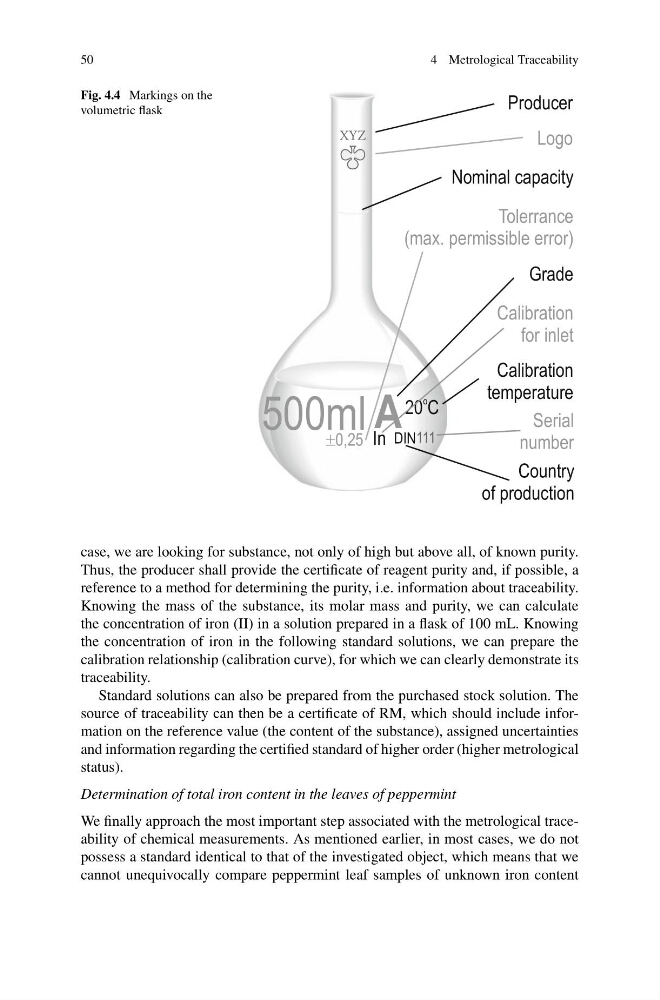
Fig. 4.4 Markings on the
volumetric flask
Producer
Logo
Nominal capacity
Tolerrance
(max. permissible error)
Country
of production
Grade
Calibration
for inlet
Calibration
temperature
Serial
number
XYZ
500ml 0,25 DIN
A
In
111
o
20 C
case, we are looking for substance, not only of high but above all, of known purity.
Thus, the producer shall provide the certificate of reagent purity and, if possible, a
reference to a method for determining the purity, i.e. information about traceability.
Knowing the mass of the substance, its molar mass and purity, we can calculate
the concentration of iron (II) in a solution prepared in a flask of 100 mL. Knowing
the concentration of iron in the following standard solutions, we can prepare the
calibration relationship (calibration curve), for which we can clearly demonstrate its
traceability.
Standard solutions can also be prepared from the purchased stock solution. The
source of traceability can then be a certificate of RM, which should include information on the reference value (the content of the substance), assigned uncertainties
and information regarding the certified standard of higher order (higher metrological
status).
Determination of total iron content in the leaves of peppermint
We finally approach the most important step associated with the metrological traceability of chemical measurements. As mentioned earlier, in most cases, we do not
possess a standard identical to that of the investigated object, which means that we
cannot unequivocally compare peppermint leaf samples of unknown iron content
4 Metrological Traceability
Fig. 4.4 Markings on the
volumetric flask
Producer
Logo
Nominal capacity
Tolerrance
(max. permissible error)
Country
of production
Grade
Calibration
for inlet
Calibration
temperature
Serial
number
XYZ
500ml 0,25 DIN
A
In
111
o
20 C
case, we are looking for substance, not only of high but above all, of known purity.
Thus, the producer shall provide the certificate of reagent purity and, if possible, a
reference to a method for determining the purity, i.e. information about traceability.
Knowing the mass of the substance, its molar mass and purity, we can calculate
the concentration of iron (II) in a solution prepared in a flask of 100 mL. Knowing
the concentration of iron in the following standard solutions, we can prepare the
calibration relationship (calibration curve), for which we can clearly demonstrate its
traceability.
Standard solutions can also be prepared from the purchased stock solution. The
source of traceability can then be a certificate of RM, which should include information on the reference value (the content of the substance), assigned uncertainties
and information regarding the certified standard of higher order (higher metrological
status).
Determination of total iron content in the leaves of peppermint
We finally approach the most important step associated with the metrological traceability of chemical measurements. As mentioned earlier, in most cases, we do not
possess a standard identical to that of the investigated object, which means that we
cannot unequivocally compare peppermint leaf samples of unknown iron content