

44
4 Metrological Traceability
In a typical analytical procedure, both measurements are performed—those that
can be directly traced to the units of physical quantities, as well as those for which the
reference standard can be realized only through metrologically well-characterized
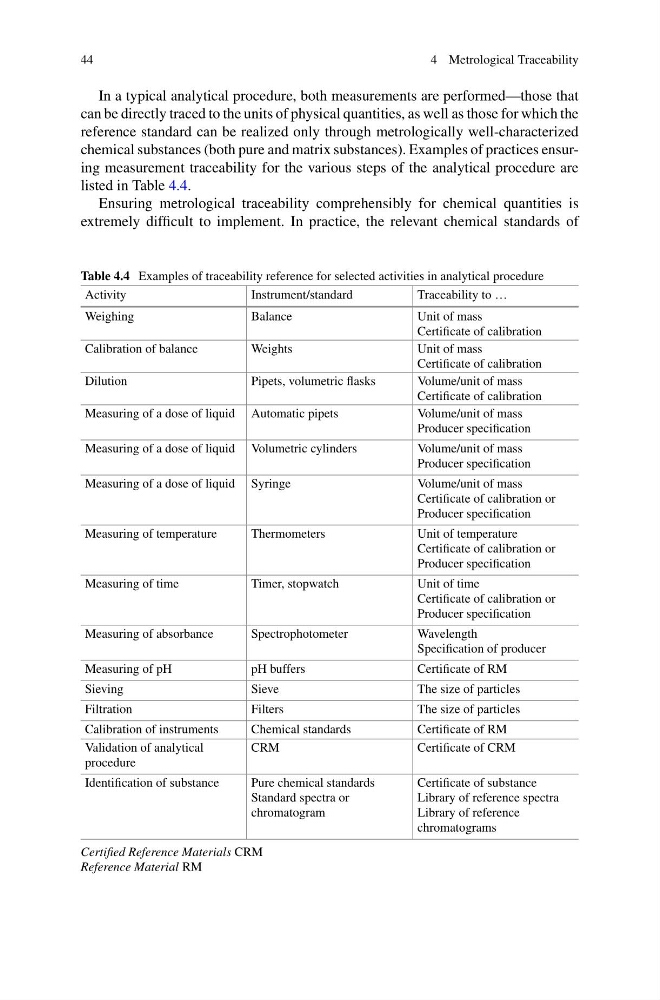
chemical substances (both pure and matrix substances). Examples of practices ensuring measurement traceability for the various steps of the analytical procedure are
listed in Table 4.4.
Ensuring metrological traceability comprehensibly for chemical quantities is
extremely difficult to implement. In practice, the relevant chemical standards of
Table 4.4 Examples of traceability reference for selected activities in analytical procedure
Activity
Instrument/standard
Traceability to …
Weighing
Balance
Unit of mass
Certificate of calibration
Calibration of balance
Weights
Unit of mass
Certificate of calibration
Dilution
Pipets, volumetric flasks
Volume/unit of mass
Certificate of calibration
Measuring of a dose of liquid Automatic pipets
Volume/unit of mass
Producer specification
Measuring of a dose of liquid Volumetric cylinders
Volume/unit of mass
Producer specification
Measuring of a dose of liquid Syringe
Volume/unit of mass
Certificate of calibration or
Producer specification
Measuring of temperature
Thermometers
Unit of temperature
Certificate of calibration or
Producer specification
Measuring of time
Timer, stopwatch
Unit of time
Certificate of calibration or
Producer specification
Measuring of absorbance
Spectrophotometer
Wavelength
Specification of producer
Measuring of pH
pH buffers
Certificate of RM
Sieving
Sieve
The size of particles
Filtration
Filters
The size of particles
Calibration of instruments
Chemical standards
Certificate of RM
Validation of analytical
procedure
CRM
Certificate of CRM
Identification of substance
Pure chemical standards
Standard spectra or
chromatogram
Certificate of substance
Library of reference spectra
Library of reference
chromatograms
Certified Reference Materials CRM
Reference Material RM
4 Metrological Traceability
In a typical analytical procedure, both measurements are performed—those that
can be directly traced to the units of physical quantities, as well as those for which the
reference standard can be realized only through metrologically well-characterized
chemical substances (both pure and matrix substances). Examples of practices ensuring measurement traceability for the various steps of the analytical procedure are
listed in Table 4.4.
Ensuring metrological traceability comprehensibly for chemical quantities is
extremely difficult to implement. In practice, the relevant chemical standards of
Table 4.4 Examples of traceability reference for selected activities in analytical procedure
Activity
Instrument/standard
Traceability to …
Weighing
Balance
Unit of mass
Certificate of calibration
Calibration of balance
Weights
Unit of mass
Certificate of calibration
Dilution
Pipets, volumetric flasks
Volume/unit of mass
Certificate of calibration
Measuring of a dose of liquid Automatic pipets
Volume/unit of mass
Producer specification
Measuring of a dose of liquid Volumetric cylinders
Volume/unit of mass
Producer specification
Measuring of a dose of liquid Syringe
Volume/unit of mass
Certificate of calibration or
Producer specification
Measuring of temperature
Thermometers
Unit of temperature
Certificate of calibration or
Producer specification
Measuring of time
Timer, stopwatch
Unit of time
Certificate of calibration or
Producer specification
Measuring of absorbance
Spectrophotometer
Wavelength
Specification of producer
Measuring of pH
pH buffers
Certificate of RM
Sieving
Sieve
The size of particles
Filtration
Filters
The size of particles
Calibration of instruments
Chemical standards
Certificate of RM
Validation of analytical
procedure
CRM
Certificate of CRM
Identification of substance
Pure chemical standards
Standard spectra or
chromatogram
Certificate of substance
Library of reference spectra
Library of reference
chromatograms
Certified Reference Materials CRM
Reference Material RM