

3.4 Writing the Unit Symbol of Volume
31
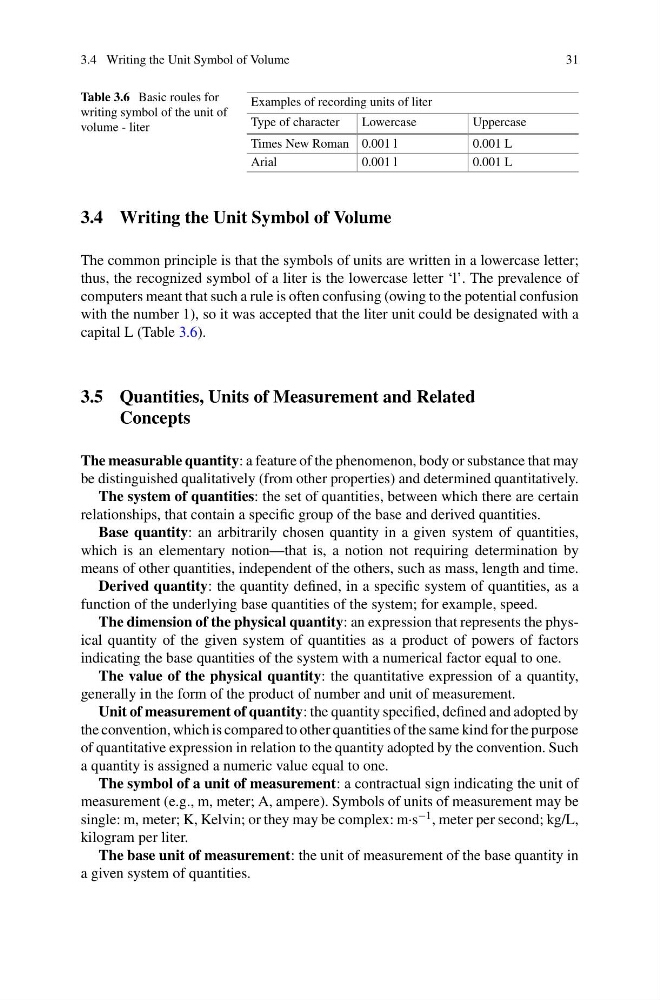
Table 3.6 Basic roules for
writing symbol of the unit of
volume - liter
Examples of recording units of liter
Type of character
Lowercase
Uppercase
Times New Roman 0.001 l
0.001 L
Arial
0.001 l
0.001 L
3.4 Writing the Unit Symbol of Volume
The common principle is that the symbols of units are written in a lowercase letter;
thus, the recognized symbol of a liter is the lowercase letter ‘l’. The prevalence of
computers meant that such a rule is often confusing (owing to the potential confusion
with the number 1), so it was accepted that the liter unit could be designated with a
capital L (Table 3.6).
3.5 Quantities, Units of Measurement and Related
Concepts
The measurable quantity: a feature of the phenomenon, body or substance that may
be distinguished qualitatively (from other properties) and determined quantitatively.
The system of quantities: the set of quantities, between which there are certain
relationships, that contain a specific group of the base and derived quantities.
Base quantity: an arbitrarily chosen quantity in a given system of quantities,
which is an elementary notion—that is, a notion not requiring determination by
means of other quantities, independent of the others, such as mass, length and time.
Derived quantity: the quantity defined, in a specific system of quantities, as a
function of the underlying base quantities of the system; for example, speed.
The dimension of the physical quantity: an expression that represents the physical quantity of the given system of quantities as a product of powers of factors
indicating the base quantities of the system with a numerical factor equal to one.
The value of the physical quantity: the quantitative expression of a quantity,
generally in the form of the product of number and unit of measurement.
Unit of measurement of quantity: the quantity specified, defined and adopted by
the convention, which is compared to other quantities of the same kind for the purpose
of quantitative expression in relation to the quantity adopted by the convention. Such
a quantity is assigned a numeric value equal to one.
The symbol of a unit of measurement: a contractual sign indicating the unit of
measurement (e.g., m, meter; A, ampere). Symbols of units of measurement may be
single: m, meter; K, Kelvin; or they may be complex: m·s
−1 , meter per second; kg/L,
kilogram per liter.
The base unit of measurement: the unit of measurement of the base quantity in
a given system of quantities.
31
Table 3.6 Basic roules for
writing symbol of the unit of
volume - liter
Examples of recording units of liter
Type of character
Lowercase
Uppercase
Times New Roman 0.001 l
0.001 L
Arial
0.001 l
0.001 L
3.4 Writing the Unit Symbol of Volume
The common principle is that the symbols of units are written in a lowercase letter;
thus, the recognized symbol of a liter is the lowercase letter ‘l’. The prevalence of
computers meant that such a rule is often confusing (owing to the potential confusion
with the number 1), so it was accepted that the liter unit could be designated with a
capital L (Table 3.6).
3.5 Quantities, Units of Measurement and Related
Concepts
The measurable quantity: a feature of the phenomenon, body or substance that may
be distinguished qualitatively (from other properties) and determined quantitatively.
The system of quantities: the set of quantities, between which there are certain
relationships, that contain a specific group of the base and derived quantities.
Base quantity: an arbitrarily chosen quantity in a given system of quantities,
which is an elementary notion—that is, a notion not requiring determination by
means of other quantities, independent of the others, such as mass, length and time.
Derived quantity: the quantity defined, in a specific system of quantities, as a
function of the underlying base quantities of the system; for example, speed.
The dimension of the physical quantity: an expression that represents the physical quantity of the given system of quantities as a product of powers of factors
indicating the base quantities of the system with a numerical factor equal to one.
The value of the physical quantity: the quantitative expression of a quantity,
generally in the form of the product of number and unit of measurement.
Unit of measurement of quantity: the quantity specified, defined and adopted by
the convention, which is compared to other quantities of the same kind for the purpose
of quantitative expression in relation to the quantity adopted by the convention. Such
a quantity is assigned a numeric value equal to one.
The symbol of a unit of measurement: a contractual sign indicating the unit of
measurement (e.g., m, meter; A, ampere). Symbols of units of measurement may be
single: m, meter; K, Kelvin; or they may be complex: m·s
−1 , meter per second; kg/L,
kilogram per liter.
The base unit of measurement: the unit of measurement of the base quantity in
a given system of quantities.