

9.2 Quality Assurance and Quality Control
159
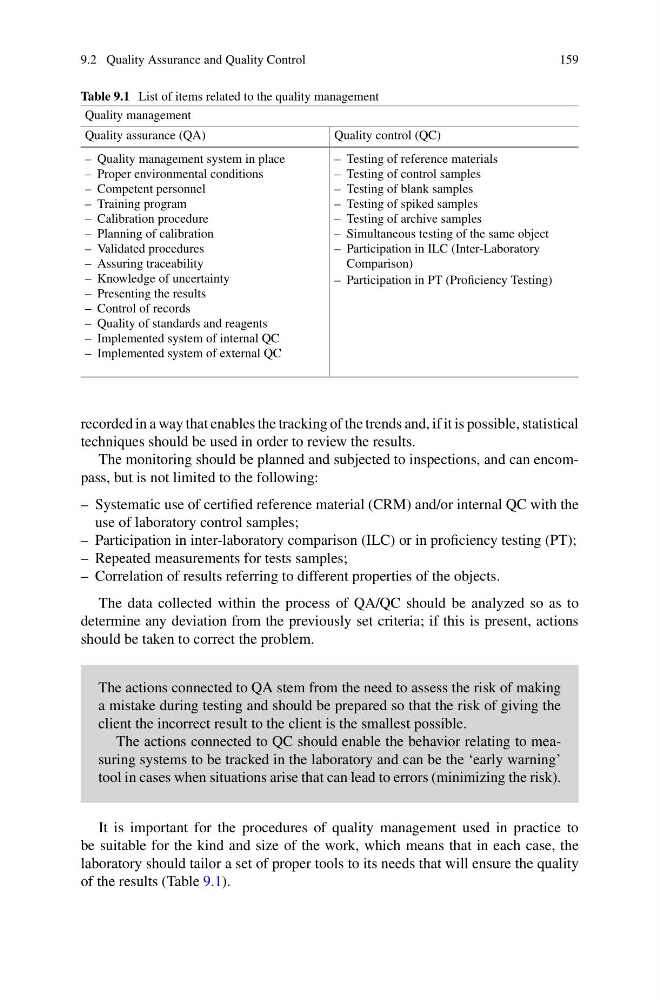
Table 9.1 List of items related to the quality management
Quality management
Quality assurance (QA)
Quality control (QC)
– Quality management system in place
– Proper environmental conditions
– Competent personnel
– Training program
– Calibration procedure
– Planning of calibration
– Validated procedures
– Assuring traceability
– Knowledge of uncertainty
– Presenting the results
– Control of records
– Quality of standards and reagents
– Implemented system of internal QC
– Implemented system of external QC
– Testing of reference materials
– Testing of control samples
– Testing of blank samples
– Testing of spiked samples
– Testing of archive samples
– Simultaneous testing of the same object
– Participation in ILC (Inter-Laboratory
Comparison)
– Participation in PT (Proficiency Testing)
recorded in a way that enables the tracking of the trends and, if it is possible, statistical
techniques should be used in order to review the results.
The monitoring should be planned and subjected to inspections, and can encompass, but is not limited to the following:
– Systematic use of certified reference material (CRM) and/or internal QC with the
use of laboratory control samples;
– Participation in inter-laboratory comparison (ILC) or in proficiency testing (PT);
– Repeated measurements for tests samples;
– Correlation of results referring to different properties of the objects.
The data collected within the process of QA/QC should be analyzed so as to
determine any deviation from the previously set criteria; if this is present, actions
should be taken to correct the problem.
The actions connected to QA stem from the need to assess the risk of making
a mistake during testing and should be prepared so that the risk of giving the
client the incorrect result to the client is the smallest possible.
The actions connected to QC should enable the behavior relating to measuring systems to be tracked in the laboratory and can be the ‘early warning’
tool in cases when situations arise that can lead to errors (minimizing the risk).
It is important for the procedures of quality management used in practice to
be suitable for the kind and size of the work, which means that in each case, the
laboratory should tailor a set of proper tools to its needs that will ensure the quality
of the results (Table 9.1).
159
Table 9.1 List of items related to the quality management
Quality management
Quality assurance (QA)
Quality control (QC)
– Quality management system in place
– Proper environmental conditions
– Competent personnel
– Training program
– Calibration procedure
– Planning of calibration
– Validated procedures
– Assuring traceability
– Knowledge of uncertainty
– Presenting the results
– Control of records
– Quality of standards and reagents
– Implemented system of internal QC
– Implemented system of external QC
– Testing of reference materials
– Testing of control samples
– Testing of blank samples
– Testing of spiked samples
– Testing of archive samples
– Simultaneous testing of the same object
– Participation in ILC (Inter-Laboratory
Comparison)
– Participation in PT (Proficiency Testing)
recorded in a way that enables the tracking of the trends and, if it is possible, statistical
techniques should be used in order to review the results.
The monitoring should be planned and subjected to inspections, and can encompass, but is not limited to the following:
– Systematic use of certified reference material (CRM) and/or internal QC with the
use of laboratory control samples;
– Participation in inter-laboratory comparison (ILC) or in proficiency testing (PT);
– Repeated measurements for tests samples;
– Correlation of results referring to different properties of the objects.
The data collected within the process of QA/QC should be analyzed so as to
determine any deviation from the previously set criteria; if this is present, actions
should be taken to correct the problem.
The actions connected to QA stem from the need to assess the risk of making
a mistake during testing and should be prepared so that the risk of giving the
client the incorrect result to the client is the smallest possible.
The actions connected to QC should enable the behavior relating to measuring systems to be tracked in the laboratory and can be the ‘early warning’
tool in cases when situations arise that can lead to errors (minimizing the risk).
It is important for the procedures of quality management used in practice to
be suitable for the kind and size of the work, which means that in each case, the
laboratory should tailor a set of proper tools to its needs that will ensure the quality
of the results (Table 9.1).