

8.22 Conclusions
151
Depending on the data available as well as purpose of the measurement, different approaches for the evaluation of measurement uncertainty can be used.
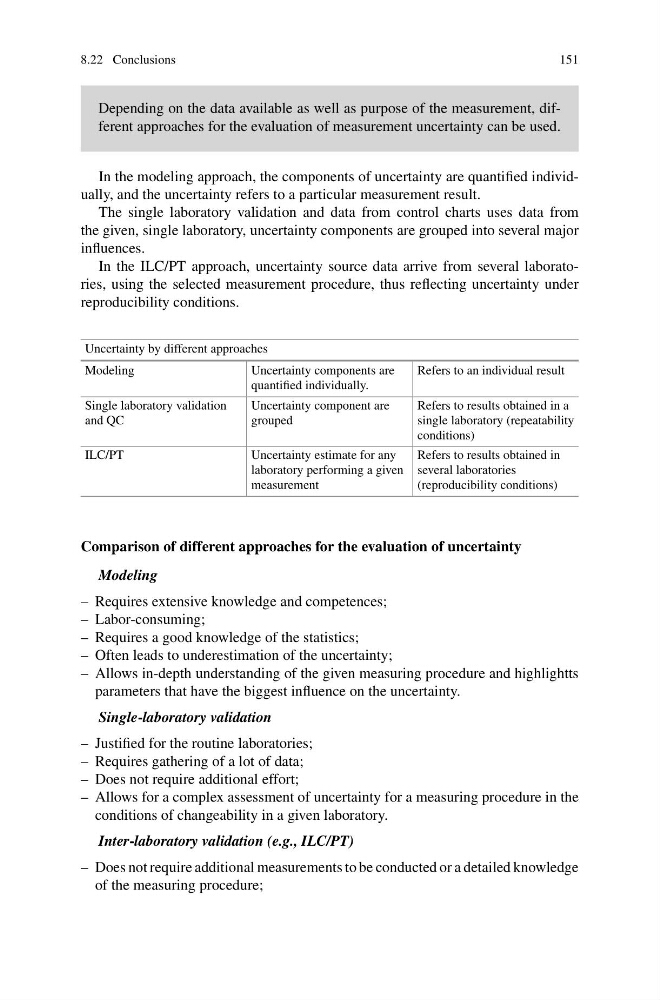
In the modeling approach, the components of uncertainty are quantified individually, and the uncertainty refers to a particular measurement result.
The single laboratory validation and data from control charts uses data from
the given, single laboratory, uncertainty components are grouped into several major
influences.
In the ILC/PT approach, uncertainty source data arrive from several laboratories, using the selected measurement procedure, thus reflecting uncertainty under
reproducibility conditions.
Uncertainty by different approaches
Modeling
Uncertainty components are
quantified individually.
Refers to an individual result
Single laboratory validation
and QC
Uncertainty component are
grouped
Refers to results obtained in a
single laboratory (repeatability
conditions)
ILC/PT
Uncertainty estimate for any
laboratory performing a given
measurement
Refers to results obtained in
several laboratories
(reproducibility conditions)
Comparison of different approaches for the evaluation of uncertainty
Modeling
– Requires extensive knowledge and competences;
– Labor-consuming;
– Requires a good knowledge of the statistics;
– Often leads to underestimation of the uncertainty;
– Allows in-depth understanding of the given measuring procedure and highlightts
parameters that have the biggest influence on the uncertainty.
Single-laboratory validation
– Justified for the routine laboratories;
– Requires gathering of a lot of data;
– Does not require additional effort;
– Allows for a complex assessment of uncertainty for a measuring procedure in the
conditions of changeability in a given laboratory.
Inter-laboratory validation (e.g., ILC/PT)
– Does not require additional measurements to be conducted or a detailed knowledge
of the measuring procedure;
151
Depending on the data available as well as purpose of the measurement, different approaches for the evaluation of measurement uncertainty can be used.
In the modeling approach, the components of uncertainty are quantified individually, and the uncertainty refers to a particular measurement result.
The single laboratory validation and data from control charts uses data from
the given, single laboratory, uncertainty components are grouped into several major
influences.
In the ILC/PT approach, uncertainty source data arrive from several laboratories, using the selected measurement procedure, thus reflecting uncertainty under
reproducibility conditions.
Uncertainty by different approaches
Modeling
Uncertainty components are
quantified individually.
Refers to an individual result
Single laboratory validation
and QC
Uncertainty component are
grouped
Refers to results obtained in a
single laboratory (repeatability
conditions)
ILC/PT
Uncertainty estimate for any
laboratory performing a given
measurement
Refers to results obtained in
several laboratories
(reproducibility conditions)
Comparison of different approaches for the evaluation of uncertainty
Modeling
– Requires extensive knowledge and competences;
– Labor-consuming;
– Requires a good knowledge of the statistics;
– Often leads to underestimation of the uncertainty;
– Allows in-depth understanding of the given measuring procedure and highlightts
parameters that have the biggest influence on the uncertainty.
Single-laboratory validation
– Justified for the routine laboratories;
– Requires gathering of a lot of data;
– Does not require additional effort;
– Allows for a complex assessment of uncertainty for a measuring procedure in the
conditions of changeability in a given laboratory.
Inter-laboratory validation (e.g., ILC/PT)
– Does not require additional measurements to be conducted or a detailed knowledge
of the measuring procedure;