

8.21 Experimental Methods of Evaluation of Uncertainty
149
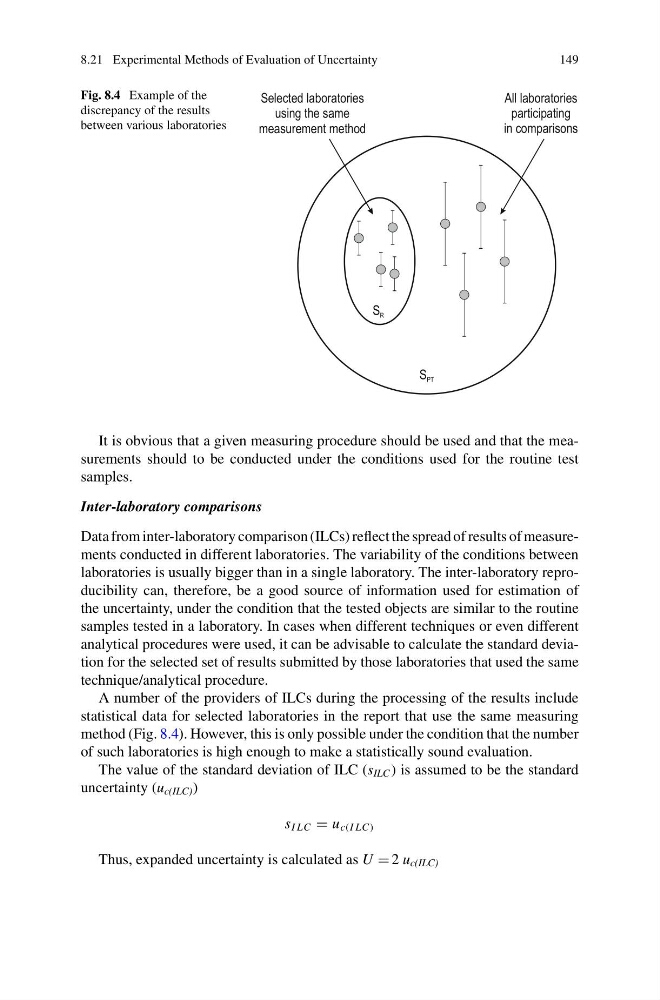
Fig. 8.4 Example of the
discrepancy of the results
between various laboratories
Selected laboratories
using the same
measurement method
All laboratories
participating
in comparisons
S R
S PT
It is obvious that a given measuring procedure should be used and that the measurements should to be conducted under the conditions used for the routine test
samples.
Inter-laboratory comparisons
Data from inter-laboratory comparison (ILCs) reflect the spread of results of measurements conducted in different laboratories. The variability of the conditions between
laboratories is usually bigger than in a single laboratory. The inter-laboratory reproducibility can, therefore, be a good source of information used for estimation of
the uncertainty, under the condition that the tested objects are similar to the routine
samples tested in a laboratory. In cases when different techniques or even different
analytical procedures were used, it can be advisable to calculate the standard deviation for the selected set of results submitted by those laboratories that used the same
technique/analytical procedure.
A number of the providers of ILCs during the processing of the results include
statistical data for selected laboratories in the report that use the same measuring
method (Fig. 8.4). However, this is only possible under the condition that the number
of such laboratories is high enough to make a statistically sound evaluation.
The value of the standard deviation of ILC (s ILC ) is assumed to be the standard
uncertainty (u c(ILC) )
s I LC u c(I LC)
Thus, expanded uncertainty is calculated as U 2 u c(ILC)
149
Fig. 8.4 Example of the
discrepancy of the results
between various laboratories
Selected laboratories
using the same
measurement method
All laboratories
participating
in comparisons
S R
S PT
It is obvious that a given measuring procedure should be used and that the measurements should to be conducted under the conditions used for the routine test
samples.
Inter-laboratory comparisons
Data from inter-laboratory comparison (ILCs) reflect the spread of results of measurements conducted in different laboratories. The variability of the conditions between
laboratories is usually bigger than in a single laboratory. The inter-laboratory reproducibility can, therefore, be a good source of information used for estimation of
the uncertainty, under the condition that the tested objects are similar to the routine
samples tested in a laboratory. In cases when different techniques or even different
analytical procedures were used, it can be advisable to calculate the standard deviation for the selected set of results submitted by those laboratories that used the same
technique/analytical procedure.
A number of the providers of ILCs during the processing of the results include
statistical data for selected laboratories in the report that use the same measuring
method (Fig. 8.4). However, this is only possible under the condition that the number
of such laboratories is high enough to make a statistically sound evaluation.
The value of the standard deviation of ILC (s ILC ) is assumed to be the standard
uncertainty (u c(ILC) )
s I LC u c(I LC)
Thus, expanded uncertainty is calculated as U 2 u c(ILC)