

8.21 Experimental Methods of Evaluation of Uncertainty
147
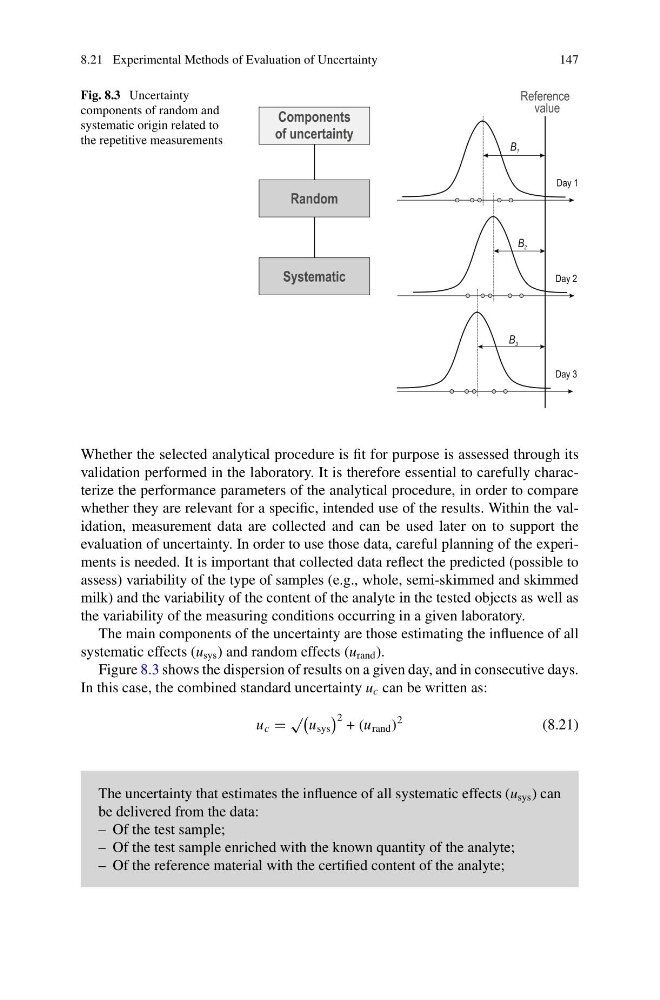
Fig. 8.3 Uncertainty
components of random and
systematic origin related to
the repetitive measurements
B 1
B 2
B 3
Day 1
Day 2
Day 3
Whether the selected analytical procedure is fit for purpose is assessed through its
validation performed in the laboratory. It is therefore essential to carefully characterize the performance parameters of the analytical procedure, in order to compare
whether they are relevant for a specific, intended use of the results. Within the validation, measurement data are collected and can be used later on to support the
evaluation of uncertainty. In order to use those data, careful planning of the experiments is needed. It is important that collected data reflect the predicted (possible to
assess) variability of the type of samples (e.g., whole, semi-skimmed and skimmed
milk) and the variability of the content of the analyte in the tested objects as well as
the variability of the measuring conditions occurring in a given laboratory.
The main components of the uncertainty are those estimating the influence of all
systematic effects (u sys ) and random effects (u rand ).
Figure 8.3 shows the dispersion of results on a given day, and in consecutive days.
In this case, the combined standard uncertainty u c can be written as:
u c
√
u sys
2 + (u rand )
2
(8.21)
The uncertainty that estimates the influence of all systematic effects (u sys ) can
be delivered from the data:
– Of the test sample;
– Of the test sample enriched with the known quantity of the analyte;
– Of the reference material with the certified content of the analyte;
147
Fig. 8.3 Uncertainty
components of random and
systematic origin related to
the repetitive measurements
B 1
B 2
B 3
Day 1
Day 2
Day 3
Whether the selected analytical procedure is fit for purpose is assessed through its
validation performed in the laboratory. It is therefore essential to carefully characterize the performance parameters of the analytical procedure, in order to compare
whether they are relevant for a specific, intended use of the results. Within the validation, measurement data are collected and can be used later on to support the
evaluation of uncertainty. In order to use those data, careful planning of the experiments is needed. It is important that collected data reflect the predicted (possible to
assess) variability of the type of samples (e.g., whole, semi-skimmed and skimmed
milk) and the variability of the content of the analyte in the tested objects as well as
the variability of the measuring conditions occurring in a given laboratory.
The main components of the uncertainty are those estimating the influence of all
systematic effects (u sys ) and random effects (u rand ).
Figure 8.3 shows the dispersion of results on a given day, and in consecutive days.
In this case, the combined standard uncertainty u c can be written as:
u c
√
u sys
2 + (u rand )
2
(8.21)
The uncertainty that estimates the influence of all systematic effects (u sys ) can
be delivered from the data:
– Of the test sample;
– Of the test sample enriched with the known quantity of the analyte;
– Of the reference material with the certified content of the analyte;