

8.13 Evaluation of Standard Uncertainty for Each Identified …
137
8.13 Evaluation of Standard Uncertainty for Each
Identified Component of the Measurement
Uncertainty
Each of the quantities is characterized by a name, unit, value, standard uncertainty
and the number of the degrees of freedom. In principle, two methods are used to
calculate the standard uncertainty, In the case of using the type A method, the value
of the standard uncertainty equals the standard deviation of the arithmetical mean.
When using type B to estimate the uncertainty, its value is strictly connected to the
probability distribution that describes the spread of the variable.
8.14 Calculating the Type A Uncertainty
The quantity X, measured directly, is treated as a random variable. Conducting direct
measurement is the equivalent of drawing n-element sample {x 1 , x 2 , …, x n } from
an infinite population, which comprises all possible measurements. We assume, by
default, that the general population has the normal distribution N(μ, σ ), where µ is
the expected value, σ —standard deviation. For the result of the measurement, the
numerical value of the estimate of the expected value is taken, which in practice
means the arithmetical mean of the measurement results.
¯
x
1
n
n
i1
x i
(8.11)
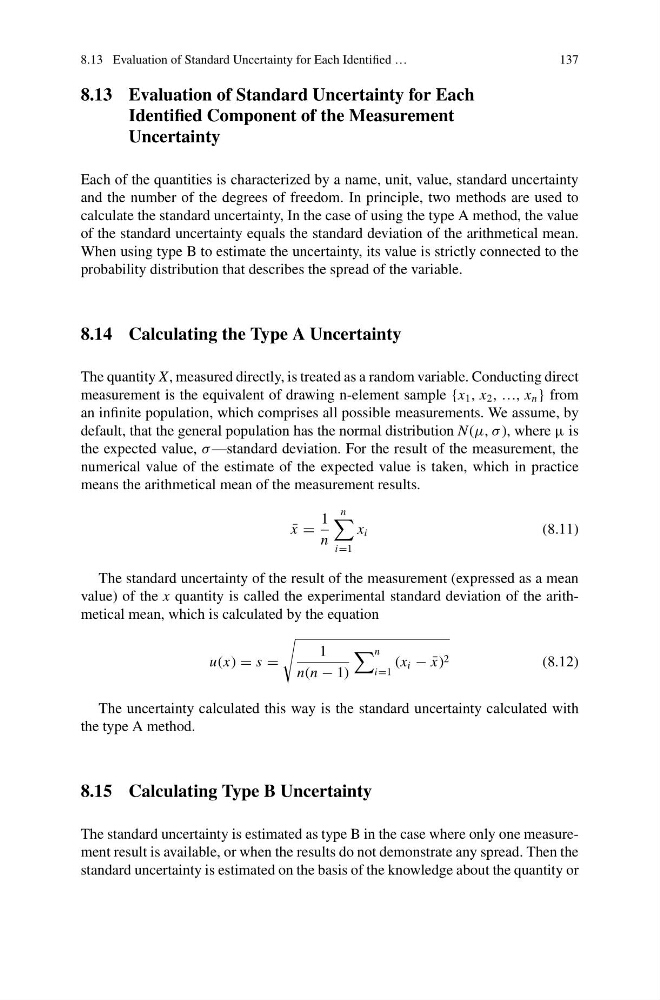
The standard uncertainty of the result of the measurement (expressed as a mean
value) of the x quantity is called the experimental standard deviation of the arithmetical mean, which is calculated by the equation
u(x) s
1
n(n − 1)
n
i1
(x i − ¯
x) 2
(8.12)
The uncertainty calculated this way is the standard uncertainty calculated with
the type A method.
8.15 Calculating Type B Uncertainty
The standard uncertainty is estimated as type B in the case where only one measurement result is available, or when the results do not demonstrate any spread. Then the
standard uncertainty is estimated on the basis of the knowledge about the quantity or
137
8.13 Evaluation of Standard Uncertainty for Each
Identified Component of the Measurement
Uncertainty
Each of the quantities is characterized by a name, unit, value, standard uncertainty
and the number of the degrees of freedom. In principle, two methods are used to
calculate the standard uncertainty, In the case of using the type A method, the value
of the standard uncertainty equals the standard deviation of the arithmetical mean.
When using type B to estimate the uncertainty, its value is strictly connected to the
probability distribution that describes the spread of the variable.
8.14 Calculating the Type A Uncertainty
The quantity X, measured directly, is treated as a random variable. Conducting direct
measurement is the equivalent of drawing n-element sample {x 1 , x 2 , …, x n } from
an infinite population, which comprises all possible measurements. We assume, by
default, that the general population has the normal distribution N(μ, σ ), where µ is
the expected value, σ —standard deviation. For the result of the measurement, the
numerical value of the estimate of the expected value is taken, which in practice
means the arithmetical mean of the measurement results.
¯
x
1
n
n
i1
x i
(8.11)
The standard uncertainty of the result of the measurement (expressed as a mean
value) of the x quantity is called the experimental standard deviation of the arithmetical mean, which is calculated by the equation
u(x) s
1
n(n − 1)
n
i1
(x i − ¯
x) 2
(8.12)
The uncertainty calculated this way is the standard uncertainty calculated with
the type A method.
8.15 Calculating Type B Uncertainty
The standard uncertainty is estimated as type B in the case where only one measurement result is available, or when the results do not demonstrate any spread. Then the
standard uncertainty is estimated on the basis of the knowledge about the quantity or