

8.11 Evaluation of Uncertainty: Requirements in Chemical Measurements
135
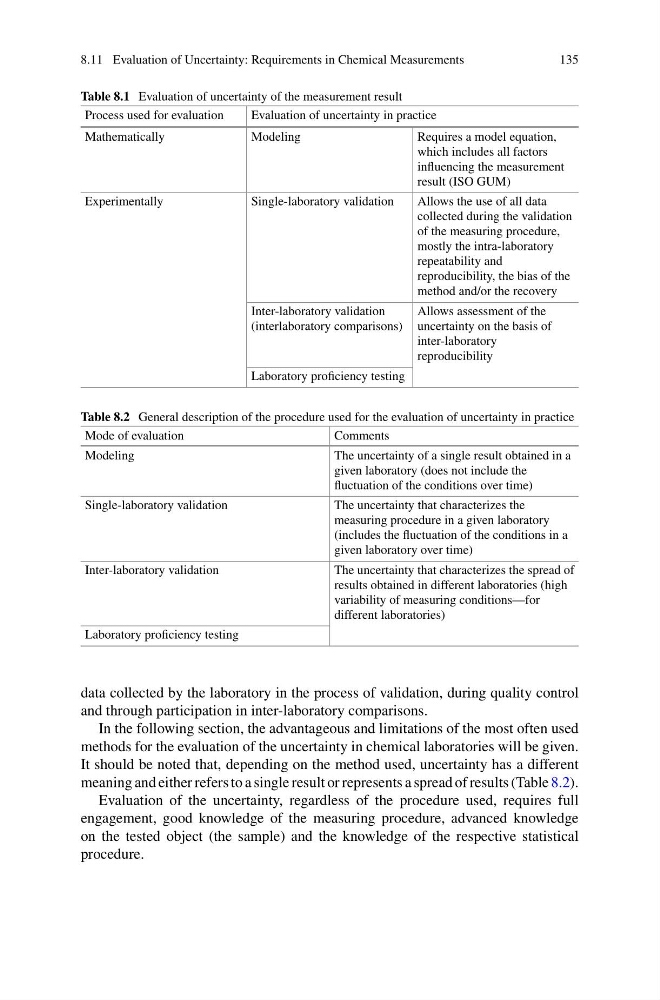
Table 8.1 Evaluation of uncertainty of the measurement result
Process used for evaluation
Evaluation of uncertainty in practice
Mathematically
Modeling
Requires a model equation,
which includes all factors
influencing the measurement
result (ISO GUM)
Experimentally
Single-laboratory validation
Allows the use of all data
collected during the validation
of the measuring procedure,
mostly the intra-laboratory
repeatability and
reproducibility, the bias of the
method and/or the recovery
Inter-laboratory validation
(interlaboratory comparisons)
Allows assessment of the
uncertainty on the basis of
inter-laboratory
reproducibility
Laboratory proficiency testing
Table 8.2 General description of the procedure used for the evaluation of uncertainty in practice
Mode of evaluation
Comments
Modeling
The uncertainty of a single result obtained in a
given laboratory (does not include the
fluctuation of the conditions over time)
Single-laboratory validation
The uncertainty that characterizes the
measuring procedure in a given laboratory
(includes the fluctuation of the conditions in a
given laboratory over time)
Inter-laboratory validation
The uncertainty that characterizes the spread of
results obtained in different laboratories (high
variability of measuring conditions—for
different laboratories)
Laboratory proficiency testing
data collected by the laboratory in the process of validation, during quality control
and through participation in inter-laboratory comparisons.
In the following section, the advantageous and limitations of the most often used
methods for the evaluation of the uncertainty in chemical laboratories will be given.
It should be noted that, depending on the method used, uncertainty has a different
meaning and either refers to a single result or represents a spread of results (Table 8.2).
Evaluation of the uncertainty, regardless of the procedure used, requires full
engagement, good knowledge of the measuring procedure, advanced knowledge
on the tested object (the sample) and the knowledge of the respective statistical
procedure.
135
Table 8.1 Evaluation of uncertainty of the measurement result
Process used for evaluation
Evaluation of uncertainty in practice
Mathematically
Modeling
Requires a model equation,
which includes all factors
influencing the measurement
result (ISO GUM)
Experimentally
Single-laboratory validation
Allows the use of all data
collected during the validation
of the measuring procedure,
mostly the intra-laboratory
repeatability and
reproducibility, the bias of the
method and/or the recovery
Inter-laboratory validation
(interlaboratory comparisons)
Allows assessment of the
uncertainty on the basis of
inter-laboratory
reproducibility
Laboratory proficiency testing
Table 8.2 General description of the procedure used for the evaluation of uncertainty in practice
Mode of evaluation
Comments
Modeling
The uncertainty of a single result obtained in a
given laboratory (does not include the
fluctuation of the conditions over time)
Single-laboratory validation
The uncertainty that characterizes the
measuring procedure in a given laboratory
(includes the fluctuation of the conditions in a
given laboratory over time)
Inter-laboratory validation
The uncertainty that characterizes the spread of
results obtained in different laboratories (high
variability of measuring conditions—for
different laboratories)
Laboratory proficiency testing
data collected by the laboratory in the process of validation, during quality control
and through participation in inter-laboratory comparisons.
In the following section, the advantageous and limitations of the most often used
methods for the evaluation of the uncertainty in chemical laboratories will be given.
It should be noted that, depending on the method used, uncertainty has a different
meaning and either refers to a single result or represents a spread of results (Table 8.2).
Evaluation of the uncertainty, regardless of the procedure used, requires full
engagement, good knowledge of the measuring procedure, advanced knowledge
on the tested object (the sample) and the knowledge of the respective statistical
procedure.