

116
8 Measurement Uncertainty
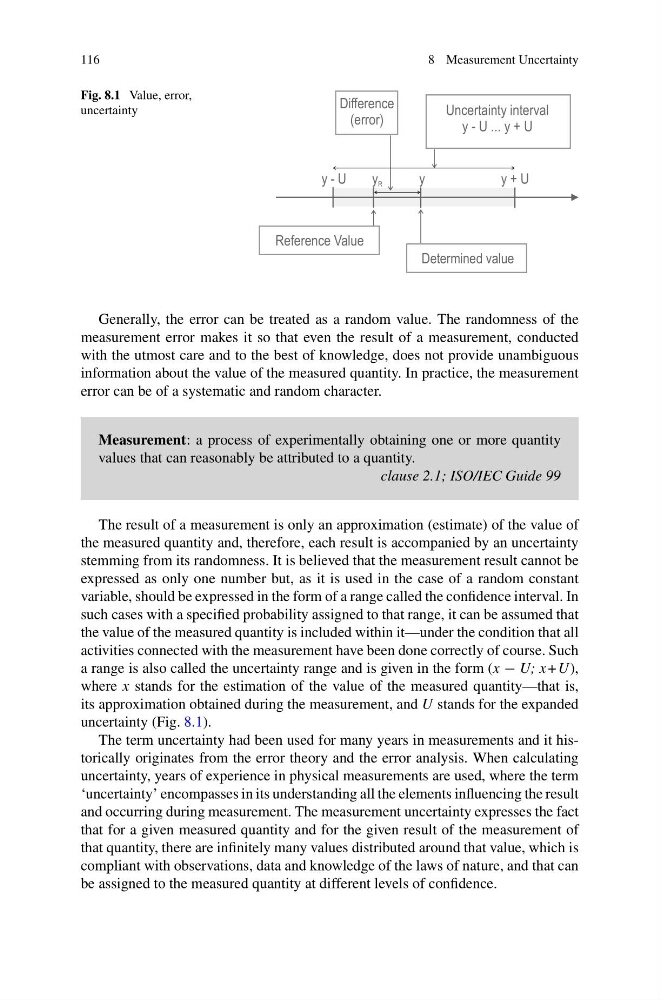
Fig. 8.1 Value, error,
uncertainty
Difference
(error)
Reference Value
Uncertainty interval
y - U ... y + U
y - U
y + U
y R
y
Determined value
Generally, the error can be treated as a random value. The randomness of the
measurement error makes it so that even the result of a measurement, conducted
with the utmost care and to the best of knowledge, does not provide unambiguous
information about the value of the measured quantity. In practice, the measurement
error can be of a systematic and random character.
Measurement: a process of experimentally obtaining one or more quantity
values that can reasonably be attributed to a quantity.
clause 2.1; ISO/IEC Guide 99
The result of a measurement is only an approximation (estimate) of the value of
the measured quantity and, therefore, each result is accompanied by an uncertainty
stemming from its randomness. It is believed that the measurement result cannot be
expressed as only one number but, as it is used in the case of a random constant
variable, should be expressed in the form of a range called the confidence interval. In
such cases with a specified probability assigned to that range, it can be assumed that
the value of the measured quantity is included within it—under the condition that all
activities connected with the measurement have been done correctly of course. Such
a range is also called the uncertainty range and is given in the form (x − U; x + U),
where x stands for the estimation of the value of the measured quantity—that is,
its approximation obtained during the measurement, and U stands for the expanded
uncertainty (Fig. 8.1).
The term uncertainty had been used for many years in measurements and it historically originates from the error theory and the error analysis. When calculating
uncertainty, years of experience in physical measurements are used, where the term
‘uncertainty’ encompasses in its understanding all the elements influencing the result
and occurring during measurement. The measurement uncertainty expresses the fact
that for a given measured quantity and for the given result of the measurement of
that quantity, there are infinitely many values distributed around that value, which is
compliant with observations, data and knowledge of the laws of nature, and that can
be assigned to the measured quantity at different levels of confidence.
8 Measurement Uncertainty
Fig. 8.1 Value, error,
uncertainty
Difference
(error)
Reference Value
Uncertainty interval
y - U ... y + U
y - U
y + U
y R
y
Determined value
Generally, the error can be treated as a random value. The randomness of the
measurement error makes it so that even the result of a measurement, conducted
with the utmost care and to the best of knowledge, does not provide unambiguous
information about the value of the measured quantity. In practice, the measurement
error can be of a systematic and random character.
Measurement: a process of experimentally obtaining one or more quantity
values that can reasonably be attributed to a quantity.
clause 2.1; ISO/IEC Guide 99
The result of a measurement is only an approximation (estimate) of the value of
the measured quantity and, therefore, each result is accompanied by an uncertainty
stemming from its randomness. It is believed that the measurement result cannot be
expressed as only one number but, as it is used in the case of a random constant
variable, should be expressed in the form of a range called the confidence interval. In
such cases with a specified probability assigned to that range, it can be assumed that
the value of the measured quantity is included within it—under the condition that all
activities connected with the measurement have been done correctly of course. Such
a range is also called the uncertainty range and is given in the form (x − U; x + U),
where x stands for the estimation of the value of the measured quantity—that is,
its approximation obtained during the measurement, and U stands for the expanded
uncertainty (Fig. 8.1).
The term uncertainty had been used for many years in measurements and it historically originates from the error theory and the error analysis. When calculating
uncertainty, years of experience in physical measurements are used, where the term
‘uncertainty’ encompasses in its understanding all the elements influencing the result
and occurring during measurement. The measurement uncertainty expresses the fact
that for a given measured quantity and for the given result of the measurement of
that quantity, there are infinitely many values distributed around that value, which is
compliant with observations, data and knowledge of the laws of nature, and that can
be assigned to the measured quantity at different levels of confidence.