

7.21 Robustness
111
finally accepted analytical conditions, where the possible range of random deviation
can be predicted. Evaluation of robustness should indicate the most critical parameters that are the most vulnerable to changes influencing the final results.
Evaluation of robustness can be carried out in two ways:
1. By interlaboratory comparisons, with a sufficient number of participating laboratories (≥10) using the same measurement procedure.
2. In the given laboratory, conducting a planned series of experiments, changing
selected parameters of measurement procedure (including all personnel conduction given testing) and evaluating their influence on the analytical result.
The process based on the interlaboratory comparisons is expensive because it
requires the involvement of many laboratories and resources needed for the data
processing. Besides, for a number of testing it is not possible to find out the organized
interlaboratory comparison or there are a lack of laboratories performing the given
testing. Another way is to evaluate robustness inside of the laboratory, under the
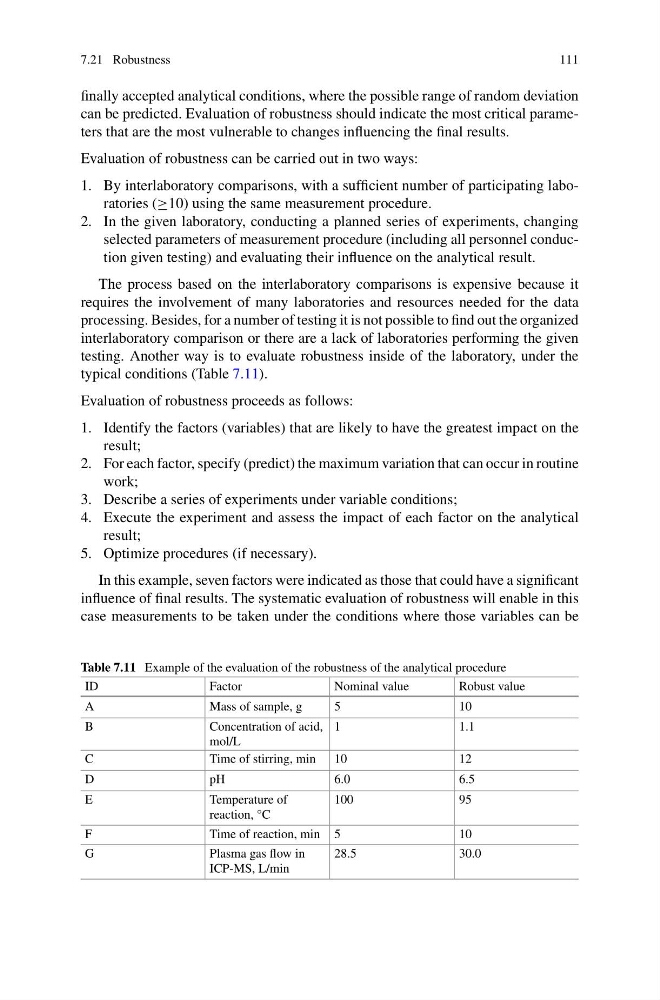
typical conditions (Table 7.11).
Evaluation of robustness proceeds as follows:
1. Identify the factors (variables) that are likely to have the greatest impact on the
result;
2. For each factor, specify (predict) the maximum variation that can occur in routine
work;
3. Describe a series of experiments under variable conditions;
4. Execute the experiment and assess the impact of each factor on the analytical
result;
5. Optimize procedures (if necessary).
In this example, seven factors were indicated as those that could have a significant
influence of final results. The systematic evaluation of robustness will enable in this
case measurements to be taken under the conditions where those variables can be
Table 7.11 Example of the evaluation of the robustness of the analytical procedure
ID
Factor
Nominal value
Robust value
A
Mass of sample, g
5
10
B
Concentration of acid,
mol/L
1
1.1
C
Time of stirring, min 10
12
D
pH
6.0
6.5
E
Temperature of
reaction, °C
100
95
F
Time of reaction, min 5
10
G
Plasma gas flow in
ICP-MS, L/min
28.5
30.0
111
finally accepted analytical conditions, where the possible range of random deviation
can be predicted. Evaluation of robustness should indicate the most critical parameters that are the most vulnerable to changes influencing the final results.
Evaluation of robustness can be carried out in two ways:
1. By interlaboratory comparisons, with a sufficient number of participating laboratories (≥10) using the same measurement procedure.
2. In the given laboratory, conducting a planned series of experiments, changing
selected parameters of measurement procedure (including all personnel conduction given testing) and evaluating their influence on the analytical result.
The process based on the interlaboratory comparisons is expensive because it
requires the involvement of many laboratories and resources needed for the data
processing. Besides, for a number of testing it is not possible to find out the organized
interlaboratory comparison or there are a lack of laboratories performing the given
testing. Another way is to evaluate robustness inside of the laboratory, under the
typical conditions (Table 7.11).
Evaluation of robustness proceeds as follows:
1. Identify the factors (variables) that are likely to have the greatest impact on the
result;
2. For each factor, specify (predict) the maximum variation that can occur in routine
work;
3. Describe a series of experiments under variable conditions;
4. Execute the experiment and assess the impact of each factor on the analytical
result;
5. Optimize procedures (if necessary).
In this example, seven factors were indicated as those that could have a significant
influence of final results. The systematic evaluation of robustness will enable in this
case measurements to be taken under the conditions where those variables can be
Table 7.11 Example of the evaluation of the robustness of the analytical procedure
ID
Factor
Nominal value
Robust value
A
Mass of sample, g
5
10
B
Concentration of acid,
mol/L
1
1.1
C
Time of stirring, min 10
12
D
pH
6.0
6.5
E
Temperature of
reaction, °C
100
95
F
Time of reaction, min 5
10
G
Plasma gas flow in
ICP-MS, L/min
28.5
30.0