

7.7 Measurement Techniques
95
enzymatic processes are being used more often, to follow the biochemical and biological compounds in particular.
An important part of the analytical process is the preparation of the sample prior
to testing. The most commonly used methods of preparation are digestion or selective extraction; in many cases, chromatographic techniques are used, which allows
components present in the sample to be separated. These processes may already be
largely automated.
The development of instrumental methods and the increasing availability of
advanced measuring instruments enabling computer control of the measurement
process and the ability to automatically obtain a result in the defined units mean that
the role of the analyst is often seen in the context of the skills required to operate
specific equipment. This is due, among other things, to the fact that modern devices
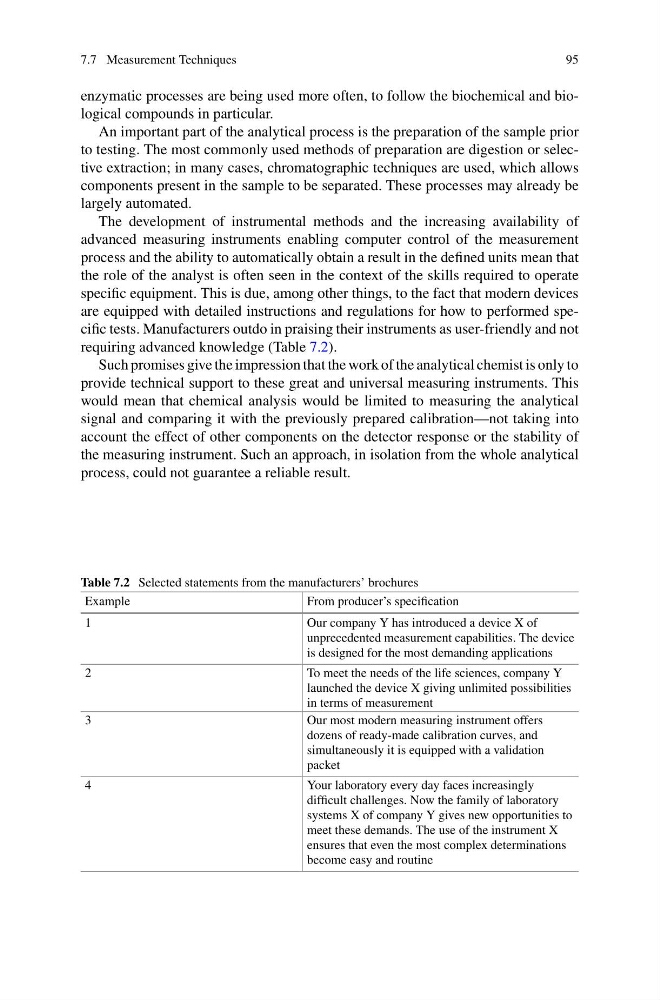
are equipped with detailed instructions and regulations for how to performed specific tests. Manufacturers outdo in praising their instruments as user-friendly and not
requiring advanced knowledge (Table 7.2).
Such promises give the impression that the work of the analytical chemist is only to
provide technical support to these great and universal measuring instruments. This
would mean that chemical analysis would be limited to measuring the analytical
signal and comparing it with the previously prepared calibration—not taking into
account the effect of other components on the detector response or the stability of
the measuring instrument. Such an approach, in isolation from the whole analytical
process, could not guarantee a reliable result.
Table 7.2 Selected statements from the manufacturers’ brochures
Example
From producer’s specification
1
Our company Y has introduced a device X of
unprecedented measurement capabilities. The device
is designed for the most demanding applications
2
To meet the needs of the life sciences, company Y
launched the device X giving unlimited possibilities
in terms of measurement
3
Our most modern measuring instrument offers
dozens of ready-made calibration curves, and
simultaneously it is equipped with a validation
packet
4
Your laboratory every day faces increasingly
difficult challenges. Now the family of laboratory
systems X of company Y gives new opportunities to
meet these demands. The use of the instrument X
ensures that even the most complex determinations
become easy and routine
95
enzymatic processes are being used more often, to follow the biochemical and biological compounds in particular.
An important part of the analytical process is the preparation of the sample prior
to testing. The most commonly used methods of preparation are digestion or selective extraction; in many cases, chromatographic techniques are used, which allows
components present in the sample to be separated. These processes may already be
largely automated.
The development of instrumental methods and the increasing availability of
advanced measuring instruments enabling computer control of the measurement
process and the ability to automatically obtain a result in the defined units mean that
the role of the analyst is often seen in the context of the skills required to operate
specific equipment. This is due, among other things, to the fact that modern devices
are equipped with detailed instructions and regulations for how to performed specific tests. Manufacturers outdo in praising their instruments as user-friendly and not
requiring advanced knowledge (Table 7.2).
Such promises give the impression that the work of the analytical chemist is only to
provide technical support to these great and universal measuring instruments. This
would mean that chemical analysis would be limited to measuring the analytical
signal and comparing it with the previously prepared calibration—not taking into
account the effect of other components on the detector response or the stability of
the measuring instrument. Such an approach, in isolation from the whole analytical
process, could not guarantee a reliable result.
Table 7.2 Selected statements from the manufacturers’ brochures
Example
From producer’s specification
1
Our company Y has introduced a device X of
unprecedented measurement capabilities. The device
is designed for the most demanding applications
2
To meet the needs of the life sciences, company Y
launched the device X giving unlimited possibilities
in terms of measurement
3
Our most modern measuring instrument offers
dozens of ready-made calibration curves, and
simultaneously it is equipped with a validation
packet
4
Your laboratory every day faces increasingly
difficult challenges. Now the family of laboratory
systems X of company Y gives new opportunities to
meet these demands. The use of the instrument X
ensures that even the most complex determinations
become easy and routine