

90
7 Validation of the Measurement Procedure
Table 7.1 Description of meaning of measurement technique, method and procedure
Description
Meaning and examples
Measurement technique
Analytical technique based on particular
physical phenomena (e.g., atomic absorption
spectrometry)
Measurement method
Detailed description of the method used for
performing measurements (e.g., determination
of calcium in mineral water by flame atomic
absorption spectrometry/determination of lead
in blood serum by electrothermal atomic
absorption spectrometry)
Measurement (or analytical) procedure
Detailed description of the entire procedure
(e.g., sample preparation, the list of reagents,
their concentration, time of the certain
processes, type of calibration)
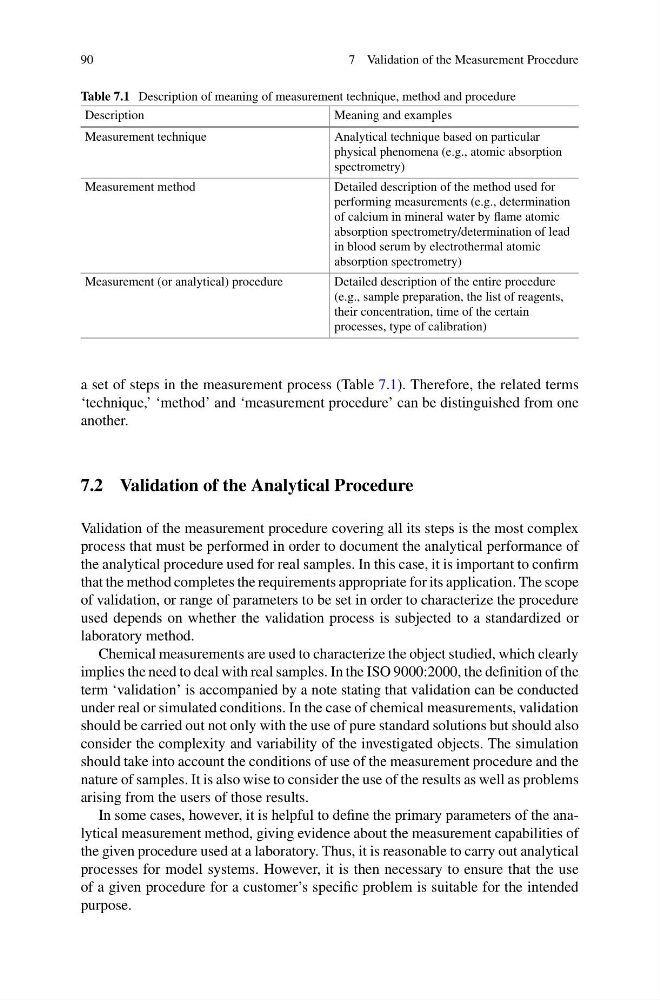
a set of steps in the measurement process (Table 7.1). Therefore, the related terms
‘technique,’ ‘method’ and ‘measurement procedure’ can be distinguished from one
another.
7.2 Validation of the Analytical Procedure
Validation of the measurement procedure covering all its steps is the most complex
process that must be performed in order to document the analytical performance of
the analytical procedure used for real samples. In this case, it is important to confirm
that the method completes the requirements appropriate for its application. The scope
of validation, or range of parameters to be set in order to characterize the procedure
used depends on whether the validation process is subjected to a standardized or
laboratory method.
Chemical measurements are used to characterize the object studied, which clearly
implies the need to deal with real samples. In the ISO 9000:2000, the definition of the
term ‘validation’ is accompanied by a note stating that validation can be conducted
under real or simulated conditions. In the case of chemical measurements, validation
should be carried out not only with the use of pure standard solutions but should also
consider the complexity and variability of the investigated objects. The simulation
should take into account the conditions of use of the measurement procedure and the
nature of samples. It is also wise to consider the use of the results as well as problems
arising from the users of those results.
In some cases, however, it is helpful to define the primary parameters of the analytical measurement method, giving evidence about the measurement capabilities of
the given procedure used at a laboratory. Thus, it is reasonable to carry out analytical
processes for model systems. However, it is then necessary to ensure that the use
of a given procedure for a customer’s specific problem is suitable for the intended
purpose.
7 Validation of the Measurement Procedure
Table 7.1 Description of meaning of measurement technique, method and procedure
Description
Meaning and examples
Measurement technique
Analytical technique based on particular
physical phenomena (e.g., atomic absorption
spectrometry)
Measurement method
Detailed description of the method used for
performing measurements (e.g., determination
of calcium in mineral water by flame atomic
absorption spectrometry/determination of lead
in blood serum by electrothermal atomic
absorption spectrometry)
Measurement (or analytical) procedure
Detailed description of the entire procedure
(e.g., sample preparation, the list of reagents,
their concentration, time of the certain
processes, type of calibration)
a set of steps in the measurement process (Table 7.1). Therefore, the related terms
‘technique,’ ‘method’ and ‘measurement procedure’ can be distinguished from one
another.
7.2 Validation of the Analytical Procedure
Validation of the measurement procedure covering all its steps is the most complex
process that must be performed in order to document the analytical performance of
the analytical procedure used for real samples. In this case, it is important to confirm
that the method completes the requirements appropriate for its application. The scope
of validation, or range of parameters to be set in order to characterize the procedure
used depends on whether the validation process is subjected to a standardized or
laboratory method.
Chemical measurements are used to characterize the object studied, which clearly
implies the need to deal with real samples. In the ISO 9000:2000, the definition of the
term ‘validation’ is accompanied by a note stating that validation can be conducted
under real or simulated conditions. In the case of chemical measurements, validation
should be carried out not only with the use of pure standard solutions but should also
consider the complexity and variability of the investigated objects. The simulation
should take into account the conditions of use of the measurement procedure and the
nature of samples. It is also wise to consider the use of the results as well as problems
arising from the users of those results.
In some cases, however, it is helpful to define the primary parameters of the analytical measurement method, giving evidence about the measurement capabilities of
the given procedure used at a laboratory. Thus, it is reasonable to carry out analytical
processes for model systems. However, it is then necessary to ensure that the use
of a given procedure for a customer’s specific problem is suitable for the intended
purpose.