

54
4 Perturbation Theory for the Electron Propagator
0 | ˆ
O H (t)| 0 =
0 | ˆ
O H (t)|
0
0 |
0
= lim
→0
0 | ˆ
U (∞, t) ˆ
O I (t) ˆ
U (t, −∞)| 0
0 | ˆ
U (∞, −∞)| 0
(4.53)
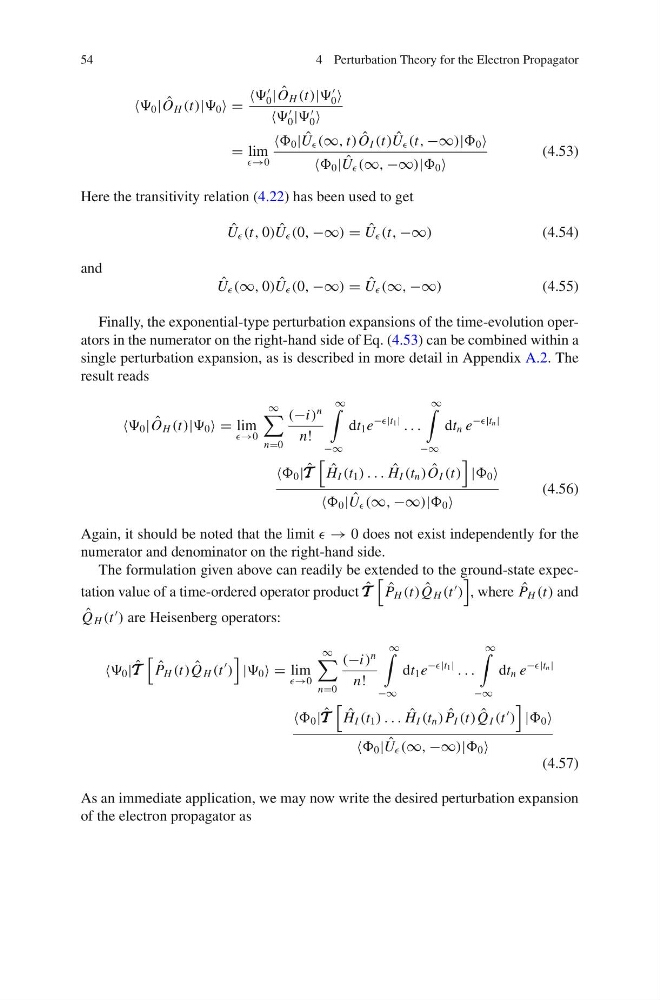
Here the transitivity relation (4.22) has been used to get
ˆ
U (t, 0) ˆ
U (0, −∞) = ˆ
U (t, −∞)
(4.54)
and
ˆ
U (∞, 0) ˆ
U (0, −∞) = ˆ
U (∞, −∞)
(4.55)
Finally, the exponential-type perturbation expansions of the time-evolution operators in the numerator on the right-hand side of Eq. (4.53) can be combined within a
single perturbation expansion, as is described in more detail in Appendix A.2. The
result reads
0 | ˆ
O H (t)| 0 = lim
→0
∞
n=0
(−i)
n
n!
∞
−∞
dt 1 e
−|t 1 |
. . .
∞
−∞
dt n e
−|t n |
0 | ˆ
T T T
ˆ
H I (t 1 ) . . . ˆ
H I (t n ) ˆ
O I (t)
| 0
0 | ˆ
U (∞, −∞)| 0
(4.56)
Again, it should be noted that the limit → 0 does not exist independently for the
numerator and denominator on the right-hand side.
The formulation given above can readily be extended to the ground-state expectation value of a time-ordered operator product ˆ
T T T
ˆ
P H (t) ˆ
Q H (t
)
, where ˆ
P H (t) and
ˆ
Q H (t
) are Heisenberg operators:
0 | ˆ
T T T
ˆ
P H (t) ˆ
Q H (t
)
| 0 = lim
→0
∞
n=0
(−i)
n
n!
∞
−∞
dt 1 e
−|t 1 |
. . .
∞
−∞
dt n e
−|t n |
0 | ˆ
T T T
ˆ
H I (t 1 ) . . . ˆ
H I (t n ) ˆ
P I (t) ˆ
Q I (t
)
| 0
0 | ˆ
U (∞, −∞)| 0
(4.57)
As an immediate application, we may now write the desired perturbation expansion
of the electron propagator as
4 Perturbation Theory for the Electron Propagator
0 | ˆ
O H (t)| 0 =
0 | ˆ
O H (t)|
0
0 |
0
= lim
→0
0 | ˆ
U (∞, t) ˆ
O I (t) ˆ
U (t, −∞)| 0
0 | ˆ
U (∞, −∞)| 0
(4.53)
Here the transitivity relation (4.22) has been used to get
ˆ
U (t, 0) ˆ
U (0, −∞) = ˆ
U (t, −∞)
(4.54)
and
ˆ
U (∞, 0) ˆ
U (0, −∞) = ˆ
U (∞, −∞)
(4.55)
Finally, the exponential-type perturbation expansions of the time-evolution operators in the numerator on the right-hand side of Eq. (4.53) can be combined within a
single perturbation expansion, as is described in more detail in Appendix A.2. The
result reads
0 | ˆ
O H (t)| 0 = lim
→0
∞
n=0
(−i)
n
n!
∞
−∞
dt 1 e
−|t 1 |
. . .
∞
−∞
dt n e
−|t n |
0 | ˆ
T T T
ˆ
H I (t 1 ) . . . ˆ
H I (t n ) ˆ
O I (t)
| 0
0 | ˆ
U (∞, −∞)| 0
(4.56)
Again, it should be noted that the limit → 0 does not exist independently for the
numerator and denominator on the right-hand side.
The formulation given above can readily be extended to the ground-state expectation value of a time-ordered operator product ˆ
T T T
ˆ
P H (t) ˆ
Q H (t
)
, where ˆ
P H (t) and
ˆ
Q H (t
) are Heisenberg operators:
0 | ˆ
T T T
ˆ
P H (t) ˆ
Q H (t
)
| 0 = lim
→0
∞
n=0
(−i)
n
n!
∞
−∞
dt 1 e
−|t 1 |
. . .
∞
−∞
dt n e
−|t n |
0 | ˆ
T T T
ˆ
H I (t 1 ) . . . ˆ
H I (t n ) ˆ
P I (t) ˆ
Q I (t
)
| 0
0 | ˆ
U (∞, −∞)| 0
(4.57)
As an immediate application, we may now write the desired perturbation expansion
of the electron propagator as