

30
2 Second Quantization
2.4 Going beyond one-particle physics, the simplest model is the two-electron–
two-orbital (2E-2O) system, as, for example, the hydrogen molecule in the
minimal-basis approximation. There are two spatial (Hartree–Fock) orbitals,
φ g , φ u , assumed to be real and of different symmetry (e.g., with respect to inversion). Let t gg , t uu denote the corresponding matrix elements of the one-particle
part of the hamiltonian, and V gggg , V uuuu , V gguu , V gugu the non-vanishing spatial
Coulomb integrals.
(a) Determine the Hartree–Fock orbital energies, g , u , according to Eq. (4.5).
(b) Write the two-electron ground state as a linear combination of the two basis
states (CI configurations) of g-symmetry, | 0 = |gαgβ|, | 1 = |uαuβ| and
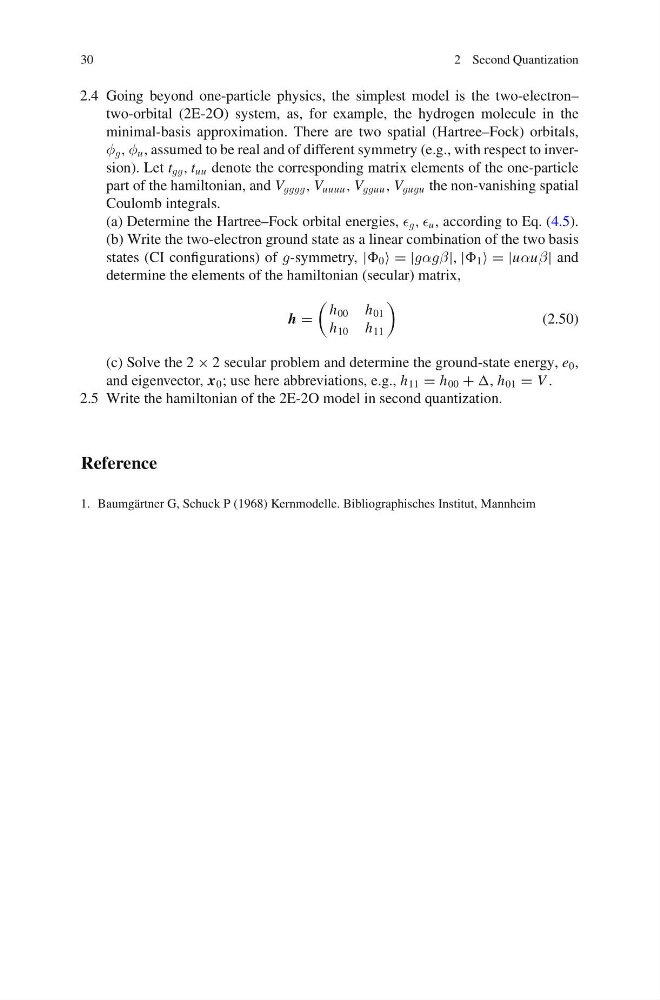
determine the elements of the hamiltonian (secular) matrix,
h =
h 00 h 01
h 10 h 11
(2.50)
(c) Solve the 2 × 2 secular problem and determine the ground-state energy, e 0 ,
and eigenvector, x 0 ; use here abbreviations, e.g., h 11 = h 00 + , h 01 = V .
2.5 Write the hamiltonian of the 2E-2O model in second quantization.
Reference
1. Baumgärtner G, Schuck P (1968) Kernmodelle. Bibliographisches Institut, Mannheim
2 Second Quantization
2.4 Going beyond one-particle physics, the simplest model is the two-electron–
two-orbital (2E-2O) system, as, for example, the hydrogen molecule in the
minimal-basis approximation. There are two spatial (Hartree–Fock) orbitals,
φ g , φ u , assumed to be real and of different symmetry (e.g., with respect to inversion). Let t gg , t uu denote the corresponding matrix elements of the one-particle
part of the hamiltonian, and V gggg , V uuuu , V gguu , V gugu the non-vanishing spatial
Coulomb integrals.
(a) Determine the Hartree–Fock orbital energies, g , u , according to Eq. (4.5).
(b) Write the two-electron ground state as a linear combination of the two basis
states (CI configurations) of g-symmetry, | 0 = |gαgβ|, | 1 = |uαuβ| and
determine the elements of the hamiltonian (secular) matrix,
h =
h 00 h 01
h 10 h 11
(2.50)
(c) Solve the 2 × 2 secular problem and determine the ground-state energy, e 0 ,
and eigenvector, x 0 ; use here abbreviations, e.g., h 11 = h 00 + , h 01 = V .
2.5 Write the hamiltonian of the 2E-2O model in second quantization.
Reference
1. Baumgärtner G, Schuck P (1968) Kernmodelle. Bibliographisches Institut, Mannheim