

28
2 Second Quantization
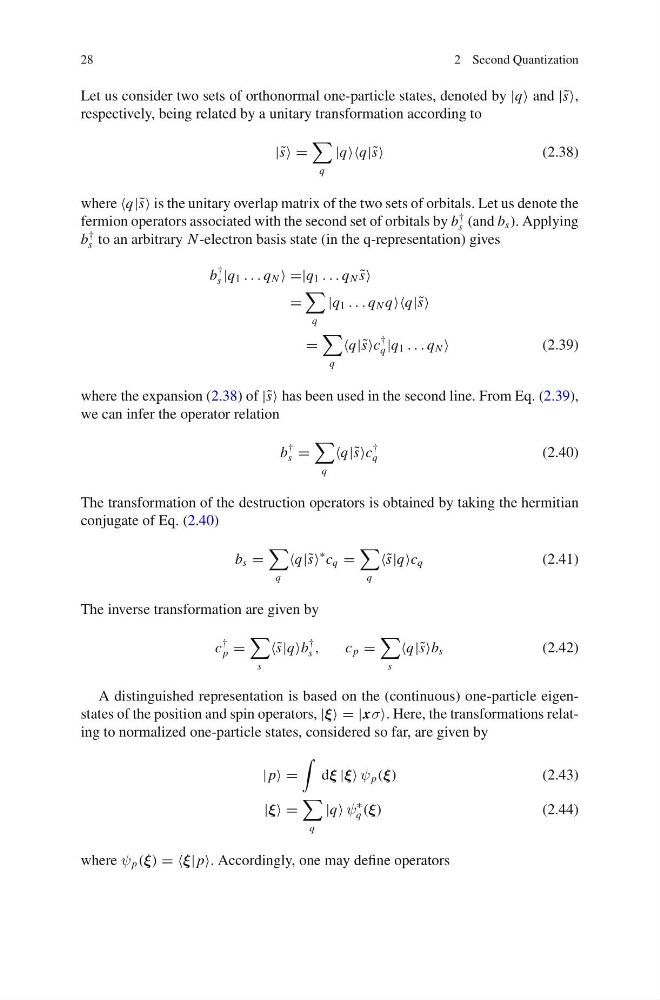
Let us consider two sets of orthonormal one-particle states, denoted by |q and |˜ s,
respectively, being related by a unitary transformation according to
|˜ s =
q
|qq|˜ s
(2.38)
where q|˜ s is the unitary overlap matrix of the two sets of orbitals. Let us denote the
fermion operators associated with the second set of orbitals by b
†
s (and b s ). Applying
b
†
s to an arbitrary N -electron basis state (in the q-representation) gives
b
†
s |q 1 . . . q N =|q 1 . . . q N ˜
s
=
q
|q 1 . . . q N qq|˜ s
=
q
q|˜ sc
†
q |q 1 . . . q N
(2.39)
where the expansion (2.38) of |˜ s has been used in the second line. From Eq. (2.39),
we can infer the operator relation
b
†
s =
q
q|˜ sc
†
q
(2.40)
The transformation of the destruction operators is obtained by taking the hermitian
conjugate of Eq. (2.40)
b s =
q
q|˜ s
∗ c q =
q
˜ s|qc q
(2.41)
The inverse transformation are given by
c
†
p =
s
˜ s|qb
†
s ,
c p =
s
q|˜ sb s
(2.42)
A distinguished representation is based on the (continuous) one-particle eigenstates of the position and spin operators, |ξ = |xσ. Here, the transformations relating to normalized one-particle states, considered so far, are given by
| p =
dξ |ξ ψ p (ξ)
(2.43)
|ξ =
q
|q ψ
∗
q (ξ)
(2.44)
where ψ p (ξ) = =ξ| p. Accordingly, one may define operators
2 Second Quantization
Let us consider two sets of orthonormal one-particle states, denoted by |q and |˜ s,
respectively, being related by a unitary transformation according to
|˜ s =
q
|qq|˜ s
(2.38)
where q|˜ s is the unitary overlap matrix of the two sets of orbitals. Let us denote the
fermion operators associated with the second set of orbitals by b
†
s (and b s ). Applying
b
†
s to an arbitrary N -electron basis state (in the q-representation) gives
b
†
s |q 1 . . . q N =|q 1 . . . q N ˜
s
=
q
|q 1 . . . q N qq|˜ s
=
q
q|˜ sc
†
q |q 1 . . . q N
(2.39)
where the expansion (2.38) of |˜ s has been used in the second line. From Eq. (2.39),
we can infer the operator relation
b
†
s =
q
q|˜ sc
†
q
(2.40)
The transformation of the destruction operators is obtained by taking the hermitian
conjugate of Eq. (2.40)
b s =
q
q|˜ s
∗ c q =
q
˜ s|qc q
(2.41)
The inverse transformation are given by
c
†
p =
s
˜ s|qb
†
s ,
c p =
s
q|˜ sb s
(2.42)
A distinguished representation is based on the (continuous) one-particle eigenstates of the position and spin operators, |ξ = |xσ. Here, the transformations relating to normalized one-particle states, considered so far, are given by
| p =
dξ |ξ ψ p (ξ)
(2.43)
|ξ =
q
|q ψ
∗
q (ξ)
(2.44)
where ψ p (ξ) = =ξ| p. Accordingly, one may define operators