

Appendix
325
ρ
(2)
kk = f
(2)
kk + f
(2)∗
kk
(A.9.17)
ρ
(2)
ka = f
(2)
ka
(A.9.18)
ρ
(2)
aa =
b,k,l
f
(1)∗
bkl,a f
(1)
bkl,a
(A.9.19)
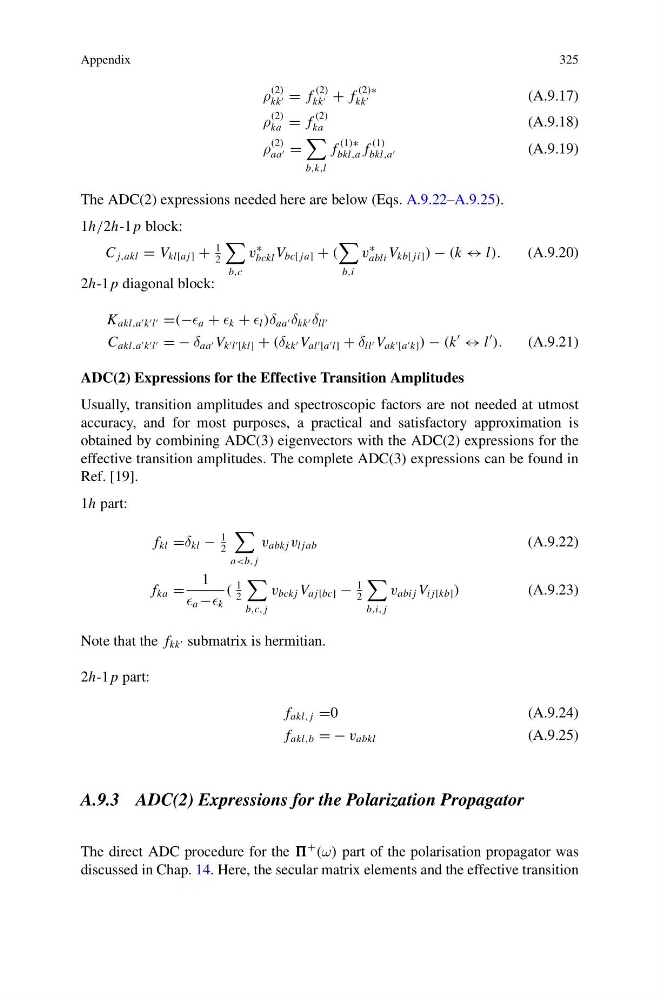
The ADC(2) expressions needed here are below (Eqs. A.9.22–A.9.25).
1h/2h-1 p block:
C j,akl = V kl[aj] +
1
2
b,c
v
∗
bckl V bc[ ja] + (
b,i
v
∗
abli V kb[ ji] ) − (k ↔ l).
(A.9.20)
2h-1 p diagonal block:
K akl,a k l =(− a + k + l )δ aa δ kk δ ll
C akl,a k l = − δ aa V k l [kl] + (δ kk V al [a l] + δ ll V ak [a k] ) − (k
↔ l
).
(A.9.21)
ADC(2) Expressions for the Effective Transition Amplitudes
Usually, transition amplitudes and spectroscopic factors are not needed at utmost
accuracy, and for most purposes, a practical and satisfactory approximation is
obtained by combining ADC(3) eigenvectors with the ADC(2) expressions for the
effective transition amplitudes. The complete ADC(3) expressions can be found in
Ref. [19].
1h part:
f kl =δ kl −
1
2
a
(A.9.22)
f ka =
1
a − k
(
1
2
b,c, j
v bck j V aj[bc] −
1
2
b,i, j
v abi j V i j[kb] )
(A.9.23)
Note that the f kk submatrix is hermitian.
2h-1 p part:
f akl, j =0
(A.9.24)
f akl,b = − v abkl
(A.9.25)
A.9.3 ADC(2) Expressions for the Polarization Propagator
The direct ADC procedure for the
+
(ω) part of the polarisation propagator was
discussed in Chap. 14. Here, the secular matrix elements and the effective transition
325
ρ
(2)
kk = f
(2)
kk + f
(2)∗
kk
(A.9.17)
ρ
(2)
ka = f
(2)
ka
(A.9.18)
ρ
(2)
aa =
b,k,l
f
(1)∗
bkl,a f
(1)
bkl,a
(A.9.19)
The ADC(2) expressions needed here are below (Eqs. A.9.22–A.9.25).
1h/2h-1 p block:
C j,akl = V kl[aj] +
1
2
b,c
v
∗
bckl V bc[ ja] + (
b,i
v
∗
abli V kb[ ji] ) − (k ↔ l).
(A.9.20)
2h-1 p diagonal block:
K akl,a k l =(− a + k + l )δ aa δ kk δ ll
C akl,a k l = − δ aa V k l [kl] + (δ kk V al [a l] + δ ll V ak [a k] ) − (k
↔ l
).
(A.9.21)
ADC(2) Expressions for the Effective Transition Amplitudes
Usually, transition amplitudes and spectroscopic factors are not needed at utmost
accuracy, and for most purposes, a practical and satisfactory approximation is
obtained by combining ADC(3) eigenvectors with the ADC(2) expressions for the
effective transition amplitudes. The complete ADC(3) expressions can be found in
Ref. [19].
1h part:
f kl =δ kl −
1
2
a
(A.9.22)
f ka =
1
a − k
(
1
2
b,c, j
v bck j V aj[bc] −
1
2
b,i, j
v abi j V i j[kb] )
(A.9.23)
Note that the f kk submatrix is hermitian.
2h-1 p part:
f akl, j =0
(A.9.24)
f akl,b = − v abkl
(A.9.25)
A.9.3 ADC(2) Expressions for the Polarization Propagator
The direct ADC procedure for the
+
(ω) part of the polarisation propagator was
discussed in Chap. 14. Here, the secular matrix elements and the effective transition