

2.1 Definition of Creation and Destruction Operators
21
is a state of N
+1 electrons, the scalar products in the second line of Eq. (2.6) vanish
unless N
= N −1, and the latter equation is simplified accordingly:
c q |q 1 . . . q N =
q
1
|q
1 . . . q
N −1 q 1 . . . q N |c
†
q |q
1 . . . q
N −1
∗
(2.7)
This means that, acting on an N -electron state, c q generates an (N −1)-electron state,
c q |q 1 . . . q N ∈ H
A
N −1 . Since the effect of the c q operators is to remove (“destroy”)
an electron, they are referred to as destruction operators. Acting on the vacuum state
yields the null vector,
c q |∅ ≡ 0
(2.8)
Using the Slater–Condon rules a1 and a2 for scalar products, Eq. (2.7) can be further
evaluated according to
c q |q 1 . . . q N =
q
1
|q
1 . . . q
N −1 q 1 . . . q N |q
1 . . . q
N −1 q ∗
= δ qq N |q 1 . . . q N −1 − δ qq N −1 |q 1 . . . q N −2 q N + δ qq N −2 |q 1 . . . q N −3 q N −1 q N − . . .
(2.9)
The destruction operator c q removes an electron in the orbital q provided q is present
in |q 1 . . . q N , that is, q ∈ {q 1 . . . q N }. The phases arise from aligning the positions
of q and q i in the two product states if q = q i , i = 1, . . . , N .
2.2 Anticommutation Relations for Creation
and Destruction Operators
To establish the anticommutation relations for the operators, we apply the operators
c p , c
†
q successively to an arbitrary basis state,
c p c
†
q |q 1 . . . q N = c p |q 1 . . . q N q
= δ pq |q 1 . . . q N − δ p,q N |q 1 . . . q N −1 q + . . .
(2.10)
and in the reversed order
c
†
q c p |q 1 . . . q N = δ p,q N |q 1 . . . q N −1 q − δ p,q N −1 |q 1 . . . q N −2 q N q + . . . (2.11)
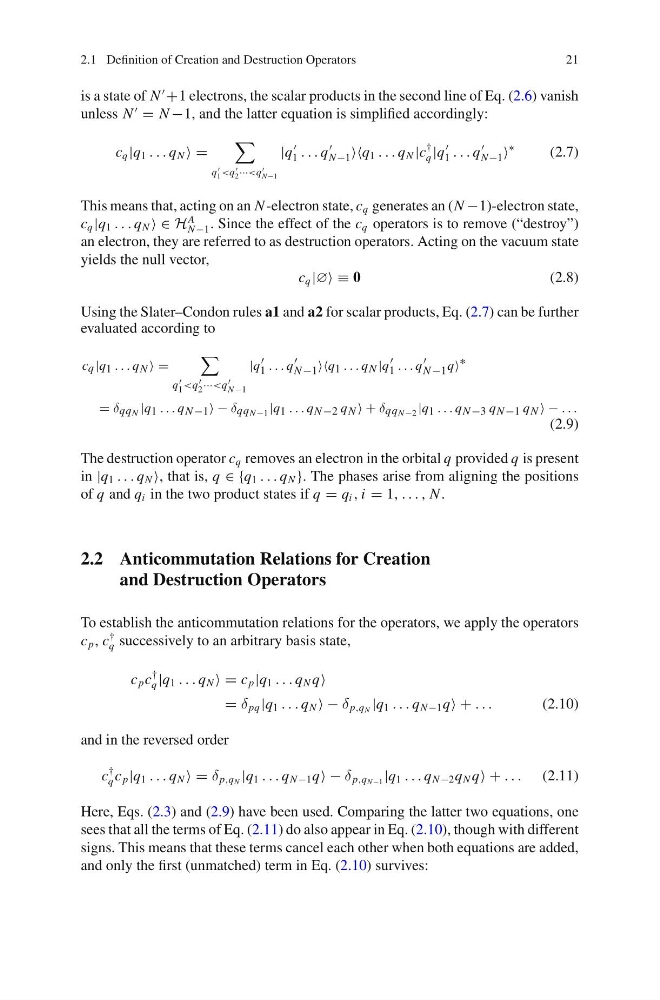
Here, Eqs. (2.3) and (2.9) have been used. Comparing the latter two equations, one
sees that all the terms of Eq. (2.11) do also appear in Eq. (2.10), though with different
signs. This means that these terms cancel each other when both equations are added,
and only the first (unmatched) term in Eq. (2.10) survives:
21
is a state of N
+1 electrons, the scalar products in the second line of Eq. (2.6) vanish
unless N
= N −1, and the latter equation is simplified accordingly:
c q |q 1 . . . q N =
q
1
|q
1 . . . q
N −1 q 1 . . . q N |c
†
q |q
1 . . . q
N −1
∗
(2.7)
This means that, acting on an N -electron state, c q generates an (N −1)-electron state,
c q |q 1 . . . q N ∈ H
A
N −1 . Since the effect of the c q operators is to remove (“destroy”)
an electron, they are referred to as destruction operators. Acting on the vacuum state
yields the null vector,
c q |∅ ≡ 0
(2.8)
Using the Slater–Condon rules a1 and a2 for scalar products, Eq. (2.7) can be further
evaluated according to
c q |q 1 . . . q N =
q
1
|q
1 . . . q
N −1 q 1 . . . q N |q
1 . . . q
N −1 q ∗
= δ qq N |q 1 . . . q N −1 − δ qq N −1 |q 1 . . . q N −2 q N + δ qq N −2 |q 1 . . . q N −3 q N −1 q N − . . .
(2.9)
The destruction operator c q removes an electron in the orbital q provided q is present
in |q 1 . . . q N , that is, q ∈ {q 1 . . . q N }. The phases arise from aligning the positions
of q and q i in the two product states if q = q i , i = 1, . . . , N .
2.2 Anticommutation Relations for Creation
and Destruction Operators
To establish the anticommutation relations for the operators, we apply the operators
c p , c
†
q successively to an arbitrary basis state,
c p c
†
q |q 1 . . . q N = c p |q 1 . . . q N q
= δ pq |q 1 . . . q N − δ p,q N |q 1 . . . q N −1 q + . . .
(2.10)
and in the reversed order
c
†
q c p |q 1 . . . q N = δ p,q N |q 1 . . . q N −1 q − δ p,q N −1 |q 1 . . . q N −2 q N q + . . . (2.11)
Here, Eqs. (2.3) and (2.9) have been used. Comparing the latter two equations, one
sees that all the terms of Eq. (2.11) do also appear in Eq. (2.10), though with different
signs. This means that these terms cancel each other when both equations are added,
and only the first (unmatched) term in Eq. (2.10) survives: