

318
Appendix
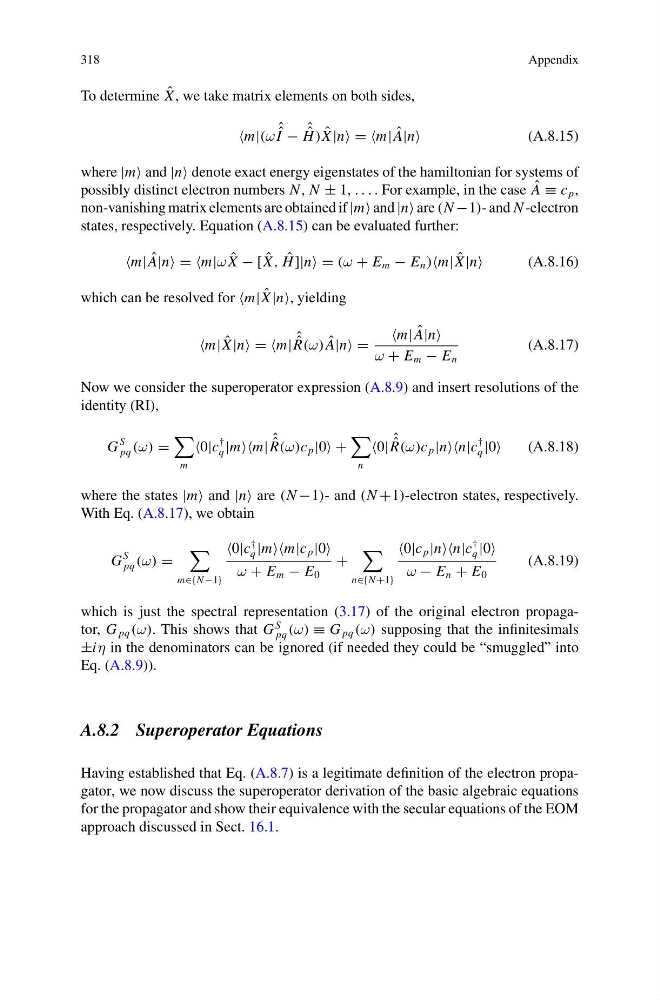
To determine ˆ
X , we take matrix elements on both sides,
m|(ω ˆ ˆ
I − ˆ ˆ
H ) ˆ
X |n = =m| ˆ
A|n
(A.8.15)
where |m and |n denote exact energy eigenstates of the hamiltonian for systems of
possibly distinct electron numbers N , N ± 1, . . . . For example, in the case ˆ
A ≡ c p ,
non-vanishing matrix elements are obtained if |m and |n are (N −1)- and N -electron
states, respectively. Equation (A.8.15) can be evaluated further:
m| ˆ
A|n = =m|ω ˆ
X − [ ˆ
X , ˆ
H ]|n = (ω + E m − E n )m| ˆ
X |n
(A.8.16)
which can be resolved for m| ˆ
X |n, yielding
m| ˆ
X |n = =m| ˆ ˆ
R(ω) ˆ
A|n =
m| ˆ
A|n
ω + E m − E n
(A.8.17)
Now we consider the superoperator expression (A.8.9) and insert resolutions of the
identity (RI),
G
S
pq (ω) =
m
0|c
†
q |mm| ˆ ˆ
R(ω)c p |0 +
n
0| ˆ ˆ
R(ω)c p |nn|c
†
q |0
(A.8.18)
where the states |m and |n are (N −1)- and (N +1)-electron states, respectively.
With Eq. (A.8.17), we obtain
G
S
pq (ω) =
m∈{N −1}
0|c
†
q |mm|c p |0
ω + E m − E 0
+
n∈{N +1}
0|c p |nn|c
†
q |0
ω − E n + E 0
(A.8.19)
which is just the spectral representation (3.17) of the original electron propagator, G pq (ω). This shows that G
S
pq (ω) ≡ G pq (ω) supposing that the infinitesimals
±iη in the denominators can be ignored (if needed they could be “smuggled” into
Eq. (A.8.9)).
A.8.2 Superoperator Equations
Having established that Eq. (A.8.7) is a legitimate definition of the electron propagator, we now discuss the superoperator derivation of the basic algebraic equations
for the propagator and show their equivalence with the secular equations of the EOM
approach discussed in Sect. 16.1.
Appendix
To determine ˆ
X , we take matrix elements on both sides,
m|(ω ˆ ˆ
I − ˆ ˆ
H ) ˆ
X |n = =m| ˆ
A|n
(A.8.15)
where |m and |n denote exact energy eigenstates of the hamiltonian for systems of
possibly distinct electron numbers N , N ± 1, . . . . For example, in the case ˆ
A ≡ c p ,
non-vanishing matrix elements are obtained if |m and |n are (N −1)- and N -electron
states, respectively. Equation (A.8.15) can be evaluated further:
m| ˆ
A|n = =m|ω ˆ
X − [ ˆ
X , ˆ
H ]|n = (ω + E m − E n )m| ˆ
X |n
(A.8.16)
which can be resolved for m| ˆ
X |n, yielding
m| ˆ
X |n = =m| ˆ ˆ
R(ω) ˆ
A|n =
m| ˆ
A|n
ω + E m − E n
(A.8.17)
Now we consider the superoperator expression (A.8.9) and insert resolutions of the
identity (RI),
G
S
pq (ω) =
m
0|c
†
q |mm| ˆ ˆ
R(ω)c p |0 +
n
0| ˆ ˆ
R(ω)c p |nn|c
†
q |0
(A.8.18)
where the states |m and |n are (N −1)- and (N +1)-electron states, respectively.
With Eq. (A.8.17), we obtain
G
S
pq (ω) =
m∈{N −1}
0|c
†
q |mm|c p |0
ω + E m − E 0
+
n∈{N +1}
0|c p |nn|c
†
q |0
ω − E n + E 0
(A.8.19)
which is just the spectral representation (3.17) of the original electron propagator, G pq (ω). This shows that G
S
pq (ω) ≡ G pq (ω) supposing that the infinitesimals
±iη in the denominators can be ignored (if needed they could be “smuggled” into
Eq. (A.8.9)).
A.8.2 Superoperator Equations
Having established that Eq. (A.8.7) is a legitimate definition of the electron propagator, we now discuss the superoperator derivation of the basic algebraic equations
for the propagator and show their equivalence with the secular equations of the EOM
approach discussed in Sect. 16.1.