

Appendix
311
X J n ←
M J K M K I
J I K I
(A.6.49)
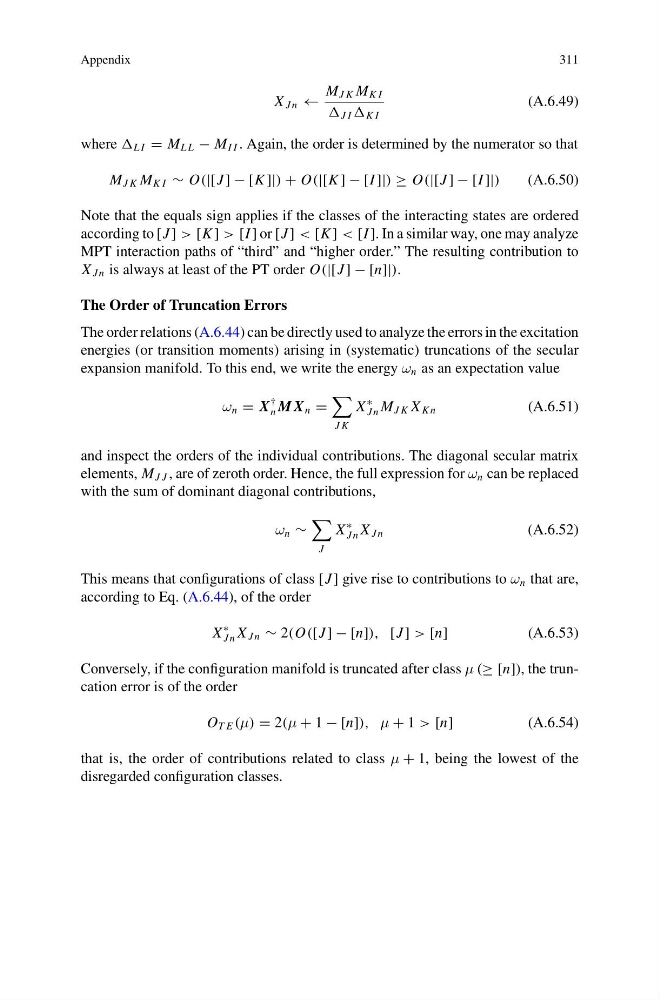
where L I = M L L − M I I . Again, the order is determined by the numerator so that
M J K M K I ∼ O(|[J ] − [K ]|) + O(|[K ] − [I ]|) ≥ O(|[J ] − [I ]|)
(A.6.50)
Note that the equals sign applies if the classes of the interacting states are ordered
according to [J ] > [K ] > [I ] or [J ] < [K ] < [I ]. In a similar way, one may analyze
MPT interaction paths of “third” and “higher order.” The resulting contribution to
X J n is always at least of the PT order O(|[J ] − [n]|).
The Order of Truncation Errors
The order relations (A.6.44) can be directly used to analyze the errors in the excitation
energies (or transition moments) arising in (systematic) truncations of the secular
expansion manifold. To this end, we write the energy ω n as an expectation value
ω n = X
†
n M X n =
J K
X
∗
J n M J K X K n
(A.6.51)
and inspect the orders of the individual contributions. The diagonal secular matrix
elements, M J J , are of zeroth order. Hence, the full expression for ω n can be replaced
with the sum of dominant diagonal contributions,
ω n ∼
J
X
∗
J n X J n
(A.6.52)
This means that configurations of class [J ] give rise to contributions to ω n that are,
according to Eq. (A.6.44), of the order
X
∗
J n X J n ∼ 2(O([J ] − [n]), [J ] > [n]
(A.6.53)
Conversely, if the configuration manifold is truncated after class μ (≥ [n]), the truncation error is of the order
O T E (μ) = 2(μ + 1 − [n]), μ + 1 > [n]
(A.6.54)
that is, the order of contributions related to class μ + 1, being the lowest of the
disregarded configuration classes.
311
X J n ←
M J K M K I
J I K I
(A.6.49)
where L I = M L L − M I I . Again, the order is determined by the numerator so that
M J K M K I ∼ O(|[J ] − [K ]|) + O(|[K ] − [I ]|) ≥ O(|[J ] − [I ]|)
(A.6.50)
Note that the equals sign applies if the classes of the interacting states are ordered
according to [J ] > [K ] > [I ] or [J ] < [K ] < [I ]. In a similar way, one may analyze
MPT interaction paths of “third” and “higher order.” The resulting contribution to
X J n is always at least of the PT order O(|[J ] − [n]|).
The Order of Truncation Errors
The order relations (A.6.44) can be directly used to analyze the errors in the excitation
energies (or transition moments) arising in (systematic) truncations of the secular
expansion manifold. To this end, we write the energy ω n as an expectation value
ω n = X
†
n M X n =
J K
X
∗
J n M J K X K n
(A.6.51)
and inspect the orders of the individual contributions. The diagonal secular matrix
elements, M J J , are of zeroth order. Hence, the full expression for ω n can be replaced
with the sum of dominant diagonal contributions,
ω n ∼
J
X
∗
J n X J n
(A.6.52)
This means that configurations of class [J ] give rise to contributions to ω n that are,
according to Eq. (A.6.44), of the order
X
∗
J n X J n ∼ 2(O([J ] − [n]), [J ] > [n]
(A.6.53)
Conversely, if the configuration manifold is truncated after class μ (≥ [n]), the truncation error is of the order
O T E (μ) = 2(μ + 1 − [n]), μ + 1 > [n]
(A.6.54)
that is, the order of contributions related to class μ + 1, being the lowest of the
disregarded configuration classes.