

Appendix
285
since ˆ
T T T
ˆ
u ν ˆ
v
= ˆ
u ν ˆ
v and ˆ
N N N
ˆ
u ν ˆ
v
= −ˆ v ˆ
u ν . Accordingly, Eq. (A.3.3) can be written
in the form
ˆ
v 1 . . . ˆ
v μ ˆ
u 1 . . . ˆ
u ν ˆ
v = − ˆ
v 1 . . . ˆ
v μ ˆ
u 1 . . . ˆ
u ν−1 ˆ
v ˆ
u ν
+ ˆ
N N N
ˆ
v 1 . . . ˆ
v μ ˆ
u 1 . . . ˆ
u ν−1 ˆ
u ν ˆ
v
(A.3.5)
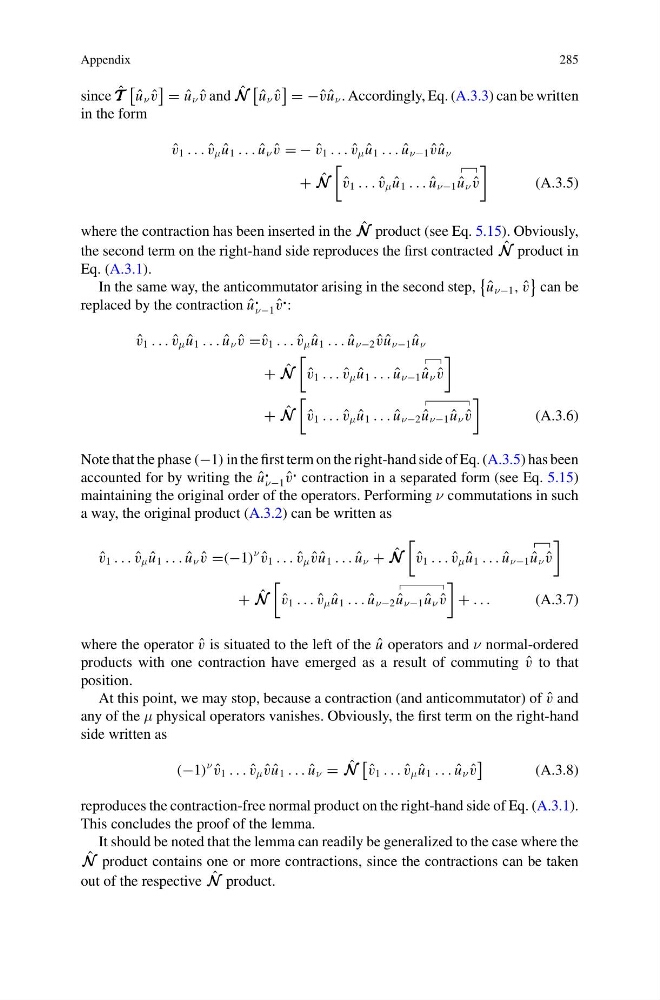
where the contraction has been inserted in the ˆ
N N N product (see Eq. 5.15). Obviously,
the second term on the right-hand side reproduces the first contracted ˆ
N N N product in
Eq. (A.3.1).
In the same way, the anticommutator arising in the second step,
ˆ
u ν−1 , ˆ
v
can be
replaced by the contraction ˆ
u
ν−1 ˆ
v
:
ˆ
v 1 . . . ˆ
v μ ˆ
u 1 . . . ˆ
u ν ˆ
v = ˆ
v 1 . . . ˆ
v μ ˆ
u 1 . . . ˆ
u ν−2 ˆ
v ˆ
u ν−1 ˆ
u ν
+ ˆ
N N N
ˆ
v 1 . . . ˆ
v μ ˆ
u 1 . . . ˆ
u ν−1 ˆ
u ν ˆ
v
+ ˆ
N N N
ˆ
v 1 . . . ˆ
v μ ˆ
u 1 . . . ˆ
u ν−2 ˆ
u ν−1 ˆ
u ν ˆ
v
(A.3.6)
Note that the phase (−1) in the first term on the right-hand side of Eq. (A.3.5) has been
accounted for by writing the ˆ
u
ν−1 ˆ
v
contraction in a separated form (see Eq. 5.15)
maintaining the original order of the operators. Performing ν commutations in such
a way, the original product (A.3.2) can be written as
ˆ
v 1 . . . ˆ
v μ ˆ
u 1 . . . ˆ
u ν ˆ
v =(−1)
ν
ˆ
v 1 . . . ˆ
v μ ˆ
v ˆ
u 1 . . . ˆ
u ν + ˆ
N N N
ˆ
v 1 . . . ˆ
v μ ˆ
u 1 . . . ˆ
u ν−1 ˆ
u ν ˆ
v
+ ˆ
N N N
ˆ
v 1 . . . ˆ
v μ ˆ
u 1 . . . ˆ
u ν−2 ˆ
u ν−1 ˆ
u ν ˆ
v
+ . . .
(A.3.7)
where the operator ˆ
v is situated to the left of the ˆ
u operators and ν normal-ordered
products with one contraction have emerged as a result of commuting ˆ
v to that
position.
At this point, we may stop, because a contraction (and anticommutator) of ˆ
v and
any of the μ physical operators vanishes. Obviously, the first term on the right-hand
side written as
(−1)
ν
ˆ
v 1 . . . ˆ
v μ ˆ
v ˆ
u 1 . . . ˆ
u ν = ˆ
N N N
ˆ
v 1 . . . ˆ
v μ ˆ
u 1 . . . ˆ
u ν ˆ
v
(A.3.8)
reproduces the contraction-free normal product on the right-hand side of Eq. (A.3.1).
This concludes the proof of the lemma.
It should be noted that the lemma can readily be generalized to the case where the
ˆ
N N N product contains one or more contractions, since the contractions can be taken
out of the respective ˆ
N N N product.
285
since ˆ
T T T
ˆ
u ν ˆ
v
= ˆ
u ν ˆ
v and ˆ
N N N
ˆ
u ν ˆ
v
= −ˆ v ˆ
u ν . Accordingly, Eq. (A.3.3) can be written
in the form
ˆ
v 1 . . . ˆ
v μ ˆ
u 1 . . . ˆ
u ν ˆ
v = − ˆ
v 1 . . . ˆ
v μ ˆ
u 1 . . . ˆ
u ν−1 ˆ
v ˆ
u ν
+ ˆ
N N N
ˆ
v 1 . . . ˆ
v μ ˆ
u 1 . . . ˆ
u ν−1 ˆ
u ν ˆ
v
(A.3.5)
where the contraction has been inserted in the ˆ
N N N product (see Eq. 5.15). Obviously,
the second term on the right-hand side reproduces the first contracted ˆ
N N N product in
Eq. (A.3.1).
In the same way, the anticommutator arising in the second step,
ˆ
u ν−1 , ˆ
v
can be
replaced by the contraction ˆ
u
ν−1 ˆ
v
:
ˆ
v 1 . . . ˆ
v μ ˆ
u 1 . . . ˆ
u ν ˆ
v = ˆ
v 1 . . . ˆ
v μ ˆ
u 1 . . . ˆ
u ν−2 ˆ
v ˆ
u ν−1 ˆ
u ν
+ ˆ
N N N
ˆ
v 1 . . . ˆ
v μ ˆ
u 1 . . . ˆ
u ν−1 ˆ
u ν ˆ
v
+ ˆ
N N N
ˆ
v 1 . . . ˆ
v μ ˆ
u 1 . . . ˆ
u ν−2 ˆ
u ν−1 ˆ
u ν ˆ
v
(A.3.6)
Note that the phase (−1) in the first term on the right-hand side of Eq. (A.3.5) has been
accounted for by writing the ˆ
u
ν−1 ˆ
v
contraction in a separated form (see Eq. 5.15)
maintaining the original order of the operators. Performing ν commutations in such
a way, the original product (A.3.2) can be written as
ˆ
v 1 . . . ˆ
v μ ˆ
u 1 . . . ˆ
u ν ˆ
v =(−1)
ν
ˆ
v 1 . . . ˆ
v μ ˆ
v ˆ
u 1 . . . ˆ
u ν + ˆ
N N N
ˆ
v 1 . . . ˆ
v μ ˆ
u 1 . . . ˆ
u ν−1 ˆ
u ν ˆ
v
+ ˆ
N N N
ˆ
v 1 . . . ˆ
v μ ˆ
u 1 . . . ˆ
u ν−2 ˆ
u ν−1 ˆ
u ν ˆ
v
+ . . .
(A.3.7)
where the operator ˆ
v is situated to the left of the ˆ
u operators and ν normal-ordered
products with one contraction have emerged as a result of commuting ˆ
v to that
position.
At this point, we may stop, because a contraction (and anticommutator) of ˆ
v and
any of the μ physical operators vanishes. Obviously, the first term on the right-hand
side written as
(−1)
ν
ˆ
v 1 . . . ˆ
v μ ˆ
v ˆ
u 1 . . . ˆ
u ν = ˆ
N N N
ˆ
v 1 . . . ˆ
v μ ˆ
u 1 . . . ˆ
u ν ˆ
v
(A.3.8)
reproduces the contraction-free normal product on the right-hand side of Eq. (A.3.1).
This concludes the proof of the lemma.
It should be noted that the lemma can readily be generalized to the case where the
ˆ
N N N product contains one or more contractions, since the contractions can be taken
out of the respective ˆ
N N N product.